Kings Place, home of the Guardian, was the venue for London’s strongest one-day tournament for many years last weekend. The open section of the third annual Kings Place festival attracted a powerful field headed by eight grandmasters and nine international masters. Overall, the event produced a full house of around 250 players, including a section for novices entitled “My first chess tournament”.
Gawain Jones, 27, and Luke McShane, 31, won their first five games, then halved out with each other in round six to share the prizes of £1,000 and £500. Both are among the six English players ranked in the world top 100, along with Michael Adams, David Howell, Nigel Short and Matthew Sadler. McShane, a City financial trader, is widely recognised as the world’s strongest amateur, who showed his class at Moscow 2012 when he was within one game of finishing first ahead of the global elite led by Magnus Carlsen.
McShane is currently on another chess comeback. Last month in the US he tied for first at the DC Open in Arlington, Virginia, then finished half a point behind the winners in the always competitive World Open.
The players who finished tied third at Kings Place included the joint reigning British champions, Howell and Jonathan Hawkins, both grandmasters, who won five games each but lost respectively to Jones and McShane. The downside was that there were only two prizes, so these top players went away with nothing. I cannot recall a previous occasion when 5/6 in such a strong open has gone unrewarded.
Another negative factor was the almost total absence of juniors. In the vintage 70s, when England’s juniors were the best in the world, one of the secrets of success was that squads of up to 30-40 of the best talents were invited and encouraged by the national federation to compete in leading London weekend opens, with financial help from the organisers and chess sponsors. Now our juniors are much weaker, while the English Chess Federation produces paper plans for elite players but fails to take the simpler step of ensuring they compete in opens like King’s Place, which would be excellent training. Next year perhaps, but do not hold your breath.
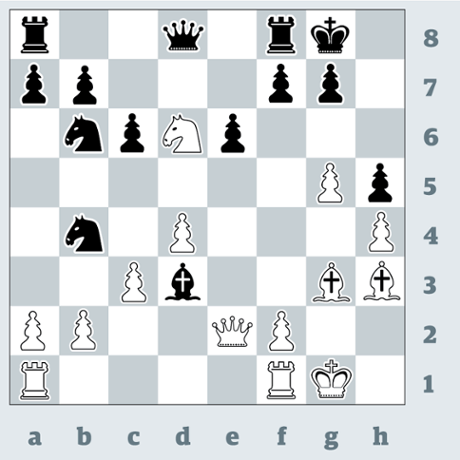
In one of the fastest wins Hawkins used a subtle strategy. His early king’s flank pawn advance persuaded his opponent that the white king would stay in the centre or castle long, a plan anticipated by Black’s Qa5 and Na6. But Hawkins calmly castled short and gained time by harassing the black queen. Despite all this Black’s game would be tenable with 17...b5, or a move later by offering rook for bishop by 18...Bxd6 19 Bxd6 Nd5, with chances against the white king. As played, Black fell for the tactic in this week’s puzzle.
Jonathan Hawkins v Robert Willmoth
1 d4 d6 2 e4 Nf6 3 Nc3 c6 4 Nf3 Bg4 5 h3 Bh5 6 Qe2 e6 7 g4 Bg6 8 h4 h5 9 g5 Nfd7 10 Bh3 Be7 11 Be3 Qa5?! 12 Nd2 d5 13 0-0! Na6 14 Bf4 dxe4 15 Nc4 Qd8 16 Nxe4 0-0 17 Ncd6 Nb4? 18 Bg3 Nb6? 19 c3 Bxd6 20 Nxd6 Bd3 (see puzzle diagram)
3399 The game ended 21 Qxh5! Bxf1? (N4d5 holds out longer) 22 g6! fxg6 23 Bxe6+ and Black resigned in the face of mate in a few moves.