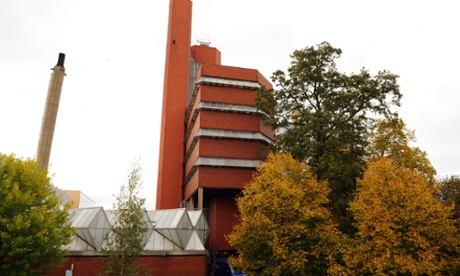
It seems odd to describe the celebrated engineering department of the University of Leicester as “Britain’s first postmodernist building” when, with its pure geometries and self-conscious industrial references, it deliberately looked back to the origins of the modern movement in architecture. What is certain is that, of the problematic trio of red tile and glass structures designed first by the partnership of James Stirling and James Gowan (obituary, 25 June) and subsequently by Stirling alone, the Leicester building is by far the most convincing and well composed. Gowan – so unfairly underrated in comparison with his former partner – had long been interested in industrial structures and made a series of photographs of the striking reinforced concrete coal bunkers erected by the London Midland and Scottish Railway between Glasgow and London, of which but one survives, at Carnforth, in Lancashire, writing that, “Laced with spidery steelwork, these giant faceted blocks catch the sunlight, command the attention and appear suspended in the air … The elevation, or should it be the levitation, of the Leicester Engineering auditoria relies on this intelligence.”