Defeats once hung over Andy Murray’s head like a black cloud, raining on his mood, flooding his thoughts with negativity. The disappointment of losing big matches threatened to drown him, never more so than in the tournaments that followed his evisceration by Novak Djokovic in the Australian Open final in 2011.
Murray has grown as a person since those days and this ferocious competitor knows how to rationalise his losses now. Losing to Roger Federer at Wimbledon was a blow but he was back in the public eye a week later, excelling for Great Britain in their Davis Cup tie against France. “Success is being happy,” Murray said after again losing to Djokovic in the Melbourne final earlier this year. “It’s not about winning every tournament you play.”
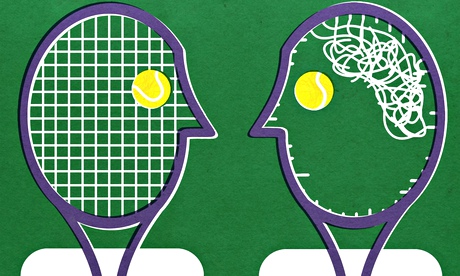
Tennis is unforgiving, ultimate glory on offer only to a select few, so the capacity to move on quickly from defeats is an enviable quality. Winning matters but to what extent? At what point does it become an unhealthy obsession? Why does it appear some players give up?
Dr Allen Fox was a player of some repute in the 60s, reaching the quarter-finals of Wimbledon in 1965 and beating the great Roy Emerson in the final of the Pacific Southwest Championships in 1966, and he later became a sports psychologist and the author of Tennis: Winning The Mental Match.
Fox is impressed by Murray’s inner peace; he knows how much losing hurts. “I would lock myself in a room and bang my head against the wall and I wouldn’t want to come out,” he said. “There’s too much pressure if you know it’s going to be that painful when you lose.”
Richard Gasquet had a good Wimbledon. He reached the semi-final of a grand slam for the third time before losing to Djokovic. His analysis was rooted in reality. “To lose against Novak in the semi-final, it’s nice for me,” the world No13 said. “I did my best.”
Perhaps Gasquet’s brain is wired in a way that means he is not ruled by an unquenchable thirst for victory and, at the age of 29, it is an uplifting way for him to view life, especially in a sport where the emotional strain can reach an intolerable pitch.
He had to be tough to carve out a career in the top 20 and is a wonderful player on his day. Paris would scarper back to Troy with Gasquet’s one-handed backhand if you took your eye off him for one second and although he has not lived up to his early promise, if he is in the 1%, then Federer, Rafael Nadal, Djokovic and Murray belong to an even more exclusive club.
Those four are different. They win not just because they are the best but also because their talent forces them to fight. It is how they were born. Nadal looks like someone has told him fishing has been banned in Mallorca when he loses a point and Djokovic’s willpower is so strong that he was still hounding Murray when he was down three match points in the Wimbledon final two years ago. Their commitment is relentless, even in times of adversity, and not everyone can match that hunger.
Some players have to take a step back and Fox believes there was an element of emotional self-preservation to Gasquet’s remark. “These are normal reactions,” he says. “High stress is not pleasant. There’s the urge to bail out, so maybe you make it emotionally easier for yourself. I don’t think people do it consciously.
“I don’t think Gasquet sits down and says ‘Maybe I won’t try that hard, because the probability is so against me’. But you shy away from the fire. If you go into it, you probably get burnt. Djokovic will be in misery if he doesn’t win the tournament, so he’ll do whatever it takes.”
I put it to Fox that although Gasquet has never won a grand slam, the $12,304,457 he has made from his career is a decent consolation prize. He disagreed. “The money is really neither here nor there at that level,” he said. “You want to be somebody. You don’t want to be the loser. It’s a particular person who rises up the tour. That’s generally a person who doesn’t like losing, who’s pretty tough to begin with.”
Sometimes we are guilty of forgetting that sport is supposed to be fun. Nick Kyrgios, the so-called bad boy of men’s tennis, is not enjoying himself at the moment. The young Australian appeared to tank a game during his defeat to Gasquet at Wimbledon and was heard saying “I don’t want to be here” during his Davis Cup defeat to Kazakhstan’s Aleksandr Nedovyesov on Friday.
“There’s another phenomenon that goes on in these tournaments,” added Fox. “Pressure builds from match to match. Kyrgios has a great win over Milos Raonic at Wimbledon but it’s a very stressful, tight situation. There’s a part of you that wants to get out. Things go bad, Kyrgios has had a couple of days of pressure and part of his brain just has enough. The brain says get out; you beat Raonic, now get out.”
And from the outside, while Kyrgios retreats into his shell, we raise our eyebrows and tut our disapproval at a 20-year-old kid who would probably rather be left alone. It is hard for us to understand when someone so talented looks like he does not care. The truth is he cares too much.