
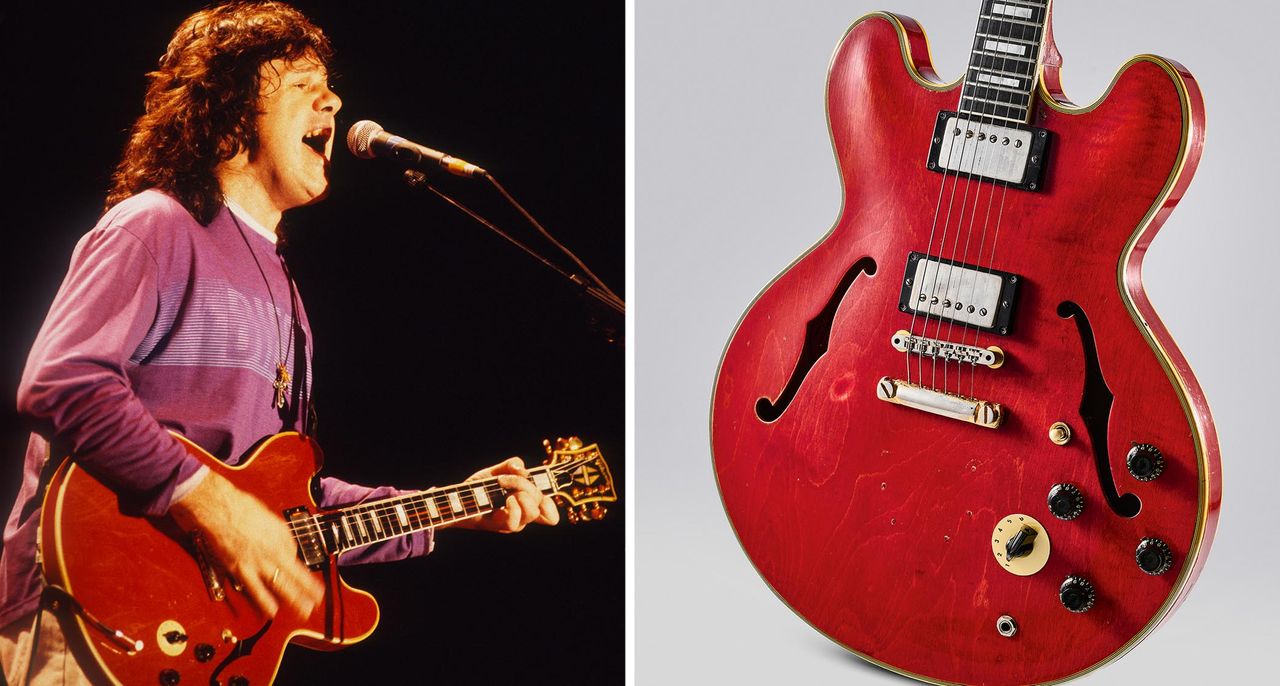
1963 Gibson ES-335TD
During our interview about Moore’s career, Neville Marten said, “Gary was great on a 335 – he really, really pulled the expression out of that guitar.” And it’s likely it was this particular 335 to which he was referring.
Steve Clarke measured the guitar’s pickup output and says “the bridge is 7.32k and the neck is 7.16k”, a vintage output that partly explains the punchy but expressive performance of the humbuckers that Gary liked so much. And at 8.32lb (3.8kg), it’s as light as many Strats of the era.

“The ABR-1 bridge has no retaining wire on it,” says Steve, which would most probably make it a replacement part; Gibson introduced the retaining wire in 1962, a year prior to this guitar’s manufacture. “And it’s also been refretted with 3.08mm wire. You’ve got two black coils [on the humbuckers] and the covers have been removed.”
Steve adds that this guitar seemed to be in good playing condition, even years after Gary last used it, needing very little fettling in preparation for the sale.
“I did a slight truss rod adjustment from memory – it was a little bit bowed – [but] it worked. I didn’t really have any issues.”

1960 Gibson ES-355TD

“It’s got the [Patent Applied For pickups] in it,” Steve Clarke remarks of Gary Moore’s exceptional 1960 ES-355TD, the Cadillac of Gibson’s range of thinline semis of the late 1950s and 1960s.
“The humbuckers have the brass screws [on the bottom plates of the pickups], for what it’s worth,” Steve observes. “And, again, it was initially dead on a couple of the [pickup/Varitone] selector positions when I first looked at the guitar. The rotary was very intermittent, and I had to get a straw inside there and give a blast of switch cleaner.
“The guitar’s had a really good refret, but the nut needed a bit of TLC because it was buzzing a bit on the B string, but I sorted that out. I also did a truss rod adjustment on that because it was back-bowed, so [the strings] were touching the 1st fret – you play an E chord and it’s rattling. So I backed it off a bit on that one.
“Once I got everything working on this thing, I took my tiny little Fender amp that I use for testing out and I plugged it in and thought, ‘Oh, this thing has got such a range of tones.’ It’s a really beautiful-sounding guitar and it’s such a nice color as well. It’s a really lovely instrument.”
- This article first appeared in Guitarist. Subscribe and save.