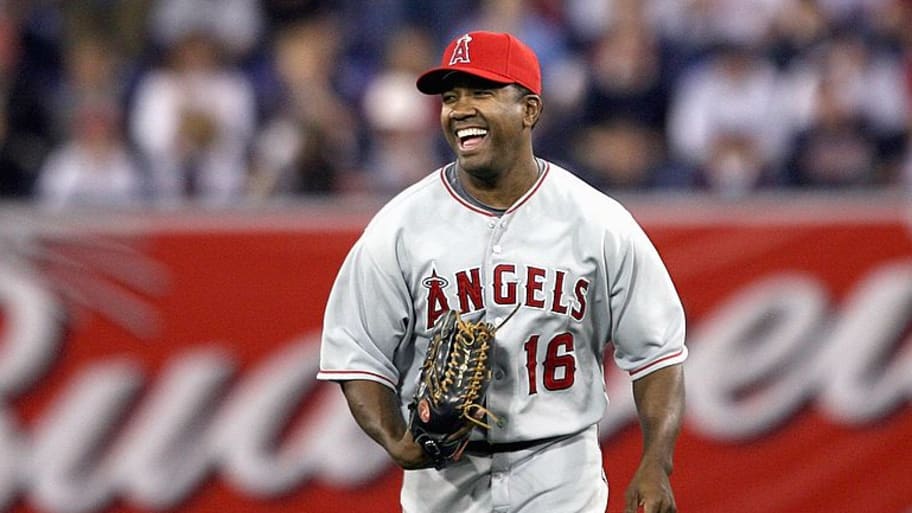
Upon the biggest hit of his life, one of only two three-run doubles to bust open a tied World Series Game 7, as teammates rejoiced and fans whooped, hollered and banged their thunderstick noisemakers, Garret Anderson never so much as opened his mouth. He stood there on second base, the joyous mayhem of Angel Stadium raging as if set afire, with his face fixed in its usual state of preternatural calm.
He allowed himself the smallest of celebrations, which for him was as much of a departure from his stoicism as cameras ever caught. He applauded politely.
The three-run double off Giants right-hander Liván Hernández broke a 1–1 tie and propelled the Angels to their first and only World Series title in 2002. Only Frankie Frisch of the Cardinals back in 1934 also cleared the bases in a tied Game 7 with a two-base hit. The reaction, more than the historic hit, defined Anderson.
Few ballplayers leave a mark on this game and this earth as did Anderson, whose sudden death at age 53 was announced Friday by the Angels. He played 17 seasons, all but two of them with the Angels, setting franchise records for hits (2,368), RBI (1,292), doubles (489), RBI in a game (10), consecutive games with an RBI (11) and consecutive games with a hit (28).
He is one of only 15 outfielders with 2,500 hits, 500 doubles and a .293 career batting average. All the others are in the Hall of Fame except PED scofflaws Barry Bonds and Manny Ramirez. Anderson played long, he played well and he played quietly.
Anderson went about his business with a smooth, flat stroke and a pulse that bordered on indecipherable. He could have played the game in an Armani tux and never harmed a crease. So stoic was Anderson in the box that he came to the plate 9,177 times and saw 30,503 pitches and was hit by only eight of those pitches, the fewest ever by anyone who came to the plate 9,000 times.
There was no filigree to Anderson. No self-promotion. Nothing extraneous. How he played happened to be exactly how he lived his life.
Says Joe Maddon, bench coach for the 2002 world champion Angels, “He was just a steady human being. He walked that way, talked that way, lived that way. Just a beautiful human being.
“Yes, he was quiet, but let me tell you that if you entered his inner circle, he was deeply, deeply engaging, even loquacious. I so enjoyed our conversations. He was just a sweetheart of a guy. All of us who knew him are just broken up about this. We all loved him. This is really, really hard.”
“He never got out of character,” says Tim Mead, a close friend of Anderson and the Angels’ former longtime public relations director. “He was consistent in everything he did. He lived his life consistently. His family and his faith were so important to him. Everything he did was purposeful and measured. Very rarely was he emotional.”
Rod Carew, his mentor, taught him that coming to the ballpark meant coming to the office, his place of work. It was serious work. But Anderson, Mead says, made sure to answer fan mail and autograph pictures and cards for fans “every single day. One of the only guys I ever saw do that.” When Mead and several of Anderson’s friends shared the news of his passing, Carew, who grades on a tough curve, told Mead, “I’m proud of G.A,” a ringing endorsement of character.
Anderson was a multi-sport star as a youth in Los Angeles who never forgot his roots. For decades he donated money through his charitable foundation, “Determined to Dream,” to his junior high, Maclay Middle School, where his basketball coach became an early mentor and friend for life. He starred at John F. Kennedy High School in Granada Hills and sifted through D-I basketball offers. But the Angels, upon drafting him in the fourth round in 1990, convinced him to start his pro baseball career.
Anderson was the key player in a golden era of Angels’ player development. From 1988 to ’90 the Angels drafted Anderson, Jim Edmonds, Damian Easley, Jim Abbott, Chad Curtis, Gary DiSarcina, Tim Salmon and Troy Percival. Darin Erstad came along in 1995.
Anderson made his debut in 1994 at age 22. A week later the players went on strike. The next year the Angels started an outfield of Anderson, then 23, Edmonds, 25, and Salmon, 26. Combined, they played 48 seasons and hit 979 home runs.
So began a decade in which Anderson became, albeit with little fanfare, one of the most reliable hitters in baseball. From 1995 to 2005 only Derek Jeter had more hits than Anderson. At the height of his powers, in the title season of 2002, Anderson finished fourth in MVP voting after hitting .306 with 56 doubles, a career high, and 123 RBI.
He took most of his at-bats hitting cleanup but never acquired the patina of a feared game changer. Consistency was his trademark. Anderson hit .293 at home and .293 on the road. He hit .294 against righties and .287 against lefties. He hit .290 with runners in scoring position and .293 overall. Metronomes have wobbled more than Anderson.
Anderson had a huge hit in Game 2 of the 2002 World Series, a two-out sixth inning single that tied the game at six. The Angels would win, 11–10.
It was Game 7 when Anderson’s biggest moment arrived. David Eckstein, Erstad and Salmon had reached base against Hernández on two singles and a hit by pitch. Hernández tried to slip an inside fastball past Anderson. With trademark calm and that level stroke, Anderson pulled it inside the right field foul line before it rattled around the corner like a hockey puck dumped into the corner. The hit made the score 4–1. No more runs would be scored.
“Take 10 seconds to pull up the video,” Mead says. “He never started smiling. There is a reason for that. He was doing what was expected. And he knew the job wasn’t done.”
When the Angels, a team beguiled by more than a franchise’s fair share of heartaches and tragedies, finally had their title, Anderson allowed himself a big smile carrying the Commissioner’s Trophy, the World Series trophy, around the bowels of Angel Stadium.
It was a tradition then for Tiffany and Co., the makers of the Commissioner’s Trophy, to allow players on the winning team to purchase a replica trophy produced at three-quarters scale. Only two Angels players, Mead says, placed an order to purchase a World Series trophy of their own. It was an indication of how much the championship meant to these players and what these players meant to the Angels. They were Anderson, the kid from L.A., and Salmon, the kid from Long Beach—the outfielders drafted in back-to-back years who became friends and world champions.
More MLB from Sports Illustrated
- Garret Anderson Was Quietly One of the Greatest Angels Ever
- New Padres Owner Has Some Enormous Shoes to Fill
- Angels Great Garret Anderson Dies at 53
- Padres Sell to Chelsea Owner José E. Feliciano for MLB-Record $3.9 Billion
This article was originally published on www.si.com as Garret Anderson Exemplified the Immense Value of Extraordinary Consistency.