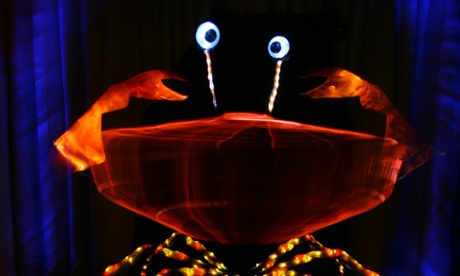
Light artist Gareth Nathan’s work often baffles people at first glance. “People often assume Photoshop has been involved,” he says. “But light painting is about using your camera to take a long exposure photograph in a dark setting where you have complete control over what your camera detects and what it does not.
“Imagine a derelict building in the middle of the night; it’s simply a blank canvas. If you take a two minute long photograph very little is likely to show up - this gives you the opportunity to light and colour a scene however you please.”
To do this, light artists like Gareth employ an array of torches, LEDs, even brightly coloured, light-up children’s toys: “If it generates light in some form, it’s a light painting tool. Every time you spin a flashing LED toy around, the patterns it generates create different outcomes. Essentially you end up jumping around in the dark waving crazy looking contraptions in a slightly choreographed manner.”
So how on earth do you end up becoming a light painter? The answer, in Gareth’s case, is by accident. “A friend and I were just playing with the camera on a beach one night when we realised fire left trails in our photo. The fire was replaced by a glow stick, which was eventually replaced by a light sabre.”

Though you might not have heard of them, light artists work in a tight community across the world, searching out new methods and locations that are perfect for their medium.
“We understand what drives each of us to do what we do as light painting has become a form of therapy for people for many different reasons. We all have that drive to go out and pull off something new and challenging. Then when you see a photo that someone has produced you understand what it took to execute, you know they spent hours thinking, building, executing and failing before getting to the end result.”
In collaboration with Valspar, Gareth lit up a children’s playground in London.“It was a great experiment,” he says. “As with most light painting projects we didn’t really know how it was going to turn out and we only had a certain amount of time to get things right; it’s always a bit of a gamble!”
And what if Gareth were to be let loose on any London structure? “Finsbury Park has a disused water reservoir made of yellow brick arches that dates back to the 1800s. Brick textures can be incredible to work with, so this is definitely on the top of my list for London. You’d have to work with the natural yellow of the scene and balance it out with some colder colours like a bright blue or a vibrant green.
“Aldwych Underground is another gem, its bright white walls would allow you to set any colour combination imaginable to create some amazing effects and patterns. A pink and turquoise striped effected down the tunnel would look amazing.”
Gareth has travelled all over the world creating breathtaking light art in all manner of unusual locations. “I collaborated with a couple of friends in Australia at a place called the ‘Death Star’ – it’s a disused underground sewage treatment plant that’s more like a space ship. Once you get over the idea of what dried remnants you’re walking on and the spiders the size of your hand, it’s an incredible place to be. We also hit up a cave covered in glow worms, which is a dream light painting scenario.”
Whilst it’s obviously a very technical medium, Gareth still finds inspiration in nature.“Turquoise is one of my favourite colours to work with, which I guess is related to my passion for the ocean.”
So what does the future hold for light painting? “There have been huge developments in purpose-built light painting tools which have opened up the art form to the world and made it much more accessible,” he says.
“People can execute these ideas much more easily which makes it appealing to those who’d rather avoid spending six hours out in the middle of the night attempting to create a photo only to be met with failure and a cold walk home. But the biggest rewards come when you’ve spent hours, days, maybe even weeks planning and building up to an idea. When its 2am, your thumbs are frozen and you’re sniffling; the camera clicks and you go running to see the result. It worked!
“Seeing the outcome of all your planning pop right up on your frost covered camera screen makes it all worthwhile. That’s the real reward for being obsessed with light and colour.”
Introducing Valspar…
Established in 1806, leading American paint brand Valspar is inspiring the UK to get colour confident with the launch of its extensive range of high quality paints and unique tinting technology, which has the ability to match any colour the eye can see – that’s around 2.2 million shades. Using their unique colour-matching technology, any colour can be scanned; be it the blue sky from a holiday photograph, or a vibrant pink from a favourite garment, and recreated in paint form.
Available exclusively at B&Q, Valspar’s Premium paints feature a super scrub formula so paint won’t fade or chip off when cleaned and it comes in a range of wide range of high quality interior and exterior paints in a variety of finishes. Valspar is available at B&Q stores nationwide, visit valsparpaint.co.uk or visit any B&Q store to find out more.