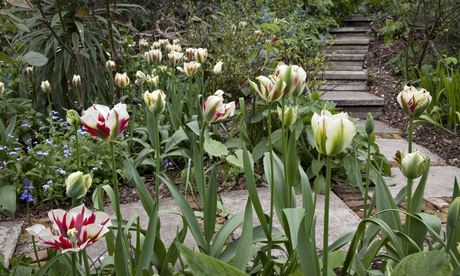
There’s a touch of theatre at 51 The Chase, a short walk from Clapham Common in south London. The stars of the late–spring run are tulips: and the performance starts before you reach the front door, with a garden path flanked by double white-and-crimson Tulipa ‘Carnaval de Nice’ and luminous white ‘Maureen’. They are a perfect marriage of exuberance and calm.
Beyond the house lies a garden packed with more than 2,000 bulbs. The man who orchestrates this display is Charles Rutherfoord: a designer of architecture, furniture and gardens, he prefers a light–touch approach in his own plot. “Chelsea flower show gardens are controlled and predictable and often very beautiful. I have learned, here in my own garden, that it doesn’t have to be controllable to be lovely. That was fantastically liberating. I like the fact that it changes and develops of its own accord.”
If the tulips are the players, the stage set is very fine: the sunshine glints on the gold window frames of the house, a Dutch–style villa designed by Harold Peto and built around 1870. Rutherfoord bought a first-floor flat in the house 32 years ago. It had a porch roof, which could be planted, and another flat roof at the back, which he made into a terrace. For 25 years a strip nearest the back of the house was communal, as was the front. So began an evolving relationship with this city plot. Over the years he and his partner, Rupert Tyler, bought the remaining flats until their takeover of the house – and the garden – was complete.
A constant in Rutherfoord’s gardening has been his love of tulips, and the Bloms Bulbs stand at the Chelsea flower show where he makes informed choices for the following spring. He changes the display each year, walking around the stand and squinting to view colour combinations. He then fills in the order form with planting positions marked carefully on his copy.
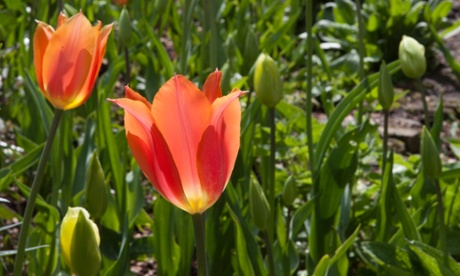
Rutherfoord always emphasises the garden’s visual link with the house. Home and garden must flow into one another, and the outlook from the upper floors is paramount. Rutherfoord repeats the same tulip cultivar in pots on the terrace and in the garden beds down below, so when you view the planting from within, the two blend together. This year the trick is played with ‘Ballerina’, an orange lily-flowered type. The tulips in the garden in turn highlight the colour of the orange brugmansia bedded out for summer and, along with echiums, cardoons and carpobrotus, add an exotic streak to the space.
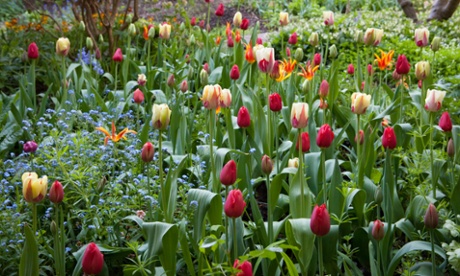
The main bed calls for two tulip varieties that come out at the same time, planted in zigzags; orange and salmon pink ‘Perestroyka’ and ‘Blushing Girl’, which is creamy white with pink tinges. A supporting cast of young bronze peony foliage and jet black mondo grass (Ophiopogon planiscapus ‘Nigrescens’) provides the backdrop. In other areas, sequential flowering gives the advantage of a longer season. Rutherfoord lights up the shadier areas with pale varieties such as ‘Spring Green’ or a shock of bright colour from ‘Fly Away’, a striking lily-flowered type with bright red petals with yellow margins. Another trick is to echo the coloration of neighbouring flowers – the red and white of ‘Flaming Spring Green’ with the white and pink camellia ‘Lady Vansittart’, for instance.
Rutherfoord is passionate about front gardens. He sees them as a key part of the townscape often sacrificed for parking. There are few surviving front gardens along The Chase. In his front garden, the more tender but less vigorous Oven’s wattle (Acacia pravissima) lights up the corner in spring. There is a medlar (“Spring blossom, fruit, good autumn colour,” he enthuses) and lots of plants for scent – mahonias and sarcococcas in winter, hyacinths and narcissi in spring, roses in summer. The copper beech hedge is kept sparse, so the front garden is shared with passersby.
After flowering, the bulbs die back for as long as Rutherfoord can bear before they become too messy. They are then dug up and replanted outside his tiny beachside cottage on Alderney in Guernsey where, by virtue of the sandy soil, they have more chance of being perennial. Most tulips are not reliably perennial, but the luxury of replacing the bulbs every year means the garden is guaranteed to be a sea of colour each spring.
Choose your tulips
Note the names of tulips you admire flowering now, in time for autumn planting. Although Rutherfoord renews his annually, there are ways to get more years’ return from one purchase.
Choose varieties carefully. Those in the Fosteriana group derived from the species Tulipa fosteriana, a flame-red beauty, are suitable for naturalising. Try ‘Madame Lefeber’ with its brilliant red flowers, black “eye” and grey-green foliage; or ‘Orange Emperor’, soft orange with a yellow base; or creamy white ‘Purissima’. Lily-flowered tulips tend to last a few years: try the pure ‘White Triumphator’; ‘Sapporo’, with buttery yellow petals that fade to cream; and bright yellow ‘West Point’.
How to grow
Give tulips good drainage and full sun. Plant bulbs deep: 25cm for chunky hybrid bulbs. On clay soils add a handful of grit to each planting hole to avoid waterlogging. Deadhead after flowering but leave all the foliage and apply bone meal or tomato feed to support the growth of new bulbs below ground.
• 51 The Chase will be open to the public on Sunday 10 May from 12-5pm for the National Gardens Scheme. Entry £4, children free.