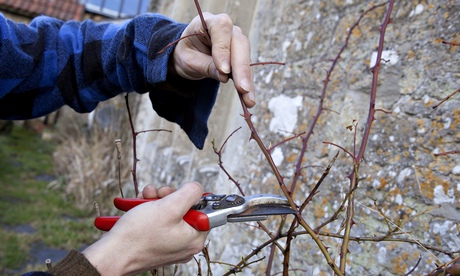
Buds have been swelling and with this my desire in ever-increasing intensity to wield the secateurs. I have five pairs: three of Felco No 2 and two Japanese pairs that are so beautiful I am wary of using them. I reserve the bluntest pair for cutting back the perennials at the end of winter as they are invariably muddied in the process and the grit blunts the blade. The sharpest pair of Felcos is saved for one of my favourite jobs: the pruning of my trees and shrubs.
You should never force a cut, for a cut is a wound and it needs to be clean to heal fast and properly. Move on to loppers if the secateurs are straining, and a hand saw when the loppers aren’t enough. I keep a folding saw in my back pocket for such occasions and always remove the weight of the limb with a first cut to avoid tearing.
Pruning is an art. Spend a day at the walled garden of West Dean in Sussex and you will see every example of wall-trained and free-standing fruit, pruned to perfection. These are the western equivalent of bonsai, with every branch considered and mapped into position.
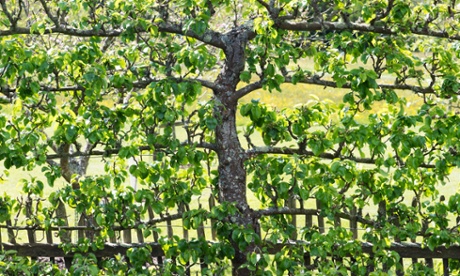
Pruning has many functions, fruiting being one of them. My own espaliered pears are just a year old. The sheep nibbled them to the quick at the start of last summer, but they have made valiant efforts and I have a modest first tier – the first step up the wall. The four-year-old orchard is being given its formative prune this year. The apples and pears are pruned in the winter, the plums in the summer when their sap is rising, to diminish their exposure to airborne silver leaf. The young trees are lightly managed to keep them open and airy and without crossing limbs. I prune for dead or diseased growth first, then for the shape.
You need to understand the spirit of a plant to try to second-guess how it will respond to a cut. If your plants are healthy, hard pruning will encourage vigorous growth. It is a mistake, for instance, to wade in on an old apple tree – it will only respond with a mass of water-shoots (tall, upright and leafy branches, producing no flowers or fruit). Take it back slowly over three years and you will maintain the balance. You may of course want a fierce response: a rush of new foliage on your Sambucus ‘Black Lace’ or a network of fine young limbs on the forsythia to keep the bush open and airy. Nothing is worse than pruning a plant without regard for its structure.
My first task is to prune my Austin roses as the new shoots are racing away. Each variety is different in growth and although some are more vigorous, they are all reduced in height by about half. I try to prune out the oldest growth to keep the wood young and healthy and to a framework of six or seven evenly spaced branches. Thorns and scratches are easily overlooked as you shape your plants for the next season.
Get growing
Feed with a handful of blood, fish and bone spread evenly over the root plate after you have pruned to reward your plants and encourage a good response.
Follow the Observer Magazine on Twitter @ObsMagazine