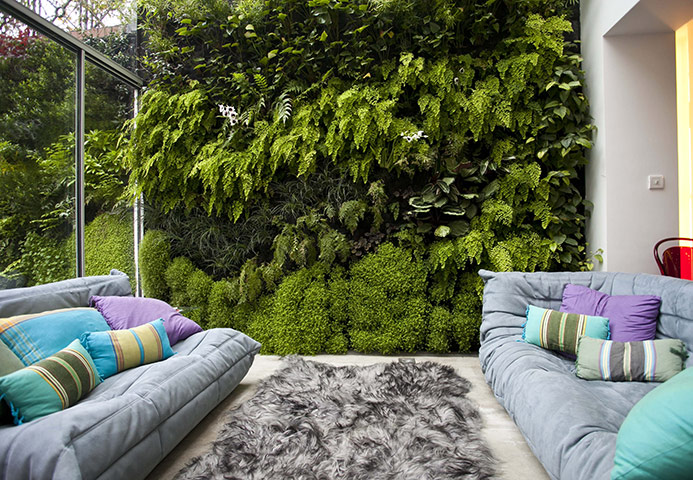
Three years ago Daniel Bell was asked to create an interior living wall for a house in north London, where the owners had dug into the basement to install a glass cube of a kitchen.Photograph: Sophia Evans“As soon as I saw the old wall outside the kitchen, I thought it was the perfect place to continue the living wall,” Bell says. Here, the outdoor section of the wall is seen from the rear of the garden. Photograph: Sophia EvansThe wall is made from two layers of capillary matting (made from recycled clothes) with a waterproof plastic backing. Bell cuts slits in the outer felt and pokes each plant through, stapling the opening to anchor the plant. The beauty of this system, he says, is that you can create different-sized pockets to suit the plants you’ve chosen, and the roots have room to spread out.Photograph: Sophia Evans
Indoors, tender miltonia orchids, calathea and the delicate, lime-green fern Adiantum raddianum thrive.Photograph: Sophia EvansOutdoors, fuchsia, parahebe, euphorbia and epidemiums grow in profusion on the 25 sq m planted wall. Photograph: Sophia EvansThe choice of plants depends on the aspect of the wall, but they should all be able to cope with growing hydroponically. Bell feels this is part of the fun for gardeners, discovering for themselves what works.Photograph: Sophia EvansHardy parahebe and euphorbia growing on the living wall's outdoor section. Photograph: Sophia EvansThe white spires of Tiarella 'Cascade Creeper' add colour in early summe, set against the leaves of hostas. For more on living walls, read Annie Gatti's feature in full. Photograph: Sophia Evans
Sign up to read this article
Read news from 100’s of titles, curated specifically for you.