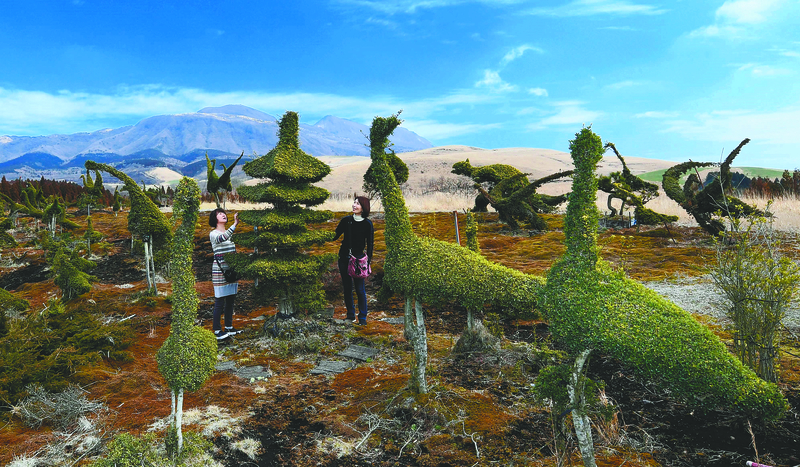
The endless blue sky was spread out above me and a range of hills and the five peaks of Mt. Aso and the Kuju-renzan mountain range in Ubuyama, Kumamoto Prefecture, made for quite the beautiful scene. Among the magnificent view that makes the image of the savanna in Africa come to mind, roughly 800 green objects shaped like various birds and beasts stand, posed as though they were playing with one another.
Michio Wakamiya who was trimming overgrown leaves while singing an enka pop song in a relaxed mood, jovially said, "I have carefully tended [the plants] for decades, and so I feel a special attachment to each and every one of them."
The animal-shaped objects are examples of topiary -- gardening arts -- where trees, such as boxwood are cut into a variety of shapes.
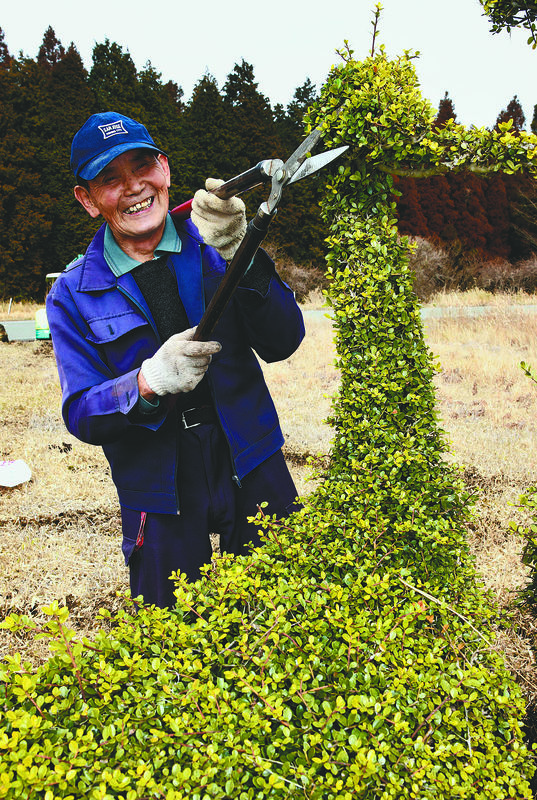
An official of the Japan Topiary Association said, "It is very rare that a single person who isn't a professional gardener to have made and displayed as many as 800 pieces."
Wakamiya is a rice farmer in Aso, a city neighboring Ubuyama. He was influenced by his father who liked the art of bonsai and began to delve into the topiary arts at home since he was around the age of 20. He began by shaping trees brought from mountains and giving them unique shapes.
About 25 years ago, Wakamiya rented a pasture at the edge of Ubuyama and opened Higotai Fruits, a produce stand specializing in locally farmed products.
Wakamiya said, "After a while, I transferred 20 to 30 of the topiary plants into the area around the produce stand, and my customers enjoyed them."
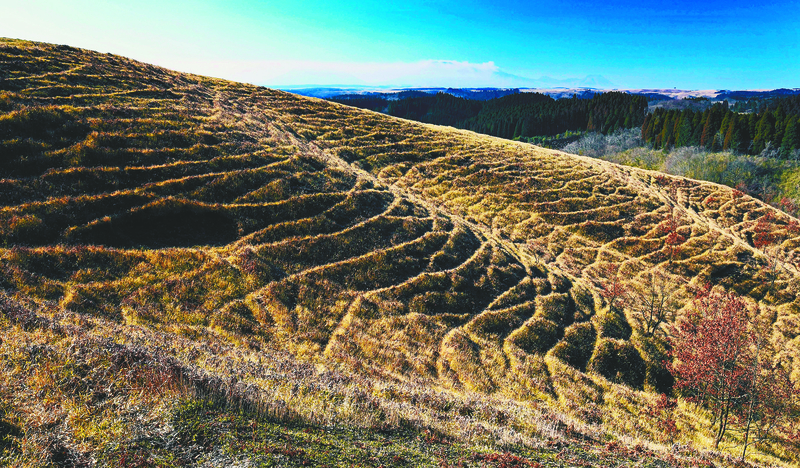
He increased the number of topiary plants through the years, not only near his stand but also in the surrounding area. Before long, the scenic view that stretches 300 meters into grasslands was formed.
Although his pieces are mostly free-form, many of them are crane-shaped because bird-shapes are easy for him to make. Other pieces include a yokozuna sumo wrestler, Urashima Taro (a character in a Japanese folk tale) and the Nagasaki Peace Statue.
"I'm always imagining what my next piece will be," he said. Though he has produced his art alone until now, recently his eldest son helps him with the work on Sundays.
The topiary art pieces are placed along the Yamanami Highway, a roughly 50 kilometer-long road on a high plateau that connects Aso, Kumamoto Prefecture, and Yufuin, Oita Prefecture.
A liaison council was established three years ago to promote tourism, which had been sluggish in the wake of the Kumamoto Earthquake, along the road between the two municipalities. Since its establishment the route has garnered attention.
Kohei Nagahama, an official of the Ubuyama village government's planning and promotion section, said, "The highway is popular also among motorbikes and bicycle lovers. Inquiries about the topiary arts began to increase when they became trendy on social media sites."
Strangely enough, the topiary arts aren't mentioned in any tourism guidebooks. Doesn't the art raise the highway's appeal, attracting tourists in cars who stop to admire it?
To this question, Wakamiya replied, wildly laughing, "Well, I wonder if they're in a good spot."
The next day, the weather was stormy. Even in winter, when Wakamiya closes his produce stand, he comes to the area every day. And on this stormy day, as I expected, he was there standing in front of the trees.
His face held a serious expression as he was reinforced a tree he'd just replanted using wires. "I do this because the wind can blow up to 30 meters per second sometimes," he explained.
The vast grassland drenched in rain looked as though it were offering compassion to the solitary craftsman.
Higotai Fruits is a produce stand that sells locally farmed produce atop a high plateau along the Yamanami Highway in Kumamoto Prefecture.
From May to October, the stand sells corn and takanazuke pickles. The topiary artwork in the area can be seen free of charge year-round. It is conveniently close to other tourist spots, such as Higotai Park in Ubuyama and the Kurokawa Onsen hot spring resort in Minamioguni, Kumamoto Prefecture.
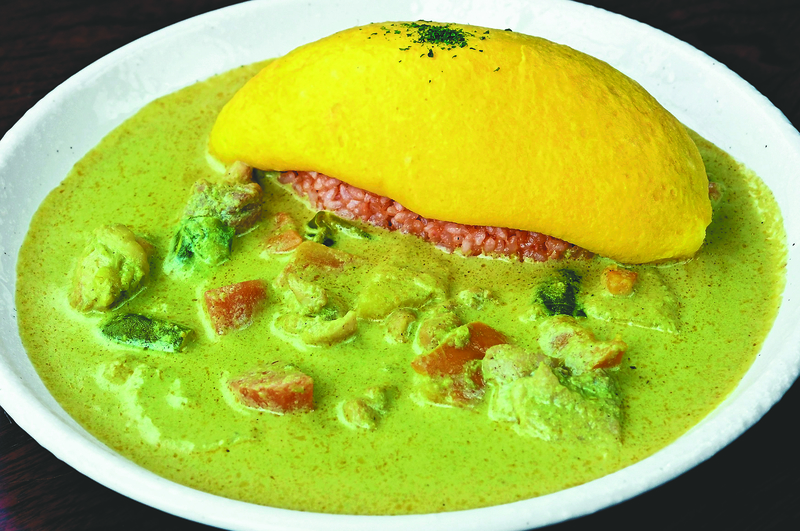
The village government and residents of Ubuyama has had a continued friendly relationship with Thailand for 32 years, which has led to the creation of the unique local cuisine, green curry with rice omelet.
Sansuitei, a restaurant in the area, serves the cuisine priced at 1,070 yen a serving.
Kunji I, former manager of the restaurant, learned of green curry dishes when he visited Thailand in an event to commemorate the 20th anniversary of the continued relationship.
He reproduced the Thai dish, and his eldest son, Ryuji who has stayed in Thailand as an exchange student in his junior high school days, combined the Thai dish with a rice omelet. The fusion cuisine became the restaurant's signature dish.
Kunji said, "Chingensai (a variety of Chinese green vegetables) -- the village's local specialty -- is kneaded in the curry soup so that the green color becomes more vivid. The level of spice is adjusted to suit Japanese tastes."
The curry soup, containing a lot of large chunks of fresh vegetables, has a creamy and gentle texture, while the rice omelet is extremely soft and thick.
The I family has collaborated with a female Thai illustrator who was formerly an exchange student in Japan. Her cute painting depicts members of the I family is on display in the restaurant.
Read more from The Japan News at https://japannews.yomiuri.co.jp/