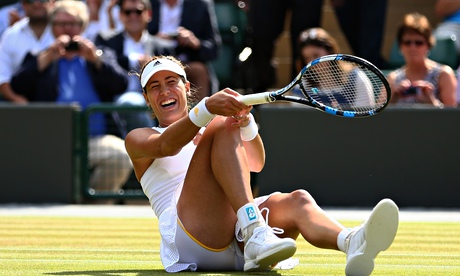
Her smile may bear a sneaking likeness to Jennifer Aniston’s, but Garbiñe Muguruza will be a poster girl in her own right after the 21-year-old’s performance on Tuesday. Muguruza became the first Spanish woman in 18 years to reach a Wimbledon semi-final (the last was Arantxa Sánchez Vicario) when she overcame Timea Bacsinszky 7-5, 6-3.
While her results on the doubles circuit have so far outdone her singles form, Muguruza is considered a future star of the women’s tour. Her success here will be a major fillip for Spanish tennis after the recent replacement of controversial Davis Cup captain, Gala León García, plus the resignation of the Spanish Tennis Federation president, José Luis Escañuela, following a financial investigation, and the departure of Rafael Nadal (and all his male compatriots) from the singles.
But Muguruza had to overcome a strong challenge from her Swiss opponent. The pair had grappled in the third round of the Australian Open and this match was equally hard fought from the outset, the opening game a display of clean, powerful hitting.
Bacsinszky’s unorthodox shots kept her well defended against Muguruza’s attacking groundstrokes. With her unusual, over-rotated grip, which sometimes leaves the right-hander holding her racket in her left, Bacsinszky sliced and chopped and more than once caught Muguruza at the back of the court while dropping the ball in behind the net. Recognising her opponent’s ability round the court, Muguruza threw everything at her first serve, and it was she who won the crucial break in the final game of the first set.
Both women have been wary of grass and after her win Muguruza said she was surprised that her first grand slam semi-final had come on the surface, especially after she had claimed after her first grass tournament in Birmingham that she was “never coming back”.
Wimbledon has treated her better. She has been a cheerful, charismatic presence here, posing as an emoji at the pre-tournament dinner and snapping a selfie with the Spanish actor Antonio Banderas in the players’ dining room. She certainly seemed to be more nervous about that encounter than about the one with Bacsinszky. “I woke up this morning thinking, I want to play the match,” she said. “I feel good … I was, you know, having fun.”
Consecutive breaks at the start of the second set left the players back on level terms, but as the match wore on it became increasingly apparent that Bacsinszky’s bag of tricks was running low. At 4-3 and 15-all Muguruza dispatched one of Bacsinszky’s wacky slices with a commanding down-the-line forehand, then took the first of two break points and served out the match in an hour and 27 minutes.
It had been both players’ first Wimbledon quarter-final, and no one who has enjoyed Bacsinszky’s return to tennis will have wanted to see the end of her campaign. The 26-year-old has spoken frankly of the “stolen childhood” she suffered at the hands of her father and coach, Igor. Her rediscovered love of the game was evident in her play. “Today I stood up strong,” she said. “Even if it didn’t happen for me to get the win, I know I made a huge improvement. So I’m really glad about this Wimbledon. I’m already looking forward to coming back next year.”
As for Muguruza, she celebrated her victory by bunny hopping about the court. “It was a very intense game, the last one,” she said, “so it was happiness and relief.” She was three when Sánchez-Vicario reached the second of her Wimbledon finals and while she is not considering her place in history just yet, you cannot doubt her growing assurance. “All this experience helps a lot when you believe that you can do it. So I’m going to be more confident.”