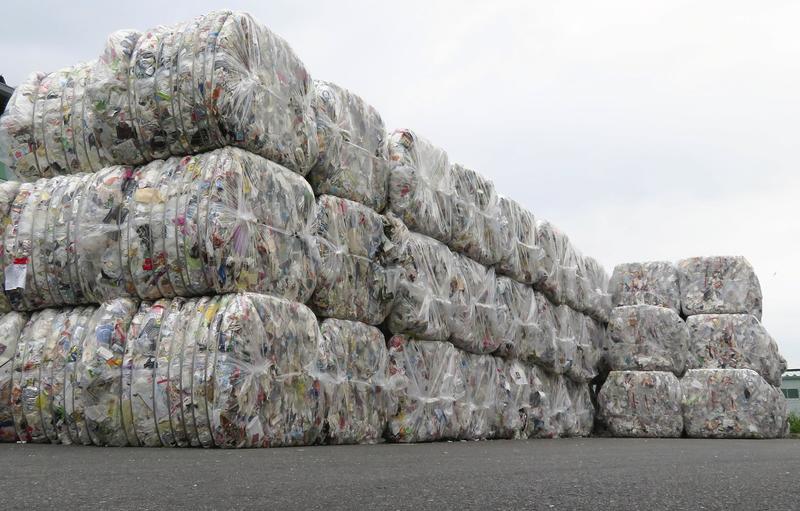
With signs of an ordinary life returning, recycling facilities are on the verge of being inundated as a massive amount of garbage has been generated during the "stay-at-home" period over the past month. Lots of plastic garbage, such as food containers, has piled up in facilities near urban areas, and a huge amount of used clothes is being stored in warehouses. Some local governments have stopped collecting them from households.
"We cannot handle any more. It's over the top," a Kanto regional waste plastic processing plant's owner said, feeling frantic.
Since the government declared a state of emergency in April and the end of the Golden Week holiday period in May, which was dubbed "Stay Home Week," the amount of household garbage, such as food containers and plastic bags has increased rapidly.
Having received more waste than expected, the plant is keeping the waste plastic, which cannot be stored in the storage area, outside in piles between three and four meters high.
The plant, which recycles waste plastic into raw material for plastic, is operating at full capacity on Saturdays. "There is twice as much garbage in storage as usual, and there is no space to store it. Given the situation, if the employees become infected, it may be over," the man said.
Although the amount of waste plastic accepted by the plant increased, the price of raw plastic materials, which are sold after recycling, dropped by 30% due to a drop in crude oil prices. "Earnings fell sharply," he sighed.
Changes in the type of garbage that is being generated by staying home all day are what is behind the frenzied situation recycling facilities are in.
According to the Tokorozawa municipal government in Saitama Prefecture, among other municipalities, the number of plastic containers, PET bottles and cans has especially increased. "This may be due to an increase in take-out and individual delicatessen packaging from supermarkets," a city official said.
Garbage collection sites are also struggling. According to a 50-year-old business operator in Yokohama, who collects PET bottles, waste plastic and cans, household waste has increased by 25% to 30%.
Although he has increased the number of collectors, trips going back and forth between garbage collection points and disposal sites are constant. "We are on the verge of reaching our limit," he said.
"In order to facilitate waste disposal, local residents should sort waste properly and buy food with as little packaging as possible," Misuzu Asari, an associate professor at Kyoto University and an expert on environmental engineering said. "It is necessary to reduce both the amount of garbage and the burden of waste disposal companies. Municipalities in charge of garbage collection should cooperate with private companies to establish a system to deal with the rapid increase in household garbage," Asari said.
Read more from The Japan News at https://japannews.yomiuri.co.jp/