GameStop’s (NYSE: GME) fiscal Q4 2025 results reveal a business stabilized after years of struggle. However, as good as some news is, other news offsets it, leaving the market in limbo, where it has been stuck for many quarters. The question now is what comes next, and the answer is likely to be more of the same. GameStop’s stock price is stuck in a trading range unlikely to break until the company turns the next corner.
The next corner is a return to growth in its core, video game business.
The caveat for would-be long-term holders is that GameStop’s core business is in a long-term, structural decline, not a temporary soft spot.
Issues plaguing the industry include the high price of consoles, the impact of inflation on consumer demand, a long-delayed upgrade cycle, the cloud, and AI.
The last major upgrade cycle was years ago, meaning most gamers already have the latest equipment.
At the same time, a shift to SaaS and cloud-based games is impacting the software side, leaving console makers and resellers in the cold.
Looking forward, future upgrade cycles are unlikely to rival those of the past as AI capabilities and the cloud advance. GameStop’s hardware and software sales are likely to experience a steady, long-term decline and eventual failure as gaming consoles become obsolete. As it stands, a major shift is expected to be completed by 2030, with edge and hybrid technology taking the fore.
GameStop Improves Profitability: Sales Decline Persists
GameStop had a mixed quarter with strengths offset by weaknesses at every turn. Revenue came in at $1.1 billion, slightly better than expected, but down more than 14% from the prior year due to declines in core businesses. Segmentally, Hardware sales fell by 12.36% for the year, and Software by 27%, offset by an increase in Collectibles. The increase in Collectibles was good news, reflecting progress on turnaround efforts, but it fell shy of moving the needle on investor sentiment.
Collectibles are still less than one third the business and insufficient to offset the expected decline in the other segments. With this in play, GameStop is unlikely to revert to growth or sustain it, and if it does, there are still questions about valuation. There are no earnings forecasts available, as no analyst is bullish on this business, leaving only the current year price-to-earnings multiple for investors to ponder. As it stands, the company trades at nearly 30X earnings, commanding a significant premium given its incredibly tepid outlook.
Earnings are another area of strength, though unlikely to invigorate bullish behavior. The company significantly improved its adjusted earnings by reducing the cost of sales and SG&A expenses. The bad news is that structural improvements are mostly completed, and the business remains in decline, with asset impairments having hurt GAAP results.
Asset impairments, AKA the massive decline in Bitcoin’s value, resulted in a contraction of GAAP profits, a 30% sequential decline in asset value, and may never be recouped. Bitcoin is down on a massive deleveraging triggered by forced liquidation as the BTC price declined. Add in macroeconomic pressures and declining liquidity, and BTC price action will remain pressured indefinitely.
GameStop Has No Buy-Side Support, Only Sell-Side Pressure
The only market group interested in GME stock currently is retail traders. The institutions that had been buying in 2025 reverted to selling late in the year and accelerated activity in early Q1 2026. This is a headwind for the market, amplified by short selling, and it could keep the market in check this year. Short interest is well off its highs but up from last year’s lows, trending near 15%, and only needs a catalyst to spike. Analysts are likewise bearish on this stock. The two with ratings provide a consensus Reduce rating and forecast more than 40% downside.
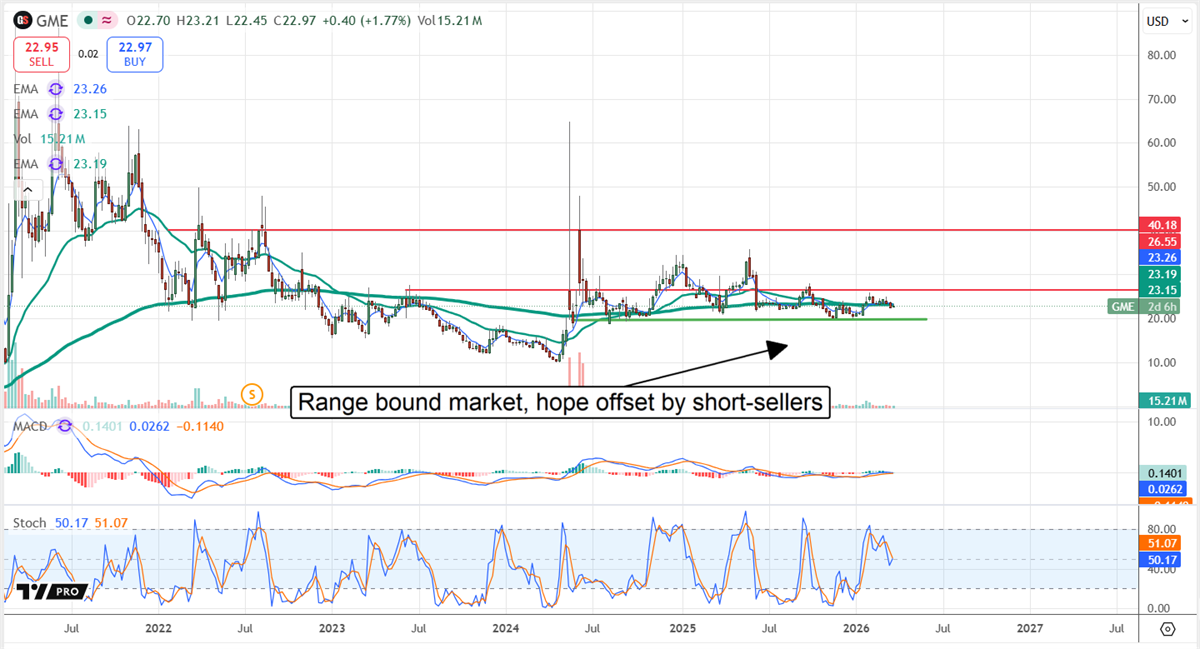
On the other hand, price action responded favorably to recent earnings news, rising approximately 1% in premarket trading and holding those gains after the open. The risk is that this market remains deep within its range, well below the critical resistance point, and is unlikely to set new highs. The critical resistance point is just above $26.50.
GameStop’s catalyst lies in its cash pile. The company is sitting on $9 billion in cash and assets, sufficient for targeted acquisitions. The hope is that the company can transition from its legacy business into a newer, holding-style business, diversified and able to sustain value-building activities.
Where Should You Invest $1,000 Right Now?
Before you make your next trade, you'll want to hear this.
MarketBeat keeps track of Wall Street's top-rated and best performing research analysts and the stocks they recommend to their clients on a daily basis.
Our team has identified the five stocks that top analysts are quietly whispering to their clients to buy now before the broader market catches on... and none of the big name stocks were on the list.
They believe these five stocks are the five best companies for investors to buy now...
The article "GameStop Stabilizing: What Comes Next for Investors?" first appeared on MarketBeat.