Known as the oldest highway in the US, the 110 North out of downtown Los Angeles comes to an end in the city of South Pasadena. Orange Grove Boulevard is your first exit, a shady tree-lined thoroughfare that used to be called Millionaire’s Row in the Victorian era. It features a progression of styles from Queen Anne and American Foursquare in the 1880s to American Craftsmen and Prairie style homes only 10 years later.
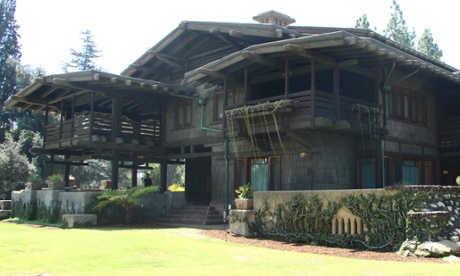
Further north, away from more ostentatious abodes, such as the Wrigley Italian Renaissance mansion, the Gamble house, built and furnished for a comparatively modest $80,000 by Greene and Greene in 1908, is considered a masterpiece of Craft-style architecture. Movie fans might recognize the low-pitched rooflines, deep eaves and handcrafted wood from Doc Brown’s house in Back to the Future, which was screened there last month for a fan event. This month it’s Upstairs Downstairs, a two-week only docent-led tour of the, servants’ quarters and kitchen, as well as the basement laundry and coal rooms, in addition to the rest of the bedrooms and family rooms.
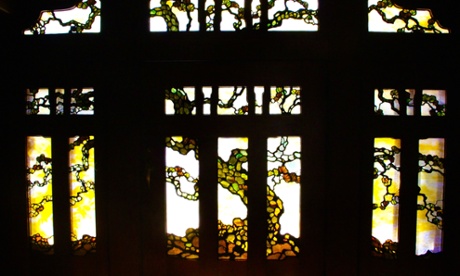
Heir to the Proctor & Gamble soap and candle company in Ohio, David Gamble and his wife Mary decided to build a winter home in Pasadena, where fellow Cincinnatians, architects Charles and Henry Greene had their practice. Devotees of Japanese style, an exotic craze that swept throughout the west at the end of the century, Greene and Greene were a perfect fit for the Gambles, who traveled extensively in the Far East. Not only is Japanese style evident in the use of wood, joinery and emphasis on structure, but most obviously in the front door, with its stained-glass mural of a Japanese black pine. Mahogany and teak inlaid walls, furniture, fixtures and rugs were all custom made for the house, ranging from the Baldwin piano in the living room to the single beds in the master bedroom.

“Doctors recommended it in order to minimize exposure to wiggling, pulling of sheets, bad breath and snoring,” curator Anne Mallek says of the sleeping arrangements. She co-authored the new book, The Gamble House: Building Paradise in California, based largely on her research at the Gamble family archive in the Countway Library at Harvard Medical School where son, Clarence Gamble was enrolled.
“We had known about the archive and no one had looked at it,” she said of the letters and journals she pored through, including entries about the building of the house as well as visits to artisan workshops related to its construction. “The Gambles came to life.”
Coming from a middle class background, the Greenes understood firsthand what was required to run a household. As such, they made sure the kitchen was an open and ventilated area that included an island like those found in most modern-day kitchens. No tiffany lamps and mahogany here, just the more practical maple and sugar pine surfaces for chopping.
A pantry separates the kitchen from the dining room, creating a sound buffer between servers and served. A similar division is evident upstairs in the servants’ quarters, (usually housing two lucky design students from University of Southern California). As expected, the stairwell is narrower and the living space is smaller, but the doorways and passageways are also tighter, and even the bathtub is only 75% normal size.
A gardener had a space in the garage, but he lived off-site, as did a laundress, seamstress and wait staff hired as needed. Living on site were a maid and cook, usually immigrants. Their quarters are neat and comfortable, though noticeably less bright and airy. In one room, a mannequin stands dressed in a maid uniform of the time.
“In the 1920s they had a Croation cook, Ljuba Sirolla,” says Mallek, who frequently came across her in letters. “They love her. She’s baking Clarence’s favorite cookies and sending them off when he’s in college. They’re taking her to dentist appointments and to the doctor. There’s a sense on both sides that Ljuba is very loyal, and the Gambles are also very appreciative.”
Mary and her sister, Julia, who was living there at the time, signed Ljuba’s naturalization papers and sponsored her in 1924. And while they considered her part of the family, their generosity had something to do with changing working conditions at the time. Twenty years earlier, service jobs were preferable to factory jobs because one was provided free room and board in addition to salary. Of course that often meant no time off, or one night and one day weekly, usually noon to four on a Sunday. The rest of the time, you were theirs. But that changed with social and labor reforms of the progressive era, and live-in workers became harder to find.
“They were progressively minded but also conservative. They were coming out of a very conservative era,” explains Mallek about the Gambles. “When you look at their house in Cincinnati, a Victorian built in 1890, and they later built this – California, wild west, sleep outdoors on sleeping porches, no gas fixtures, all electric, there’s even a fitting for a central vacuum system.”
Despite their success, Greene and Greene dissolved their practice in 1922. Henry mostly withdrew from architecture after the death of his wife in 1935, while Charles remained active through the Depression and later embraced spiritualism and the study of Eastern philosophy. Their contribution to architecture went generally unnoticed until 1948 when they received a citation from the Pasadena chapter of the American Institute of Architects. Just before they died, they were cited again from the national body of the organization in 1952 for their contribution to “new and native architecture”. Their work was subsequently embraced and celebrated around the world by a new generation, thought it took until 1978 for the Gamble house to finally be given landmark status.