
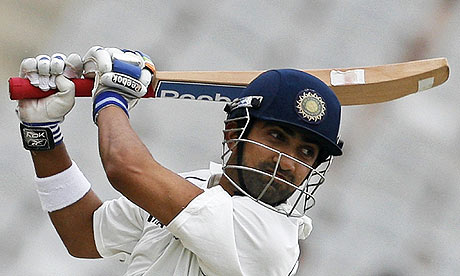
It wasn't the sort of innings that you expected from someone who had scored 534 runs from just 379 balls in the inaugural Indian Premier League. In those 14 matches for the Delhi Daredevils, he had whacked 68 fours – a record – and eight sixes, and guided his team to the semi-finals. At McLean Park in Napier the hare turned tortoise and went one step further. Like a determined periwinkle on storm-tossed rock, Gautam Gambhir refused to budge as New Zealand strove for the victory that would have squared the series. In one innings he spent more time in the middle than he had during the entire IPL, facing 436 balls for 137. The knock spanned 643 minutes and six sessions and was reminiscent of one that India's coach, Gary Kirsten, had played to get South Africa out of jail in a Durban Test.
When you add in the fact that Gambhir made 1,119 one-day international runs at 46.62 in 2008, the most by anyone, you begin to get some idea of how good he has become. His limited-overs exploits have thrust him into the limelight with a Coke commercial shot in Mumbai getting plenty of airplay in recent times. But it's as a Test batsman that he has surprised most people, showing steeliness and a patience that not many had associated with him in the past. When he came into the side in 2004 he was quickly dismissed as a flat-track thumper who flailed at the ball away from his body. He stayed in the side a year but was quietly jettisoned after a poor home series against Sri Lanka.
If domestic form had been the criterion for selection then it should probably have been his Delhi team-mate, Aakash Chopra, who got a call-up against Pakistan in December 2007. Gambhir failed in that Bangalore Test but his fluent strokeplay in coloured clothes kept him on the radar. And after Wasim Jaffer played his way out of the team against a classy South African pace attack, Delhi cricket's Mr Angry had his chance to prove the doubters wrong.
He didn't quite do that in Sri Lanka, where he got starts in every innings and made three half-centuries against Muttiah Muralitharan and Ajantha Mendis. Failure to kick on and make a defining score counted against him and when he started the home series against Australia with scores of 21 and 29 in Bangalore, the clock was once again ticking.
There was something about the Australians, though, that got Gambhir's competitive juices flowing. Never one to take a sledge lying down, he responded with often thrilling strokeplay as India ran riot in Mohali. Scores of 67 and 104 set him up perfectly for the Diwali Test on home turf. At the Feroz Shah Kotla he made 206 but a snide little elbow into Shane Watson's midriff meant that he would miss the final Test in Nagpur. No matter. He made 361 in two Tests against England, including a marathon 179 in Mohali, sharing a 314-run partnership with the man who helped him save the Napier Test, Rahul Dravid.
In the 10 Tests since his return the man cast as Robin to Sehwag's Batman has 1,389 runs at 73.1, 505 more than his illustrious partner has managed in the same period. He got out to an atrocious stroke in the first innings in Napier but curbed his instinct to dominate to such an extent in the second dig that he went nearly an hour while adding just one to his score. It was an effort that would have done Dravid proud and, after a poor decision from Ian Gould had sent the senior man on his way, it was Gambhir that soldiered on to ensure that there would be no joy at all for Daniel Vettori's men.
While he still loves to crash the ball through point, the technique is noticeably tighter and he appears more than content to wear bowlers down. With Sehwag at the other end there is seldom any scoreboard pressure and, even in his most obdurate mood, Gambhir rarely misses the chance to put the bad ball away. His footwork to the spinners is decisive and he's too short to really be bothered about the bouncers.
Napier was no solo effort, though. India's batting titans have often been derided as soft touches under pressure, an assertion that's made to look utterly ridiculous by matches such as Kolkata (2001), Adelaide (2003) and Perth (2008). But the memories of humiliation in 2002 must have been fresh in some minds after New Zealand piled up 619 for nine and then bowled India out for 305. The old stagers responded as they knew best, by scoring runs in their own inimitable fashion.
Dravid was tenacity itself, scoring 83 and 62, though he will regret the uncharacteristic swish that cost him another Test century. Tendulkar's back-foot cover-drives during innings of 49 and 64 were played with such panache that Martin Crowe, who knew a thing or two about classy batsmanship, couldn't stop purring up in the commentary box. But even he was eclipsed by Indian cricket's ultimate stylist.
When on song, Vangipurappu Venkata Sai Laxman makes most others look second-rate and he was in his element on a pitch where the bounce was just to his liking. After 76 in the first innings, he droved, pulled and flicked his way to an unbeaten 124 in the second, with exhibition strokeplay in the hour after the game had been saved.
He has some previous. Kolkata aside, there was a remarkable effort at Mohali in 2003, when unconquered efforts of 104 and 67 [coming in at 18 for three] thwarted Stephen Fleming's New Zealand after India had been made to follow on. A year earlier, he had gone to the scene of his greatest triumph, Eden Gardens, and scored an unbeaten 154 after coming to the crease with India in danger of an embarrassing innings defeat. The man who added 214 with him then? Tendulkar.
Some bottlers, eh?













