With China in mind, the government aims to develop a new base for the training and deployment of Self-Defense Forces in the Nansei Islands that run from Kyushu through Okinawa.
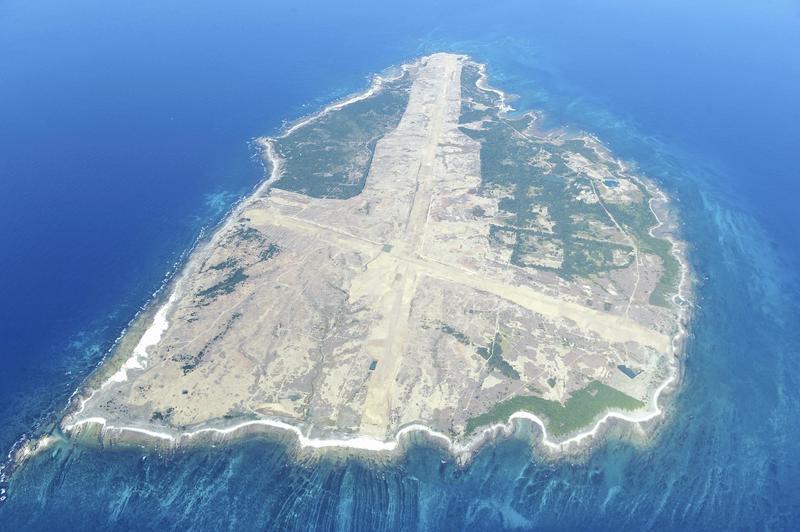
The plan is to construct a base on Mageshima, an uninhabited island of the city of Nishinoomote, Kagoshima Prefecture, for the SDF in addition to its initial purpose of carrying out field carrier landing practice for U.S. carrier-borne aircraft.
FCLP uses runways to simulate the deck of an aircraft carrier to maintain fighter pilots' skills. This practice involves intense noise and is conducted once or twice a year when an aircraft carrier leaves port.
Obtaining the understanding of local residents in the areas surrounding the planned base site and easing their worries about issues such as noise pollution will be key to starting construction of the base as soon as possible.
-- 16 billion yen. land purchase
Mageshima is a flat island about 12 kilometers west of Tanegashima island in the same prefecture. It is about 8 square kilometers, which is 16 times as large as Tokyo Disneyland.
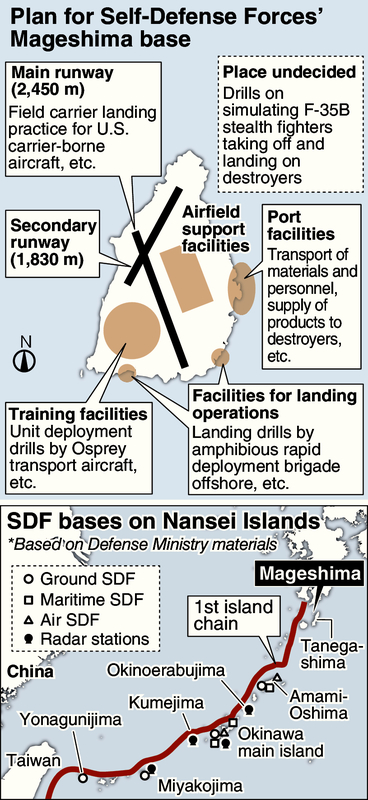
According to the government's plan, the entire island will become an SDF base mainly with port facilities, training facilities and facilities for landing operations to be constructed, as well as a 2,450-meter main runway and a 1,830-meter secondary runway for use when a crosswind blows.
Since Oct. 29, the Defense Ministry has started briefing sessions for residents of Nishinoomote, which spans Mageshima and the northern part of Tanegashima, to give them explanations on the construction of the new base. The ministry is planning a series of briefing sessions in 12 areas of the city.
Above that, the ministry intends to begin a boring survey and an environmental impact assessment within this month. It plans to start full-fledged construction as early as fiscal 2022 and complete construction in about four years.
The construction of the new base on the island has surfaced as it became necessary to secure a site for FCLP for aircraft units on U.S. carriers headquartered at the Yokosuka base in Kanagawa Prefecture.
FCLP had been carried out in areas such as the Atsugi base in Kanagawa Prefecture, with fighter jets repeatedly practicing take-off and landing regardless of whether it is day or night. Since 1991, however, under endless complaints about noise pollution, FCLP has in principle been conducted at Iwoto island of Tokyo, far from Honshu.
After the realignment of U.S. troops, aircraft units were shifted from the Atsugi base to the Iwakuni base in Yamaguchi Prefecture. As a result, the distance to Iwoto was prolonged to about 1,400 kilometers. If an aircraft encounters trouble on the way to and from the island, there is no emergency landing area at sea, creating a safety concern.
Therefore, the U.S. government has strongly and repeatedly asked the Japanese government to secure another site for FCLP not far from the Iwakuni base.
In June 2011, the Japanese and U.S. governments held a Security Consultative Committee meeting, known as 2-plus-2 security talks, and chose Mageshima as the site for FCLP.
The Japanese government had difficulties promoting negotiations to buy the island from a private company based in Tokyo that owned most of the island. But it reached an agreement with the company in November 2019 by finally increasing the land purchase price to 16 billion yen from the initial 4.5 billion yen that was calculated based on a simple asset value.
-- Noise pollution worries
There have been pros and cons for the new base construction plan among local municipalities and residents.
The central government has been explaining to them that Mageshima is an uninhabited island and there will be little influence on surrounding areas, but some residents are worried that noise and environmental pollution could spread.
Nishinoomote Mayor Shunsuke Yaita has expressed his intention to oppose the new base plan, aiming for his reelection in a mayoral election to be held in January next year.
The issue of the relocation of the U.S. Marine Corps' Futenma Air Base from Ginowan, Okinawa Prefecture, to the Henoko district of Nago in the same prefecture is a good example of the opposition of a local government to a base relocation involving the U.S. military.
Although the relocation of the base was agreed upon in the final report of the Special Action Committee on Okinawa (SACO) between the Japanese and U.S. governments in 1996, it has yet to be finalized.
However, the local governments are not all opposed to the new SDF base plan. For example, except for Nishinoomote, understanding of the new base plan has been spreading on Tanegashima in the two towns of Nakatane and Minamitane. The Tanegashima fisheries cooperative, which could suffer damage to their fishing operations, has submitted a certificate of consent to a boring survey.
Behind the moves in favor of the plan is the expectation that the acceptance of the base plan could lead to the promotion of the local economy. The central government plans to build accommodations for 150 to 200 SDF personnel on Tanegashima and provide a subsidy to be paid to local governments that cooperate in the realignment of U.S. troops.
The central government is giving consideration to reducing the new base's impact on surrounding areas. It changed the direction of the main runway in its initial plan so that aircraft will not fly over Tanegashima.
Amid these circumstances, Kagoshima Gov. Koichi Shiota, who has the authority to give permission to any reclamation work, building certificates, boring surveys, among others, has so far not shown a clear attitude toward the plan.
This year, the Defense Ministry was forced to abandon deploying the Aegis Ashore ground-based missile defense system in Akita and Yamaguchi prefectures after a series of defects were revealed at briefing sessions to local residents. Such a failure should not be repeated.
The central government is urged to make efforts to widen understanding of the plan through persistent explanations to ease the concerns local residents are feeling, such as environmental and noise pollution, as well as making an appeal to the necessity of the new base in terms of national security.
-- Essential to defense
Mageshima is located at one end of the so-called first island chain that links the Nansei Islands to the Philippines and beyond. Amid China continuing its provocative activities in waters around the Senkaku Islands in Okinawa Prefecture and the Taiwan Strait, the new base is expected to be an essential point for the defense of the Nansei Islands.
The plan at first is only for units related to maintaining and improving the base to be stationed on Mageshima. Because runways and port facilities will be built on the island, however, the central government intends to use the island base as a depot to deploy materials and personnel in the event of an emergency in and around the Nansei Islands.
The total distance of the Nansei Islands, from Tanegashima to Yonaguni Island in Okinawa Prefecture, is about 1,200 kilometers, almost the same length as that of Honshu from north to south. The number of main SDF bases on the Nansei Islands is just nine: four for the Ground Self-Defense Force, three for the Maritime Self-Defense Force and two for the Air Self-Defense Force.
For Mageshima to become a deployment base will enhance the SDF's response capabilities.
The new base will also help solve the SDF's long-standing problem of a shortage of SDF training sites. It will make it possible to conduct various kinds of drills throughout the year, including one that simulates state-of-the-art F-35B stealth fighters taking off and landing on destroyers and another using the GSDF's Osprey transport aircraft.
At the facilities for landing operations, the SDF is likely to conduct drills for the defense of remote islands, including landing operations in which the GSDF's amphibious rapid deployment brigade lands vehicles from offshore. It is important to enhance deterrence by carrying out drills similar to actual battles on the assumption of conflict on remote islands such as the Senkaku Islands.
Read more from The Japan News at https://japannews.yomiuri.co.jp/