This is the second installment of a series.
A 40-year-old man often sold used books through Amazon Marketplace, Amazon.com's online e-commerce site, but stopped listing items on the website in May. He reflected on his decision, saying, "The demands on sellers are too extreme."
Amazon's system of returns was particularly unacceptable to him. When books are returned to the seller, shipping is paid upon delivery by the seller. The seller cannot refuse to receive the returned books, even though he has to bear the cost of the return and thus makes a loss on the transaction.
"Changes to the regulations and fee increases would also happen suddenly," the man, who lives in Kyoto, lamented.
A Tokyo-based app development company has been selling an iPhone game app through Apple Inc., but this year was suddenly confronted with changes to the contract via an email. The contents of the email were to the effect that the fee paid to Apple would increase to 30% of app sales. The company had been paying only a few percent of its app sales as service fees for credit card payments.
It was a unilateral decision. Apple gave no explanation in response to email inquiries made by the app company. Their service fees swelled by several hundred million yen a year and the business, which had been performing well, was instantly at risk of a deficit. "Apps get noticed when they become popular," the company's president, who is in his 40s, lamented. "But we cannot defy Apple," he added.
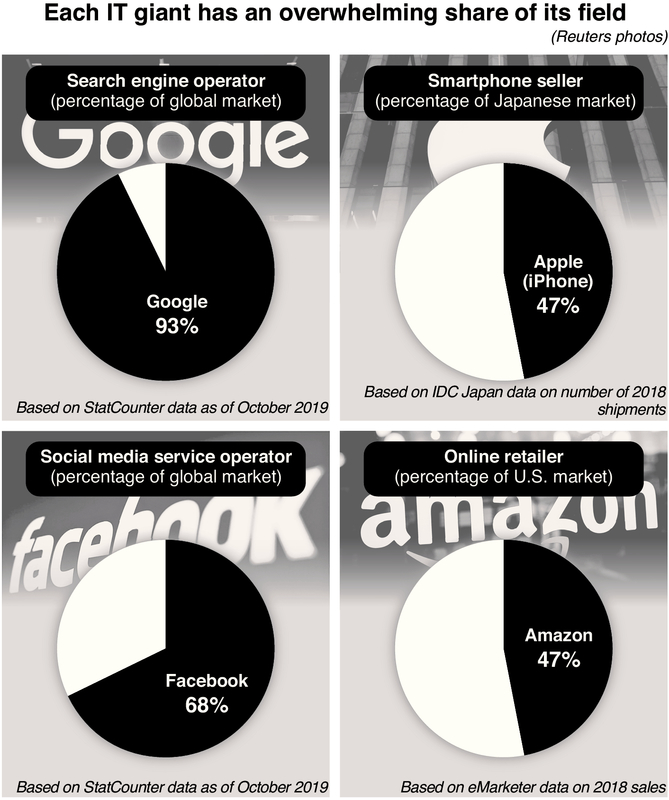
The big technology companies hold significant market share in their fields of expertise. Are they applying pressure on companies that trade with them to ensure the profitability of their own businesses, supported by the power of their oligopoly? Antitrust authorities in various countries have commenced full-scale investigations.
Japanese regulators powerless
Giant technology companies such as Google LLC, Apple Inc., Facebook Inc., and Amazon.com Inc., which are collectively known as GAFA, expand their opportunities for online shops and app businesses on a global-scale through their own platforms, holding a huge market share and a large number of users. They cannot be avoided when doing business online. One app developer described them as "godlike beings."
The Fair Trade Commission conducted a survey on the actual conditions of companies that do business with the GAFA firms. The survey, which was released in October, revealed that the companies are forced to unilaterally comply with the giants because of their oligopoly.
The FTC has warned the big tech companies that forcing sellers to accept returned goods or raising fees in a unilateral manner may represent an "abuse of their superior position," which is prohibited by the Antimonopoly Law.
Kobe University Prof. Fumio Sensui pointed out that GAFA may be treating Japanese competition authorities with contempt.
"The effectiveness of Japan's Antimonopoly Law is low in comparison with those of the European Union, and surcharges are also lower," he added. He argued that Japan needs a new law that serves as a "weapon" for authorities so that they can legally enforce demands for the disclosure of information from companies.
Demolition on the table
In the United States, the behavior of GAFA has become a point of concern for Congress.
"If Amazon stops us from listing on its online shop site, we will go bankrupt."
A man testified at a public hearing in November at the U.S. House of Representatives. He runs a toy sales company in Texas with four full-time employees, and he explained how he was dependent on Amazon's site.
He testified that the company relies on sales through Amazon for 98% of its revenue. And he indicated his distress about his dependent position, saying that if Amazon told them to "jump," they had to ask "how high?"
In the United States, investigations have started at each state level as well as in Congress and the Justice Department.
While the GAFA firms continue swelling, discussions about dismantling them has arisen in the United States.
Democratic Sen. Elizabeth Warren made an appeal at a rally in Iowa on Nov. 25, insisting that the big tech companies are causing problems for the U.S. economy. She said that Americans needed a president with the courage to break them up. Warren is a representative of the radical left in the party's candidacy struggles for the 2020 U.S. presidential election. Her statement was met with big cheers from the audience.
She has continued to criticize three GAFA companies -- Google, Facebook and Amazon -- saying that they have too much power. She said that they have used people's personal information to make profits while small-scale businesses were trampled underfoot.
She has received strong support from people who feel this disparity, such as the younger generation.
Meanwhile, it has become clear that the GAFA side is investing a lot of money in hiring lobbyists and engaging in political maneuvers.
The companies have taken steps to approach the U.S. administration.
For example, Facebook CEO Mark Zuckerberg had dinner with U.S. President Donald Trump at the White House in October, and Apple invited Trump to visit its computer factory in Texas on Nov. 20.
Bargaining between GAFA and regulatory agencies is also gaining intensity.
Read more from The Japan News at https://japannews.yomiuri.co.jp/