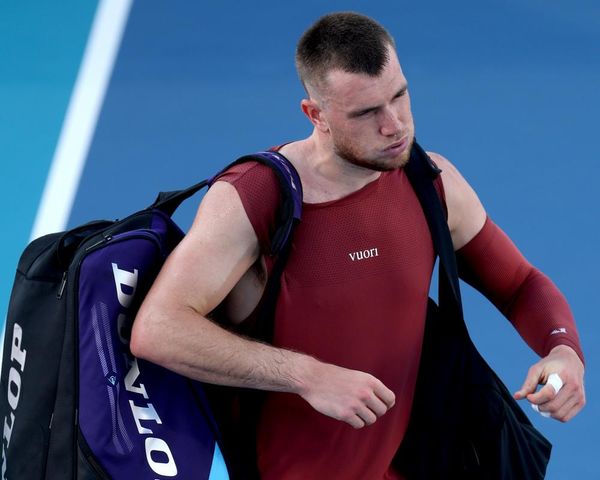
If Gaël Monfils were to retire during his semi-final against Novak Djokovic on Thursday – and his circus-like acrobatics always carry the threat of disaster – the impression would be strongly embedded that the Serb’s name is already on this trophy.
Djokovic has never had such a blessed run in a tournament: a minor hiccup in his first match of the fortnight before a withering finish blew away Jerzy Janowicz remains the only proper workout of his five matches. There was the second-round walkover against Jiri Vesely (who had beaten and bagelled him in Monte Carlo), the collapse-and-quit performance of Mikhail Youzhny, a quick three-setter against Kyle Edmund and, on Tuesday evening, another retirement, by Jo‑Wilfried Tsonga at the start of the third set with Djokovic having won the first two.
The US Open is invariably the most attritional of the majors, coming towards the end of a gruelling season, but this is some casualty list. And there was something unintentionally comical about Djokovic’s immediate reaction: “I can only wish all of my opponents a speedy recovery.” Christmas cards to follow. He added: “I never experienced something like this, to have three retirements on the road to the semi-finals.” Nor has the tournament.
It should be pointed out the world No1 would have won all three matches that either didn’t start or didn’t finish in the regular way. But their curtailment has provided Djokovic with the almost perfect preparation for the final push: minimum exertion over nine sets of tennis in four matches while getting a feel for the court and conditions, especially in his night appearances.
The final is scheduled to begin at 4pm local time on Sunday, so the heat of the day will probably be less intense and the ball will move to his liking on Arthur Ashe Court – especially so if the new roof is drawn across against the elements.
All of these factors have to be computed alongside the injury problems that Djokovic has had to cope with since his shock early exit from Wimbledon. He said at the start of this tournament that his problems were not physical but to do with matters away from the court and the speculation was left hanging.
There seems to be a lingering issue with either his left wrist or his right elbow (the physio’s room at most tournaments in the modern era should be fitted with revolving doors). The wrist injury arrived during the Olympics in Rio, he said, and Juan Martín del Potro took full advantage to put Djokovic out in the first round. The loser wept on court, clearly devastated after committing to the Olympics where others had been less enthusiastic.
He then withdrew from the Cincinnati Open and there appeared to be a problem with his right elbow. That injury has been under close scrutiny here and Djokovic reacted curiously when asked about it after his match against Edmund. He had called for the trainer to massage the elbow after the British player broke him in the third set, yet insisted later there was nothing wrong. Plainly there is.
He sounds content, though. “At this stage of the season, considering some physical issues I have had in the last month, month and a half, this was the scenario that I needed and I wished for. I got a lot of days off and recovered my body. Right now I’m feeling very close to the peak.”
And overall, Djokovic’s tennis is in good shape. He is doing what he does at nearly all slams: growing into his proper stature after a brief period of vulnerability. In normal circumstances, then, Djokovic would be considered a strong favourite to beat the brilliant if erratic Monfils – except the Frenchman is not playing to stereotype here. He is as crazily athletic as ever, but there is solidity in his game that often has been missing. His game-face is serious and determined, where once there was a playful, carefree mien.
Monfils has had a good season, perhaps his best in terms of performance. As Djokovic observed after Monfils destroyed his compatriot Lucas Pouille in three sets in the first quarter-final: “He seems more focused at this time of his career.”
But can he beat Djokovic? Logic says the gap of 12 places between them in the rankings is not there by accident. Nor is it wise to ignore the other 12 factor: the number of defeats Djokovic has inflicted on Monfils in their 12 encounters. That is total dominance.
Yet, as much as sport is all about the numbers, romance and unpredictability – qualities with which Monfils has always been associated – can come into play at any time. Djokovic will be alert to the danger of an upset and Monfils will be committed to it.
“I thought that I came out with the right intensity,” Djokovic said of his aborted match against Tsonga. “The quality of my game and level of performance has raised in the last couple of days, which obviously encourages me prior to the last four.
“I put myself in a position again to be one match away from the finals. As the tournament progresses, I feel like I’m getting better. This grand slam is unique for me.”
Monfils, who turned 30 last week, is keeping his charisma and his jokes in check for now. “I missed a good chance two years ago against Roger [Federer],” he said of making his first semi-final here. “But, you know, I just live now, and now I’m happy. I played great tennis so far.” And he wanted to put to bed the notion that he does not take his sport seriously, that his priority is to entertain.
“If I do a trick shot and still kill it, you will say I’m a showman. So, with all the respect to everyone, it is you guys who put me on the spot.” But he is still the prince of legerdemain – a word from old French that translates as “light of hand”. Nobody personifies it better.