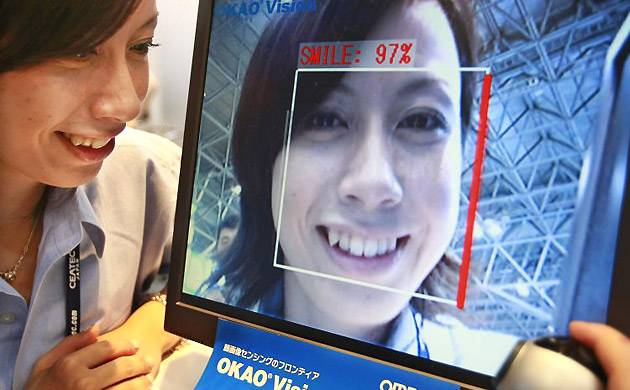
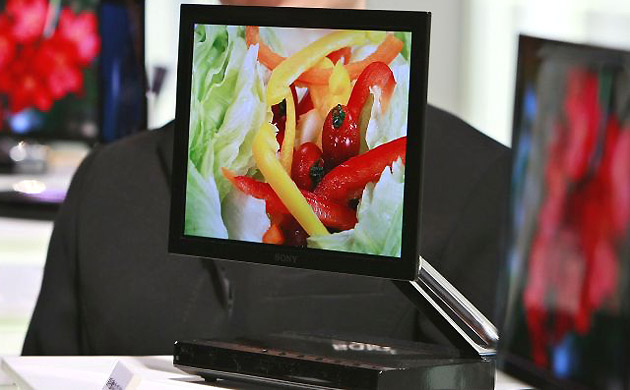
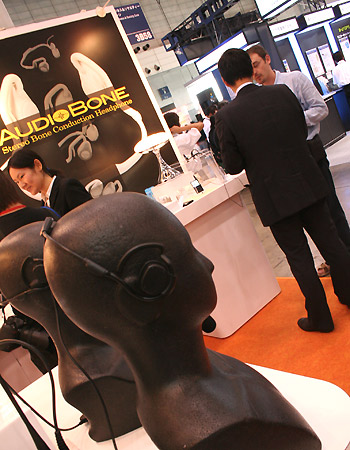
Ever wondered whether your smile is worth a million dollars, or just a few quid? Omron has the answer, with real-time face recognition software it says can evaluate the scale of a person’s grin, offering a real-time ’smile factor’ for each subject of between 0% and 100%. Omron hopes the software will appeal to businesses, for use in training staff to crack their faces when greeting customers.Photograph: Itsuo Inouye/APSony’s belated embrace of flat-screen technology was partly to blame for its recent troubles, so there was a certain irony in the identity of one of biggest attractions at Ceatec - its super-thin OLED (organic light emitting diode) TV. The picture is sharper and more colourful than on LCD (liquid crystal display) and plasma TVs, and with no need for back lighting to illuminate its 11-inch screen, the Sony TV is also thinner - a mere 3 mm.Photograph: Itsuo Inouye/APBeethoven is the inspiration behind the latest in bone conduction technology. The composer is said to have worked with a baton clenched between his teeth to sense sound vibrations. Now, the Japanese firm Goldendance has taken the principle to its technological zenith with the world’s first waterproof bone conduction headphones. The earphones rest on the bony area just in front of the ears, so there is no risk of damage to hearing associated with conventional headphones.Photograph: Justin McCurry/guardian.co.uk
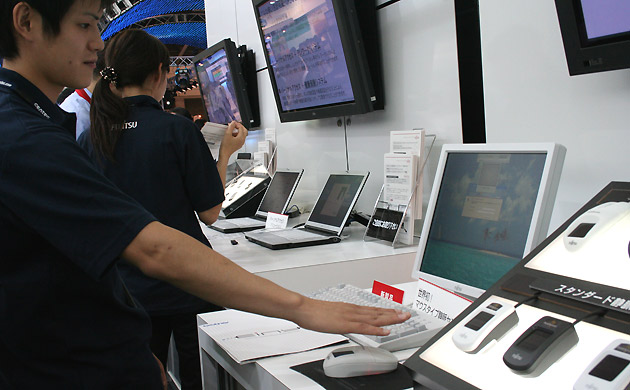
Fujitsu’s finest minds may just have succeeded in their search for watertight computer security - by focusing on the hand. But rather than scanning fingerprints to confirm a user’s ID, the firm’s new PC mouses goes even deeper. Embedded in the top of the mouse is an infrared sensor that can 'read' the veins in the user’s palm as it hovers above. Since no two sets of veins are the same, the technology is far safer than either iris or fingerprint recognition.Photograph: Justin McCurry/guardian.co.uk
Sign up to read this article
Read news from 100’s of titles, curated specifically for you.