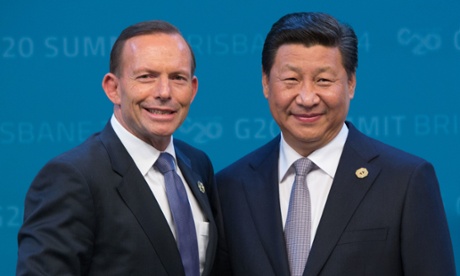
Zaijian
Zaijian blogans.
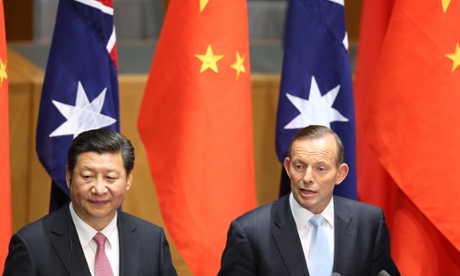
Well, that will do for this evening. Thank you very much for your fine company throughout the day. I’ll be back early tomorrow with Politics Live – another special sitting beckons on the morrow for Narendra Modi, the Indian prime minister. And that FTA will continue to bounce bounce bounce through the news cycle. Bounce. Yes, enough.
Today, Monday:
- Brisbane folded its tent and Canberra relocated back to Canberra after all that G20 business.
- Sydney broadcaster Alan Jones shouted at the prime minister for fifteen minutes for failing to meet the pub test and for producing an agreement that Alan didn’t like because it didn’t allow the prime minister to buy a coal mine in China. Whether the prime minister wanted to buy a coal mine in China was a question that Alan didn’t linger on. The fact that the agreement had not yet been produced at that point was also moved past rather quickly.
- The pomp and circumstance began in Canberra to mark the “historic” visit of Xi Jinping. Wildlife was inspected. A wombat was cuddled. The sun shone.
- President Xi made his way to parliament and spoke of China being the big guy in Asia, but the big non threatening peacenik guy in Asia, so long as everyone understood China was the actual Asia superpower and not some other country that wasn’t actually mentioned. (Hint: the other country wasn’t Australia.)
- The FTA, dubbed the virtual agreement by China’s Xinhua news agency, was duly produced. It was a virtual agreement in the strict sense (there was no text, and much of the controversial stuff was actually not in the text-that-wasn’t-a-text but perhaps merely an indicative form of words); but it did have a number of specific commitments that were welcomed by business happy to get whatever could be gained from Beijing.
- President Xi told us to look into the sun because then you don’t see shadows. (Do not try that at home, children.) He also told us that it was very hard to sharpen a sword but it was all good as long at the sword got sharpened in the end. This wisdom was imparted at a press conference that journalists were cordially not invited to attend.
That’s today, at least all the important bits.
Have a lovely evening. See you on the morrows.
Updated
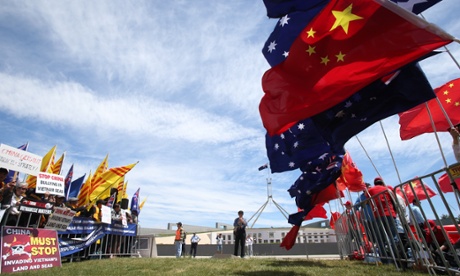
Before we wrap for tonight – just a bit more lovely Bowers from officialdom versus dissent down the front today.
Superb shot.
Just a couple of other points for context:
- China’s FTA with New Zealand imposed labour market testing for contractural service suppliers.
- The Abbott government removed labour market testing from the recent Korean FTA for contractural service suppliers. Labor supported the Korean FTA, but there was a fight about that in the caucus.
Just on that broad labour mobility point, a short statement just now from the immigration minister Scott Morrison.
The Investment Facilitation Arrangement will allow Chinese owned companies registered in Australia to negotiate project-based labour agreements for large infrastructure development projects.
Sponsors seeking to enter into a labour agreement under the Investment Facilitation Arrangement would need to demonstrate a labour market need, pay the Australian market salary rate and comply with all Australian laws, including those relating to employment and licensing.
Devil in (no) detail: watch this space folks
I’m interested in the FTA’s labour mobility provisions because Labor has already flagged that it may not support this trade pact if it allows Chinese workers to take jobs that would otherwise be done by Australians.
The wording in this not-yet-finished text is very non-specific about when labour market testing would apply. The words “labour market testing” do not actually appear in the reference to Chinese contractual service suppliers in this text. The omission may be deliberate, or it may not. It looks like one of those situations where the devil is in the detail which we don’t have yet.
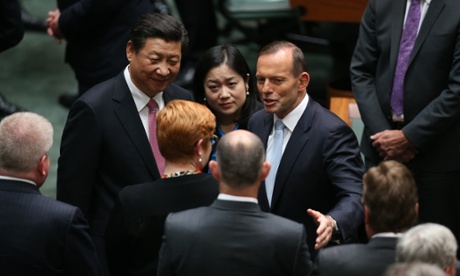
There’s also no specifics about the investor state dispute settlement mechanism – another potential flashpoint in the Labor caucus. Well it will be a flashpoint. It’s just hard to say whether it will be a deal breaking flashpoint or a noisy but not terribly consequential flashpoint.
It’s these two issues that are most problematic for Labor. One unsettles the traditional industrial left, the other the progressive inner city left.
Updated
Just while I digest the labour and people movement provisions – quick flashback. The look that Jacqui Lambie has on her face here ..
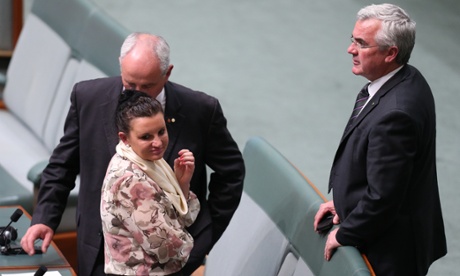
.. is intended for this chap. Her boss.
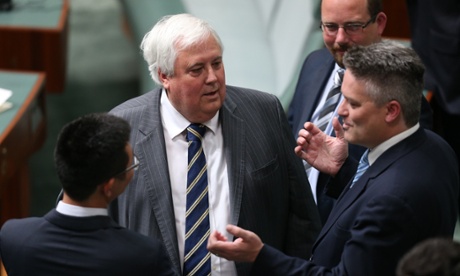
Back to the detail now. The Coalition says this new FTA provides significant breakthroughs in services: better market access for banks, insurers, law firms, education services providers, construction and manufacturing. This includes an agreement by China to allow Australian owned hospitals and aged care facilities to operate in China. I doubt this includes media companies. (Sorry, couldn’t resist.)
Investment I’ve already flagged, at least in part. The new agreement will give Chinese investors (private investors) the same rules as the US, Japan and Korea – so the screening threshold goes from $248m to just over $1bn. All state owned investment will be screened. There will be special caps for farmland and agri-businesses.
Ah yes, off they go.
No questions.
As far as I know this is one of those absolutely ideal press conferences where journalists are not permitted to ask any questions.
Mr Bowers tells me images are also pooled for this event – highly unusual. He can’t remember a comparable example in thirty years.
President Xi.
As the Chinese saying goes ..
(Yes, here it comes)
.. it takes 10 years to sharpen a sword so we are so glad to see that after nearly 10 years of negotiation our two sides have announced the conclusion to the bilateral FTA negotiation.
As a Chinese saying goes, even a thoroughbred cannot cover ten paces in a single stride but even a worn out horse can.
(That last one is in the staring at the sun category.)
Now ..
(You can’t always get what you wah-nt.)
Abbott:
Now, in life you don’t have one-way relationships, because one-way relationships are not sustainable – and in trade, which is an expression of two countries working together, you always have two-way relationships.
I should stress that negotiations are negotiations and you don’t always get everything that you want in a negotiation but, as I said, there will be the chance to review the agreement and review it within three years.
Bit rude about New Zealand.
Abbott:
This agreement is the first that China has concluded with a substantial economy, with a major economy; and it’s the most comprehensive agreement that China has concluded with anyone.
It opens the doors to Australia and it opens the doors to China. It’s a reflection on both our countries’ ability to be reliable partners and obviously what this agreement means is more jobs.
I’ll come back to detailing outcomes, but I need to digress briefly to cover the formal remarks on the proposed FTA from Tony Abbott and Xi Jinping.
History, the prime minister says. History.
Tony Abbott:
I think we’ve heard from the president of speech of historical significance so this is not just a historical day for Australia with the signing of our free trade agreement, it is a historical day for China with some of the statements that the president has chosen to make to the Australian parliament about the democratisation of China and the fundamentally ethical approach that China intends to take with its partners, with its neighbours in its region and in the wider world.
History.
To the gains.
Agriculture:
- Tariffs on dairy to go within four to eleven years.
- The beef tariff (between 12 and 25%) to go within nine years.
- Tariffs on live animal exports (10%) to go within four years.
- Removal of sheep meat tariffs (12 to 23%) over eight years.
- Wine tariffs gone in four years (14 to 20%).
- Horticulture tariffs “mostly” gone in four years (up to 30%).
- Barley tariff (3%) gone.
- Seafood tariffs gone in four years.
Resources and manufacturing:
- Tariffs on coking coal gone immediately on the agreement taking effect.
- Tariffs on thermal coal (currently 6%) gone in two years.
- A bunch of nuisance tariffs on copper and alloys, alumnium oxide, nickel, aluminium waste and other energy products – gone.
- Four year phase out on 10% tariffs on pharmaceuticals – including vitamins.
- Four year phase out on tariffs on manufactures, like car engines, plastics and centrifuges.
Free trade agreement – three key issues at a glance
The embargo on details of the China FTA has just been lifted.
I’ll walk this through step by step for the remainder of the afternoon, but in this first post I’ll cut very quickly to the chase.
This deal is a two stage process: there are concrete agreements now, and then there’s a mechanism to pursue the issues that could not be resolved now.
In the too hard basket:
- The screening thresholds for investment by Chinese state owned enterprises. As I flagged on the live blog earlier today, the Chinese wanted a better deal. Australia rebuffed that request for now. All investment by Chinese state owned enterprises will be screened by the Foreign Investment Review Board. So the current arrangements remain in place.
- Also left out of the FTA: wool, oil seeds, cotton, sugar and rice. No progress in this free trade agreement. It will be interesting to get play back from the Nationals and the farmers federation about that.
Not in the too hard basket, but likely to be a serious flash point:
- There is an investor state dispute clause. A safe prediction: this will be very controversial.
Decoding the Xi address
Just before we get into the virtual FTA – a couple of very quick thoughts on that Xi speech. It was a very interesting outing.
If we cut through all the proverbs and the people-to-people links (Lord the Chinese love that phrase), Xi wanted to send a few clear messages.
Here are the messages.
- We are the big guy in Asia. You need not be afraid of us, because our intentions are peaceful. We have known war, and we don’t want to visit that horror on others.
- But take note: we are the big guy in Asia. We are the Asia-Pacific power. We will assert our rise in the region, and we will do it on our own terms.
- It’s a message of course for America and for the world – and an interesting follow on from the climate agreement Xi struck with America last week, and president Obama’s contributions over the past few days.
- The grown ups, the great contemporary powers, are speaking in Australia, and over the heads of Australia.
This falls in the category of deep Bowers dreaming.
Interesting PUP/Labor/Greens/LNP seating arrangements in the House of Reps for Xi's speech. (Apologies to @mpbowers). pic.twitter.com/5HsfBFCic5
— Alice Workman (@workmanalice) November 17, 2014
But I like it.
Twitter is telling me that Xi’s look at the sun quote is from Helen Keller.
A well known Austrian. Sorry, that’s the Arnie joke.
Here’s the chamber, from Mike Bowers.
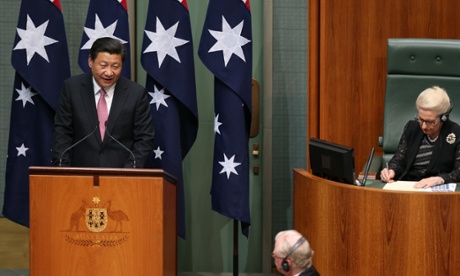
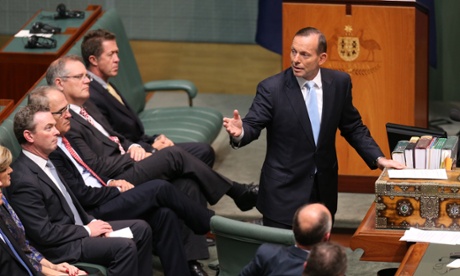
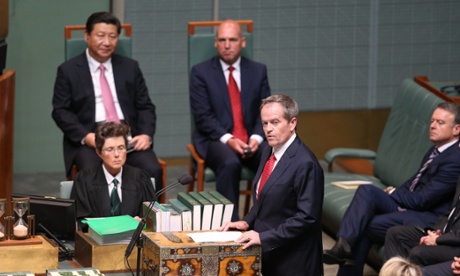
The parliamentarians like the rock and the wall.
Warmer applause marks the conclusion of the Xi address. I swear looking at the sun makes you go blind. I’m digging in behind that.
Now we are deep cross over dreaming.
We are the rock. China is the wall.
Xi:
As the Chinese saying goes, true friendship exists only when there is an a binding commitment to pursue common goals. I am confident that with our joint efforts, the friendship between Chinese and Australian people will span over mountains and oceans, such friendship will withstand rain and storm and be a strong and everlasting as the majestic Uluru rock in central Australia, and the Great Wall in northern China.
The Australians often say that those who lose dreaming are lost. As Chinese and Australian people strive to fulfil our respective dreams, let us join hands and work shoulder to shoulder to create a brighter future for China/Australia comprehensive strategic partnership. And enhance peace, stability, and prosperity in the Asia Pacific.
Xi says China supports Australia’s development in our north and China supports Australia’s interests in China’s development of its frontier west.
Xi:
We should also increase two-way investment and create a fairer and more enabling environment for it.
(I suspect that’s code for more beneficial investment rules covering Chinese state owned enterprises. Remember we expect investment by Chinese SOEs to be in the too hard basket when this FTA is unveiled later on.)
I have never heard of this saying.
Xi:
There is an Australian saying: keep your eyes on the sun and you will not see the shadows.
(I thought if you looked at the sun, you might go blind. I must have been poorly educated.)
Xi:
China and Australia differ in history, culture, social system and stage of development. So it is natural for us to have disagreements on some issues. What is important is that we should keep to the right direction of bilateral relations, talk to each other candidly, seek common ground despite our differences and meet each other halfway. We should respect each other’s core interests and major concerns and properly handle our differences.
This segment of the speech allows Xi to assert its presence in the Asia Pacific. China is an Asian power. China’s development allows China to spread the benefits of its progress to neighbours. It’s a virtuous cycle, the president says.
The Chinese government is ready to enhance dialogue and cooperation with relevant countries to jointly maintain freedom of navigation and safety of maritime rules, and ensure a maritime order of pies, tranquility and a win/win cooperation. At the same time, the Chinese people will firmly uphold the core interests of China’s sovereignty, security and territorial integrity.
He references territorial disputes. Xi contends China doesn’t want confrontation.
It is China’s long-standing position to address peacefully its disputes with countries determined on territorial sovereignty, through dialogue and consultation. China has settled land boundary issues with 12 out of its 14 neighbours through friendly consultation; and will continue to work in this direction. China sincerely hopes to work with other countries in the region to build a harmonious and a prosperous Asia Pacific.
Xi invokes an oceans metaphor to describe the goodwill between Beijing and Canberra. He then invokes his governing slogan which I referenced on the live blog this morning – the Chinese dream.
Xi:
We Chinese are striving to achieve the Chinese dream, which is the renewal of the Chinese nation.
Xi says the dream means Beijing will stay committed to socialism with Chinese features.
The Chinese president says some people (he means foreign observers) applaud China’s modernisation, some people are apprehensive about China, and others find fault with everything that China does. China is the big guy, Xi says – and invites a big guy response. People aren’t sure what the big guy will do.
Xi says he intends to provide some particulars.
First of all China is a peaceful country. China has been through many ordeals, Xi says, and doesn’t intend to inflict ordeals on others.
China needs peace. Neither turbulence nor war serves the needs of the Chinese people.
He says all war-like states eventually fall. He says China is on the alert against challenges to peace.
Xi says China’s rise presents opportunities to the world.
Given the flashpoints of the day – just a quick flashback – here were the PUPs arriving for the Xi address.
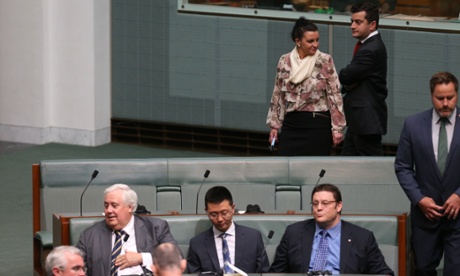
Cute shot, now back to Xi and people to people exchanges.
President Xi now rises for his address. He is delighted to be meeting on a sunny day in the southern hemisphere. Through parliament, he extends the good wishes of China to the people of Australia. He congratulates Australia on the success of the G20 summit.
Xi says his first visit was in 1988. The visits have left a great impression. Koalas, fluffy white sheep, the opera house – the expanse of the outback. But Xi says Australia is not all fluffy sheep and resources – it is a country of dynamism and innovation. It is a country that has made many contributions to human progress.
There was a proverb, but sadly, I’ve already forgotten it. The Labor leader, fortunately, is deploying his ordinary voice for this address.
Shorten in his welcome for Xi is traversing similar human history ground to Abbott, and also asserting Labor’s contribution to the FTA that will be announced this afternoon. He’s acknowledging China’s rise. Shorten also raises human rights directly but not specifically – he says trade liberalisation and economic propserity has meant progress in this regard. The Labor leader praises China on its ebola response, and he says Labor looks forward to building a clean energy future with China. A bit of none too subtle troling of Abbott.
Shorten:
You are most welcome here, you always will be.
Abbott rounds out his introduction to Xi by saying humanity has a long journey to make and only one planet to share.
Now it’s the Labor leader, Bill Shorten’s turn, with the proverbs.
Abbott is outlining previous trips to Australia by Xi – not as leader, this is his first, but the Australian prime minister notes he is well travelled in this country.
The prime minister also gives a shout out to Gough Whitlam for opening relations with the Peoples Republic. Abbott prods Labor MPs to acknowledge with hear hear. They oblige.
Now we are in to the history of the Chinese in Australia. The human history of Chinese migrants in this country is a human arch to our near north. (That’s a Menzies-ism.) Abbott speaks of trade and investment – two way trade is because we have to, investment is because we want to. It’s a trust thing. The current level of investment indicates trust and confidence between Canberra and Beijing.
President Xi Jinping addresses the Australian parliament
With Australian parliamentarians duly gathered, the special guest is making his way into the House of Representatives. The applause is warm, not rapturous.
The prime minister makes the introduction.
Tony Abbott:
It is a joy to have friends come from afar.
(I might be imagining it, but the prime minister has adopted a slightly sing song voice.)
Here are the division bells, the address from Xi Jinping is coming up very shortly.
Updated
Relax.
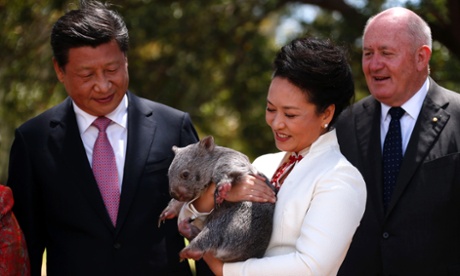
The wombat has landed.
Let’s take stock quickly before we enter the serious, business end of the afternoon.
- Right now, reporters are down in a background briefing about the declaration of intent, or as Xinhua would have it, the virtual free trade agreement. (I’m not, obviously. I’m here, talking to all of you. When I’m permitted to talk to you about the agreement that dare not speak its name, I will.)
- The chamber is gearing up for the special address very shortly by Xi Jinping. That’s in about fifteen minutes. Refresh your beverage of choice. I’m very interested to hear the pitch from the Chinese leader.
To the relief of most everyone, further questions have been placed on the notice paper.
Look at this glorious image. Some segue back to China day, Mr Bowers. Blessings.
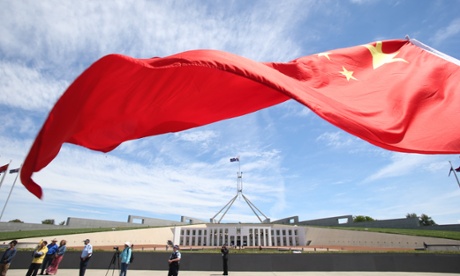
Palmer on Lambie: you’ve got to try to sort out problems, not throw them to the wolves
The defence minister David Johnston is telling the senate that the ADF pay offer in no way represents the value the government places on the defence forces. A tough line to sell, that, but he’s doing his darndest.
Meanwhile, regular Politics Live folks know my colleague Daniel Hurst generally leaves no stone unturned. He’s just back from collaring Clive Palmer in the corridor. Things, as we know, are tense in the PUP kennel – courtesy of that ADF pay issue and other tetchy micro party stuff.
Here’s Daniel:
Clive Palmer has signalled he is not about to ask Jacqui Lambie to quit the Palmer United Party. Asked if PUP had an irreconcilable difference with Lambie, Palmer told Guardian Australia:
She hasn’t resigned from the party … she’s indicated she doesn’t want to resign … I think when you’ve got people that work with you or anywhere having problems you’ve got to try to sort out their problems not throw them to the wolves … We’ll try to help anyone who needs assistance. I think she needs some assistance from us and we’re prepared to help.
Palmer said Lambie was “right” in raising concerns over the inadequate defence pay deal, but “of course there are a lot of other things important for Australia too” so a blanket vote against all legislation was the wrong approach.
We vote for things on their merits; Senator Lazarus does and so does Dio Wang.
Updated
The context for the great lady doing great things in Europe was a question from Labor about the Coalition cutting funds to NICTA – that research centre Merkel visted this morning.
Labor’s Kim Carr thought this eventuality somewhat unfortunate. Abetz thought the unfortunateness Carr’s fault.
A great lady doing great things, in Europe.
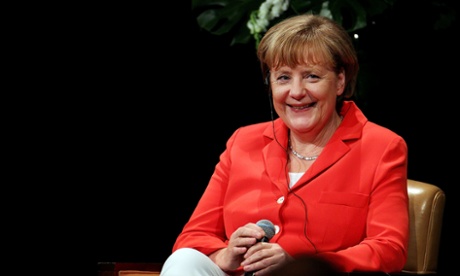
A great lady, who is doing great things, especially in Europe.
Eric Abetz, on German chancellor Angela Merkel.
(Here’s your hat, Angela, what’s your hurry?)
The once Democratic Labour Party senator John Madigan (now independent) – if I’m not mistaken – would like more tariffs, not less. Madigan wants to know what percentage of Chinese exports to Australia have zero tariffs. The question is to the finance minister, Mathias Cormann, who clearly has no idea. He says all will be revealed in good time.
Madigan:
It’s a pretty simple question. Surely to God the government knows that.
Cormann:
I’m only the minister representing the minister for trade.
I’d pay Cormann that – he is the minister representing, not the man with the brief.
But a bit more worrying that he can’t answer the next question, which is what percentage of investment in Australia comes from private Chinese companies as opposed to state owned enterprises.
Cormann doesn’t know that either. He’s taking it on notice.
Greens leader Christine Milne would like to know whether the Coalition still intends to abolish the Clean Energy Finance Corporation, given the CEFC was being held up as a clean green virtue by Tony Abbott during the G20-stravaganza. Is it facing the axe, or was the prime minister lying to world leaders?
Senate president Parry wants lying off the table. Milne takes lying off the table but stands by the question.
A bad fumble from Abetz. He initially tells the senate that the Coalition will not axe the CEFC. That’s news to everyone.
Abetz corrects.
Mr president, our policy remains.
Abetz gets a question on the US/China deal to curb emissions. Oh, that old thing, Abetz says. Australia is doing. Others are talking.
Will we make a contribution to the green climate fund? No, Abetz says. Well not now, anyway, is the rationale.
Eric Abetz thinks there’s another question today – not what’s in the deal, but will Labor remain slaves to their perverse protectionist philosophy?
Question time
It being 2pm, the senate is rolling over now to Question Time.
Labor wants detail on the FTA. The Coalition is not intending to humour that request.
Labor’s senate leader and trade spokeswoman, Penny Wong is wanting to poke the Nationals. Are the agricultural commodities wheat, sugar and cotton out – and if that’s right, when were the Nationals informed?
Government senate leader Eric Abetz:
Is everything we wanted in the agreement? No, it’s not.
He says trade pacts are about give and take.
Wong wants to know why the media can be backgrounded about the deal but the senate can’t be informed about the deal before it is inked. What’s up with that?
Abetz:
Will we release it beforehand? Of course not. There’s an established practice here.
It’s official.
We have virtual agreement.
#BREAKING: China, Australia announce virtual conclusion of FTA negotiations
— China Xinhua News (@XHNews) November 17, 2014
The Greens meanwhile are on a rare unity ticket with Alan Jones. This deal (which we haven’t yet seen) doesn’t pass the pub test – the assessment of Peter Whish Wilson, Greens trade spokesman.
Meanwhile, back at the pomp.
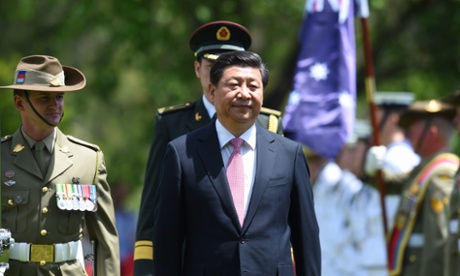
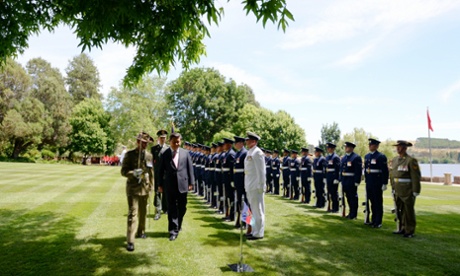
How many officials does it take to get a declaration of intent?
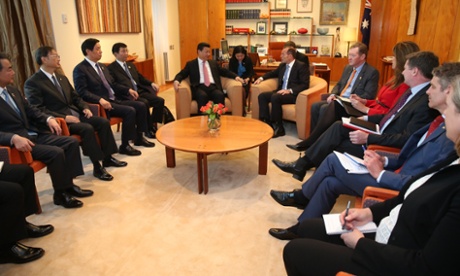
Given we will shortly know what we know regarding the China free trade deal – it’s pointless to speculate this late in the game. It will be odd, however, if this looming declaration of intent shifts many of the most contentious issues off for further work. There have been various speculative reports pointing to this eventuality over the past week or so, that this trade pact will be work in progress.
What, then, are we welcoming?
I have noted it but I’ll note it again, lest it get lost in the zinger wash.
Senator Lambie is emotional today. She’s obviously under considerable pressure.
Gold stamp to Shane Bazzi.
Signs, symbols and portents.
She’s not wearing her @PalmerUtdParty yellow scarf today RT @mpbowers Senator Lambie #senate @GuardianAus @murpharoo pic.twitter.com/gD21MEUmuL
— Shane Bazzi (@shanebazzi) November 17, 2014
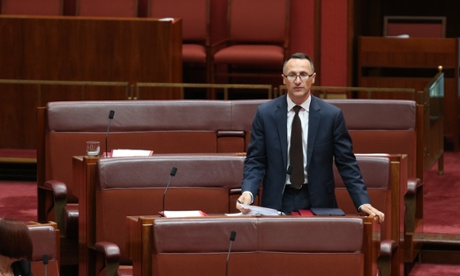
Lambie right now is engaged in a stand-off with Cory Bernardi. Bernardi is in the chair in the senate, presiding. Lambie is persisting in today’s tactic, which is give the same speech about ADF pay in every legislative debate.
Given the subject to hand is actually sports doping, Bernardi would like Lambie to address her remarks to the substance of the issue. Lambie ignores him, persisting in her moving monologue. Green Richard di Natale steps in to help Bernardi, because that’s how we are rolling, today. Sensing the growing absurdity of this sit com casting, Lambie gives way.
Updated
Politics, this lunchtime
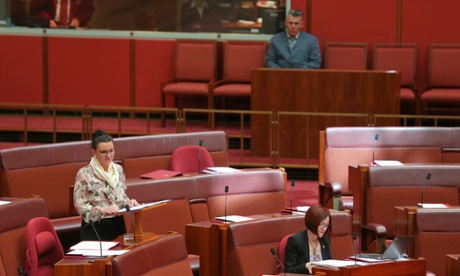
Here’s our crusader, Jacqui Lambie. In the back of Mike’s shot, you’ll see her chief of staff, Rob Messenger – the chap booted from the PUP by Clive Palmer last week. All rather unseemly – the PUP wars.
But let’s keep the blogue bus rolling by stopping to make sure that we are all fully on top of the morning in politics. Canberra, this Monday.
Thus far:
- The G20 read out was either shocker or salvation for Tony Abbott, or possibly both, depending on which version of events you consumed.
- After a challenging weekend, the prime minister sought a more orderly start to the morning by seeking a fireside chat with Alan Jones – or perhaps Alan sought to dial up an otherwise dull Monday by hyperventilating at the prime minister – in any case, regardless of who sought out whom, it was character forming fifteen minutes for Tony Abbott, who in no particular order, failed the pub test; could not buy a coal mine in China; had not spruiked coal and other suitably carbon intensive energy options enough; had not managed to hold off the awful French in Brisvegas; had not banned wind farms; had not king hit Barack Obama; had not produced a register of foreign investment in farmland.
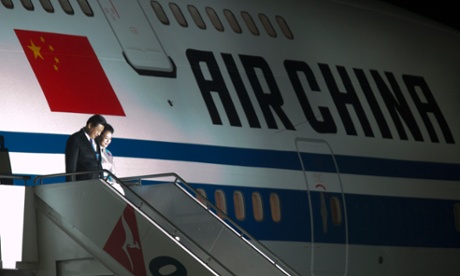
- Chinese president Xi Jinping arrived, with cheersquad, and pen, to sign a declaration of intent on a free trade agreement.
- In Sydney, the German chancellor Angela Merkel spoke about post war European diplomacy; about Russia’s departure from the norms of post war European diplomacy – and she urged American security forces to try another line when it came to understanding the political class in Berlin. Don’t tap the phone, take us to dinner.
- PUP renegade Jacqui Lambie did everything possible to be noticed. Breaking.
Updated
I should have mentioned this before but got caught in my various wave jumping(s) – NICTA (visited this morning by Chancellor Merkel) got its funding cut in the May budget.
Awks.
If you want to know what we think, don't tap our phone, take us to dinner: Merkel
Q: I’m going to ask a final question. You may remember candidate Barack Obama visiting Berlin in 2008 and one of the things he said then was “true partnership and true progress requires allies who will listen to each other.” It turns out in the case of Germany, the National Security Agency took his comment literally as you found out. How should western countries strike a balance between on the one hand collecting the intelligence that guarantees our security and on the other hand not engaging in overzealousness that damages important relationships with friends?
Merkel says different countries approach this issue differently.
However.
There’s one view I don’t share and this is a disagreement with the United States.
The political class in Berlin doesn’t need to be supervised and monitored by security services to know what they’re thinking. Go for dinner or lunch with them or read the papers and you know 99.9% of what they actually think.
No FTA text today – just a declaration of intent
One of those cross currents that are inevitable on a day like today.
-
FTA: an update
Tony Abbott has just issued a statement that indicates the FTA negotiations are now complete. But it seems clear that there won’t be a finalised text today. The Abbott statement says today, the two governments will sign a declaration of intent – a precursor to a legal text. So no settled text in other words. The same thing happened with Japan and Korea – the broad parameters, fine print to follow. (Shh, don’t tell Alan.)
- Back now to Merkel.
The questions have been firing away. Is the German chancellor concerned about the UK drifting away from Europe?
(Yes.)
Merkel:
I’m doing everything I can in order for the UK to remain a member of the European Union for very good German reasons. What the British decide to do is something they have to decide for themselves and they certainly will not listen to what others have to say on this, but it is most important for us to have the United Kingdom in the union.
How about the rise of China? Merkel says China is intent on entering a new and glorious period in history. How the rise of China squares with American strategic interests is the key to the thing.
Step-by-step they want to become an international, global player. The Chinese-American relationship also is of tremendous importance in this respect.
Updated
Merkel is moving now to questions at the Lowy Institute. Before the lecture this morning, the chancellor made a visit to NICTA – Australia’s Information and Communications Technology Research Centre of Excellence. Thanks to Annie O’Rourke for this picture.
@murpharoo Angela Merkel enjoying a tour of @NICTA earlier this morning pic.twitter.com/tRmUeqo6d4
— Annie O'Rourke (@89oEast) November 17, 2014
First question to the chancellor is how do we influence Vladimir Putin, given that the sanctions seem only to have driven up his popularity?
Q: What is the best combination of carrots and sticks to influence Mr Putin?
Merkel:
We need to have the necessary patience for an uphill battle.
We have to prove that we’ve learned something from the past. And since you cannot make any safe predictions as to the future, it’s not all that easy to find the right course of action. We know that you cannot and should not be too peaceful. You should take it seriously when somebody sort of threatens you, or keep a very close eye on the actions of others, and we know that even small conflicts may very well turn into bigger complications very quickly.
She says the EU needs to stand together and stand with the US.
The biggest danger is that we allow ourselves to be separate, to be divided, that a wedge will be driven between us. So it was in Europe and in the world, so it was so important for the US and Europe to pursue the same course, for a very long time.
Merkel moves from diplomacy to economic consolidation after the global financial crisis, and to geopolitical security. The German chancellor says Europe needs structural reform and Europe needs to go for growth. In terms of security, Europe has an interest in seeing the states of Asia rise peacefully and without any sort of sharp ruptures. Merkel lists the current challenges before the world: Ukraine, the Middle Eastern conflagration, ebola. She says economic integration imposes broader obligations – and like minded countries need to work together.
Merkel:
Globalisation is no longer merely an economic phenomenon. It has turned all of us into neighbours. More and more countries see themselves facing the same kind of challenges and for Europe and Germany, it’s most important to have a partner in Australia here in this Asia Pacific region that shares the same values that we have.
Climate change too. (Here’s looking at you, Tony.)
If we do not put a brake on climate change, it will have devastating consequences for all of us, there will be more storms, there will be more heat and catastrophes more doubts, there will be a rising sea levels an increasing floods. Climate change knows no borders. It will not stop before the Pacific Islands and the whole of the international community here has to shoulder a responsibility to bring about a sustainable development.
Our ambition is to come for – to – an agreement that is binding for all states. Only in this way can global warming be actually limited to 2 degrees celsius. So all countries are called upon to announce their national contributions for this world climate agreement until the first quarter of 2015 at the very latest. Only in this way will we be able to prepare the conference in Paris in an appropriate way and be able to achieve a substantial result there.
The German chancellor Angela Merkel has stepped up at the Lowy Institute in Sydney. The audience have their translation head sets on. Merkel’s address this morning is about European diplomacy – the structures imposed after two world wars to promote consensus. Shifting power struggles and alliances, she says, have been replaced by the rule of law. There are, sadly, exceptions. The chancellor is looking at you, Vladimir.
Merkel:
And yet we have to see that in Europe too there are still forces that refuse to accept the concept of mutual respect and of settling conflicts with democratic and legal means. Those that put the right of the stronger before the right of the strength of the law. And this is exactly what happened with the annexation of the Crimea, it is a clear violation of international law and that was carried out by Russia at the beginning of this year. Russia in this way violates territorial integrity and the sovereignty of Ukraine as a state, a neighbouring state is labelled and seen as part of a sphere of influence. After the horror of two world wars and the end of the Cold War, this caused the whole of the European peaceful order into question.
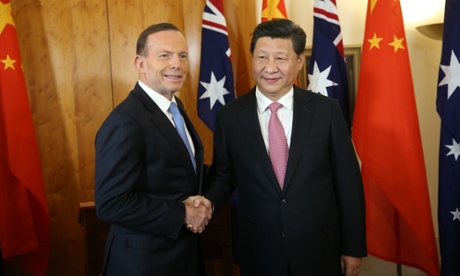
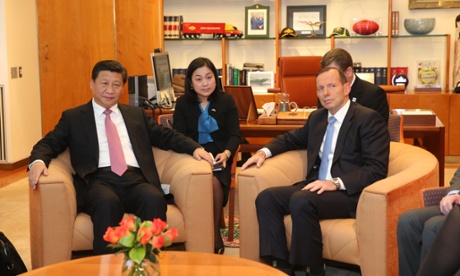
Mike Bowers has been down shooting pool pictures for the Xi visit. Here’s a sample.
Might be just me but I did a small recoil at the grip and grin. More like a grimace from the prime minister.
Well, hello there.
Some pictures now. Earlier I mentioned there were duelling protesters down the front waiting for president Xi.
Let’s call this officialdom versus dissent, a case study.
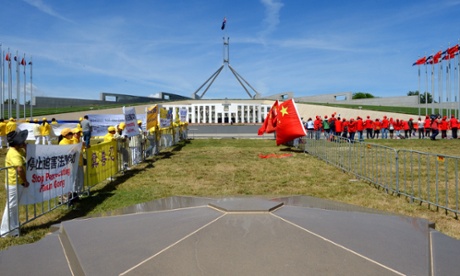
Meanwhile, over in the senate, the sometime/kinda/sorta PUP senator Jacqui Lambie is wedged deep in struggle street. She’s voting against everything until the diggers get a better pay rise. I think. The sharp end is a bit lost on the various evils inflicted on the populace by everyone apart from Lambie.
Ah, yes, that is the point. She’s calling for a cross bench revolution – don’t vote for anything until the Coalition revokes its disgusting pay offer. (Suck on that Cliev.)
Lambie is trembling with rage. She either has the flu or she’s about to burst into tears.
Aren’t we all, Intern.
I'm excited. #LowyLecture #Lowy pic.twitter.com/CL63cx5Svh
— ABC News Intern (@ABCnewsIntern) November 17, 2014
Meanwhile, in another venue, in another city, with considerably less contention.
Appropriately orderly and efficient queue for #AngelaMerkel @murpharoo She speaking in 45 mins pic.twitter.com/B1mluNBJy6
— Michael Safi (@safimichael) November 16, 2014
Looking past Alan's faux pub test to the practical sensitivities
To organising principles.
Whether you buy Alan’s pub test or not, the broadcaster’s encounter with the prime minister this morning does underscore the point there are political sensitivities around free trade deals in general, and this free trade deal in particular.
Jones spent time on Chinese investment in his interview today with Abbott. We of course don’t yet have the detail associated with this trade pact, but the non-official official word for some time has been that China will get the same deal as the United States, Korea and Japan. That means the investment threshold attracting scrutiny by the Foreign Investment Review Board (Firb) will be increased from $248m to $1bn. That’s for private investment. Folks who follow these debates closely will know that the bulk of in-bound investment from China is from state owned enterprises (SOEs), not from private firms. The early word from Camp Abbott had been that SOEs would get a better deal in this FTA, essentially because Beijing wanted a better deal. But more recent reports suggest that’s not the case. Currently all SOE investment is screened by Firb.
In no particular order, these are some of the political sensitivities related to an FTA with China:
-
Foreign investment regulations, particularly in farmland and agri-businesses (because the National party gets very antsy about this issue)
- People movement and temporary migration provisions (because the ALP and the union movement are very antsy about this issue)
- Copyright and predatory pricing (because business is very antsy about the propsect of China dumping goods in Australia below cost)
-
Investor-state dispute settlement (ISDS) provisions (because these are the new battlefront in the age old trade liberalisation versus sovereignty argument)
Updated
As Alan performances go, that one was only four stars. He did leave some headroom there. It is helpful though, as an organising principle. More of that shortly.
Live pictures coming through now of president Xi coming in to the prime minister’s office. The senate is also sitting, taking care of business. One of the social services bills is being debated.
Alan is refusing to desist from the fast breathing.
This is a dog, this China deal. A dawg.
Abbott:
Alan, look, many voters disagree with many things governments do.
Alan has achieved his objective and is now bored. He dismisses the prime minister who he’s sure is very busy and has things to do. Alan always has things to do, obviously. Let the record show, that so dismissed, the prime minister moved on.
Jones:
I’ve had this out with Andrew Robb, he thinks I’m a nutter.
The prime minister:
Well I’m not sure he does.
He can respectfully disagree without thinking people are nutters.
Jones points out that Abbott can’t buy a coal mine in China either. Another aspiration dashed.
Abbott points out to Alan that in a communist regime, ownership is actually complex business.
Alan doesn’t want reason cluttering up this conversation.
Jones:
PM you don’t have a mandate for this!
Actually, it was [sharp intake of breath] PM, YOU DON’T HAVE A MANDATE FOR THIS.
Back now to the pub test, because Alan hasn’t finished with that.
This FTA with China, that’s failed the pub test. They aren’t swallowing this in the pubs, Alan says.
Jones:
Q: To win an election, you have to pass the pub test. Now I can tell you the board here this morning is in meltdown on the open line. Why can’t we see this free trade agreement?
Abbott, (periodically):
Uh huh.
Jones:
Q: China is giving us nothing. The dairy farms are owned by China. By this time next week who is going to own little Tasmania?
Abbott:
Well, Alan ..
Jones:
Q: Can Tony Abbott buy a farm in China?
Abbott:
Err ..
Jones:
Q: The answer is no.
Alan never lets incoherence blunt his natural vehemence. Jones tells the prime minister global warming is a hoax and wind turbines are a fake.
Jones:
Q: Doesn’t economic growth start at home?
Abbott:
Well, it does Alan.
(After a suitable interval.)
Abbott:
I can’t work miracles Alan.
Jones wants to know why a wind turbine manufacturer from Qatar gets a subsidy and the working stiff doesn’t get a subsidy. He wants to know why there isn’t more coal worship. The prime minister points out he has been engaged in coal worship. Yes, but why isn’t that taking off, Alan wonders. The left and the Abbott haters, that’s why. And that meaningless climate agreement Barack Obama signed with President Xi. That’s why. The eternal why.
Alan Jones to Tony Abbott: you don't pass the pub test
Alan is evidently unhappy that we spent a whole lot of money on a summit in Brisbane that achieved nothing.
The prime minister is unhappy that he chose Jones for this morning’s fireside chat because this interview is not going to plan and we are only five minutes in.
Jones declares that Abbott – a person he’s known for thousands of years – does not pass the pub test.
Neither does anything that comes out of his mouth.
Jones:
People listening to you, because my real concern here is a lot of this does not pass the pub test. And I suppose as someone who has known you for thousands of years – you don’t pass the pub test on some of these things too.
Updated
I’ll come back to specific FTA issues, but first, back to Alan. I’ve only just hit the opening editorial set up from Jones, but it’s clear already this one’s a keeper. This will be full frontal populism.
Jones suggests that the G20 meeting in Brisbane is the only time in history where a coherent agenda has been presented. Only time in history, because let’s face it, the rest of the world is completely incompetent.
Jones:
France – no leadership at all.
Hopeless.
Gems to follow, very shortly.
One useful thing to wrap our mind around before things get brisk today is – who is our visitor? Where does he sit on the spectrum of Chinese leadership?
The Xi slogan in China has been “Chinese dream.” Analysts are still coming to terms with what that means in a practical sense, but much of the reporting about China’s leader suggests he’s a nationalist.
Here are some helpful readings.
-
From the New York Times: Xi as conservative, leftist, nationalist.
Mr. Xi’s hard line has disappointed Chinese liberals, some of whom once hailed his rise to power as an opportunity to push for political change after a long period of stagnation. Instead, Mr. Xi has signaled a shift to a more conservative, traditional leftist stance with his “rectification” campaign to ensure discipline and conspicuous attempts to defend the legacy of Mao Zedong.
-
From The Economist: on Xi’s “Chinese dream” – a creatively ambiguous marker of generational change
Flanked by six dour-looking, dark-clad colleagues from the Politburo’s standing committee, Mr Xi told a gaggle of press and museum workers that the “greatest Chinese dream” was the “great revival of the Chinese nation”. Nationalists see their own dreams validated. To them the tall and portly Mr Xi represents a new vigour in Chinese politics after Mr Hu’s studied greyness. His talk of China’s revival plays to their sense that China has a rightful place at the top of the global pecking-order.
There is much pomp planned of course for Xi Jinping’s visit to Canberra today.
For folks who like to plan, and have a low tolerance for pomp – the business end of today is this afternoon rather than this morning. The Chinese president’s address to parliament is mid afternoon, 3.35pm; as is the press conference with Tony Abbott, which is expected at 4.30pm. I’m glad of the slow burn – it means more time to set up the substance of the day properly – a rare luxury in this format.
Speaking of unhappy, as I mentioned to you earlier, Sydney broadcaster Alan Jones sounded distinctly unhappy about the China FTA in the tail end of the interview with the prime minister that I referenced first up on Politics Live this morning. Frequent listeners to Jones would not be shocked by that development.
I’ll chase up more of that when I can.
Down the front of parliament house right now the official Chinese welcoming party – those folks who turned up ‘spontaneously’ at the airport to welcome president Xi last night – are facing off against a bunch of Falun Gong folks.
The sanctioned welcomers have a talent for placing themselves in the live TV pictures.
Back to hosing out the venue after the G20.
Oh dear. Safe to conclude either:
1. The prime minister is unhappy that the US president Barack Obama brought climate change to Brisbane when he was meant to be fascinated by jobs and growth; or
2. The Australian’s Greg Sheridan is unhappy on the prime minister’s behalf.
It’s a strange way to treat a friend but it is all of a piece, sadly, with Obama’s presidential style, especially as the power ebbs from him in the dying days of his reign. The damage may not be long-lasting because the US president’s remarks bore little relation to anything he can deliver or will do. Instead, they reprise the most ineffably capricious and inconsequential moments in the Obama presidency: grand gestures, soaring visions, which never actually get implemented in the real world. Obama went out of his way to imply, in the most politically damaging fashion he could, that Australia’s efforts on climate change were negligible and compared poorly with America’s. In fact, Australia’s efforts on greenhouse gas reduction are almost identical with those of the US.
Poor old Barnaby can’t share a word, but here’s the FTA lowdown courtesy of the toplines various secret squirrels have shared with various scribes.
- The Australian tells us Tony Abbott has won a “dramatic increase in market access for Australian farmers, services and manufacturers in a trade deal worth at least $18 billion over a decade that maintains full scrutiny of investments by Chinese state-owned enterprises.”
- The Australian Financial Review tells us service providers “have won unprecedented access to Chinese markets under the Australia-China free trade agreement, which will liberate more than 90% of Australian exports from tariffs over the next four years.”
We’ll tease out various FTA issues here – policy issues, and political implications and consequences – throughout the day.
The agriculture minister Barnaby Joyce is on the ABC’s AM program, speaking about the looming free trade agreement that will be unveiled this afternoon.
Joyce informs his host Chris Uhlmann he has the FTA text in front of him, but he can’t possibly tell us what it says. Joyce invokes a folksy but not terribly conprehensible Christmas tree analogy. Then he tells the truth. He says if he spills the beans, it’s back to the backbench for Barnaby. Or perhaps he’ll be quarantined at the airport as an ebola risk. Happy days. There’s no B in team.
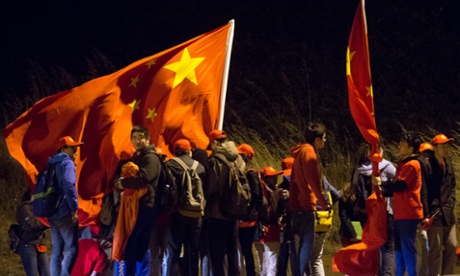
Good morning to Mr Bowers, who was at RAAF Fairbairn last night to welcome president Xi Jinping to the Australian capital.
With a few folks who just spontaneously turned up with very big flags.
Good morning and welcome to the Monday after the Friday, Saturday and Sunday before. In Brisbane they are packing up the party pies and the cameo koalas and the shirtfronts. Australian politics and the G20 folks who just don’t want to go home yet are currently making their way to Canberra because too much summiting is barely enough.
It’s one of those mornings where the events of the past few days are in the eye of the beholder.
If you glance at The Courier Mail, Tony Abbott wasn’t shirtfronted by the US president over climate change (which was the weekend consensus elsewhere) – Tony was actually the shirtfronter of the US president.
Bad Barack. Bad, bad Barack.
"@wrongdorey: @couriermail pic.twitter.com/BICmfxjPMd" Am I reading this right? Abbott didn't shirtfront Putin, but he did yell at Obama?
— George Megalogenis (@GMegalogenis) November 16, 2014
But if you read the LA Times, the prime minister’s performance at the G20 was more Clearasil than shirtfont.
Occasionally, there’s an awkward, pimply youth moment so embarrassing that it does sting. Like when 19 of the world’s most important leaders visit for a global summit and prime minister Tony Abbott opens their retreat Saturday with a whinge (Aussie for whine) about his doomed efforts to get his fellow Australians to pay $7 to see a doctor.
Moving forward.
The prime minister has stopped by 2GB this morning to wrap up the G20 weekend and point triumphantly forward (I’ve just caught the tail end of this conversation, so sadly I’ve missed the advertorial for digestion aids that normally sets up a prime ministerial interview) – Alan Jones seems in a terrible tizz about the free trade deal with China.
Alan’s voice has climbed several octaves.
Jones:
It’s going to be signed before we see it!
(Well, yes, Alan. That’s how things tends to go: secret until public. Fortunately the government has ‘helped’ by leaking much of the bits and pieces.) The prime minister sounds like you sound when you’ve clenched your jaw in order to prevent unseemly words escaping from your lips.
It’s combat everywhere, actually. The environment minister Greg Hunt is on ABC Radio National Breakfast dressing down host Fran Kelly for climate change related thought crimes. Very touchy.
Anyway, strap on your bike helmets. It’s going to be a lively day. We will wind, elegantly, out of Brisbane, and leap forward with Beijing. The lawn mowers are whirring downstairs in preparation for today’s visit to Canberra by president Xi Jinping. Various pomps and circumstances will be followed by signatures on a premable to a bilateral free trade pact. I’ll be covering all that live.
The Politics Live thread is open for your business. I’ll fire up the Twits in a moment, and you can reach me there @murpharoo and the man with the lens @mpbowers