Who’s in it?
Twenty major economies from around the world – not the 20 largest national economies, but rather a grouping of significant economies representing the developed and developing worlds, the major markets and producers. It’s sometimes criticised as over-representing Europe (France, Italy, Germany, the UK and the European Union) – which has five seats for a European economy broadly the same size as the United States (one seat) – while under-representing Africa (South Africa).
The members are: Argentina, Australia, Brazil, Canada, China, France, Germany, India, Indonesia, Italy, Japan, Mexico, Russia, Saudi Arabia, South Africa, South Korea, Turkey, the United Kingdom, the United States and the European Union.
It’s also convention for the host to invite half a dozen guest countries. Australia has asked along: Mauritania (as 2014 chair of the African Union), Burma (as 2014 chair of Association of Southeast Asian Nations), New Zealand and Senegal (as New Partnership for Africa’s Development representative). Spain is a permanent guest. The big initialisms – the WTO, IMF and UN – are invitees as well.
It’s more than G20 and a few plus-ones, it’s like the G20 posted its party details on Facebook and a whole lot of people showed up.
So it’s the G-plenty?
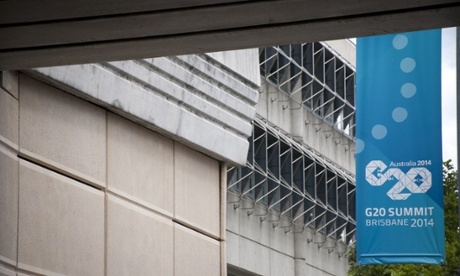
Very good. More than 30 state aircraft will land in Brisbane in just two days. There will be 4,000 delegates at the event and more than 3,000 media personnel have been accredited to cover their activities (almost one per delegate). Queensland police will roster on 4,500 officers over the weekend, supported by 1,500 colleagues from other states and New Zealand.
What does the G20 do?
The G20 is a finance body. Its primary concern is global economic reform, promoting growth, free trade and economic co-operation. And it is undeniably powerful. Collectively, the G20 economies account for two-thirds of the world’s people, 85% of its gross product and three-quarters of global trade.
How long has it been around?
The G20 first met in 1999 when it was a finance ministers’ meeting. Its initial focus was on international financial stability and addressing transnational economic issues beyond the power of any single country to deal with. The first leaders’ summit was in 2008, at the height of the global financial crisis.
Why is the summit important?
Because it’s a leaders’ meeting. The people in the room are the people who make the decisions. On the agenda at every G20 meeting are a couple of meetings that involve just the leaders of nations and key institutions – no advisers, no entourage. These meetings are often where the key decisions are taken, where the “heavy lifting” happens.
Who likes the G20?
Those who are in it. At the peak of the global financial crisis of 2008, the G20 emerged as the premier world economic body, one that was big enough to be representative of the major economies but also one whose membership was small enough for decisions to be taken.
Who doesn’t like the G20?
Those outside the tent looking in.
In 2010, Norwegian foreign minister Jonas Gahr Støre described the G20 as “one of the greatest setbacks since World War II”, arguing membership was “arbitrary” and that the group lacked legitimacy because it was “self-appointed”. “No one needs a new Congress of Vienna,” he said.
Strong stuff, but perhaps the most strident criticism has come from citizens of the world, who have launched occasionally violent protests against the global economic order the G20 is seen to represent, in Toronto, St Petersburg and Pittsburgh, in fact at most summits. Protests are very much a part of the G20 tableau now, and while demos are expected in Brisbane, it’s coming into a Queensland summer and it’s hot under those masks.
What has the G20 done well?
Handled a crisis. The G20 was a fairly nondescript finance minister’s meeting for a decade until the GFC. Then, the G7, realising it lacked credibility and authority, elevated the importance of the G20 so that it could calm crashing markets. The G20 coordinated fiscal stimulus efforts around the world, it redrew the regulatory framework around global finance and began the reform of international institutions. Handy in a global meltdown, that’s the G20.
Where has it failed?
When there’s not a crisis, the G20 has descended, perhaps predictably, into partisan, parochial bickering. Even when leaders have agreed to significant reforms, they have struggled to convert those promises into action in their own countries. Beyond the pomp and promise of the summits themselves, there are always domestic battles to win back home. The G20 is a political animal.
What will come out of the Brisbane summit?
Every country that acts as president wants a signature reform to come from its meeting, proof that it’s a capable steward and a major international player. Australia is no different. International taxation issues – in particular the practice of profit-shifting (companies channelling profits through low-tax havens to avoid paying tax) have worked their way to the top of the meeting agenda, but many countries are pushing for a strong statement on climate change. (Australia is not one of these.)
.png?w=600)