When was your first gig?
It was back in May 2004 at a place called Corks wine bar in Bond Street. I was at drama school at the time, and on the verge of being let go. I didn’t think I could do standup, I thought I would be a comic actor instead.
[Doing standup] didn’t click at first. The stress I went through on stage, it was so bad I thought no man should go through that. I didn’t like how you were so up and down, and how self-conscious I felt. I only did a second gig when I was let go from drama school and I was running out of options in my life.
When did comedy click for you?
Not until 2012 – all the time I was on the “black and urban” scene, it was fine, I was going through the motions and I was doing well, but I wasn’t being challenged as a comic or as a person. My material was very Nigerian and very niche – even Caribbeans who came to the show wouldn’t get it as it wasn’t about their experience. I wanted to get out to a wider audience, but I did one gig at Up the Creek in 2010 and didn’t enjoy it, and I didn’t go back until 2012.
Funnily enough what changed was my mum saying to me, stop looking at the audience as black or white, look for some common ground. At that time the Olympics was coming up and that was perfect for talking to any audience, and getting myself into the mainstream circuit. So when I went back to Up the Creek in 2012, that was when I realised what it meant to really work out material and do a proper set. Everything changed from that point really.
What happened at drama school?
I was at the Poor School in King’s Cross. I think I just wasn’t prepared for it at the time. I was working hard at Harrods in the morning then I’d go to Poor School in the evening, it was really demanding. The first term was great but I lost momentum and I ended up being let go.
What did you do at Harrods?
I was one of the porters, it was just a summer job, pulling palettes. It wasn’t very nice. Once you get over the fact you’re at Harrods, it’s just another job. The dynamics there are really funny – it seemed to me that all of the minorities and working-class people worked in the basement: the cleaners, the porters. It’s really representative of the class system. I felt like I was too educated for the basement and I was capable of more. But at the same time, I felt like they were my people and we were gonna grind it out together.
Who are your comedy heroes?
I honestly believe anyone goes on stage and makes people laugh is a hero, but having said that, Bill Hicks, Richard Pryor and Chris Rock – they are the ones who just understand how to be a comic. Chris Rock provokes thought as well as making you laugh, he challenge beliefs you might have.
Is that something you want to do with your comedy?
Definitely. I want to talk about things that are important to me, like the election, how London has changed. I talk about race a lot, but not really about black people being oppressed, I don’t want to come from that angle. I try to come from an objective point of view, we’re all ignorant about stuff so I don’t want to judge people – I used to have a joke about getting upset when people said my name wrong, but then I’d see eastern European names and realised I didn’t have a clue either.
What’s the story of your Edinburgh show?
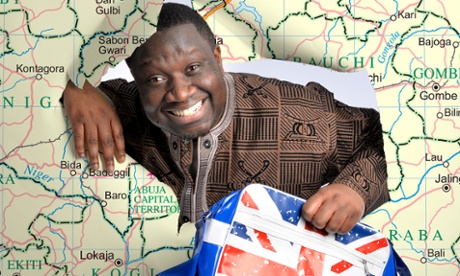
It’s the story of when I went back to Nigeria. I was 10 years old and I went out there with my mum and my three brothers and my sister, and my dad came out to join us a year later. I was there for six years in all. My parents wanted me to get some Nigerian culture and not just be a British kid. The title is a reference to the fact that I don’t feel like I have a sense of belonging in either nation. I was born and raised in Hackney but when I’m in London I’m seen as Nigerian, and when I was in Lagos I was always the “English kid”. So it’s about me trying to find myself in two different worlds.
Do you have friends who are second-generation immigrants who feel the same?
Absolutely. None of my friends claim to be Nigerian – they like the culture and the movies and the food but you won’t have the same mindset. But they also don’t see themselves as British, or what the media portrays as being British, so we’re always in that bit inbetween.
It’s sad because that’s why we have things like the riots. People went to the police wanting some answers but felt like they were being fobbed off and they weren’t being listened to. There’s a feeling that people in authority don’t care about them – even though they were born and raised in this country they feel they’re ignored and don’t belong here. So they don’t give a shit and that’s why it all kicked off.
You’ve spoken about how the Olympics was a sort of holiday from all that.
For that moment we all saw ourselves as British, we were so excited to have an event like that in this country. It showed us how it could be, because even though people think we live in a multicultural society, there’s actually a massive divide.
Everyone was moaning [about the Olympics] at first, about how it would disrupt their train journey, but it was the best thing I’ve ever witnessed in this country. I couldn’t believe how proud I felt to live here, I was telling foreigners – this is how we do it, welcome to my country.
How do you describe Lagos to someone who’s never been there?
Well when I was growing up, Africa was not portrayed to be very glorious on TV, so I was like, OK we’re going there?
Then I got there and it was a totally different story. I was young so adapted and accepted the things I was witnessing. There is real hardship and poverty but also a heavy western influence.
How did you adapt?
I forced myself to be Nigerian! I didn’t want to stand out as the British kid. The first thing I said when I walked into class was “hello”, and the whole class stopped. They were fascinated by how I sounded, so I started to put on a Nigerian accent.
Hip hop was on the rise then too and people were copying so I started wearing Timberlands and lumberjacks – which was ridiculous as Lagos is so hot. We thought we were cool even though we looked like builders.
Do you still have friends and family there?
Yes I went there last year for my sister’s wedding and I’ve still got friends there. I actually performed a show over there in 2007. The funny thing was I came on as “the British guy”, but they didn’t want that, they wanted their son back, so when I said, “hey guys how are you doing?” they were just silent – I switched to pidgin English straight away.
• Funmbi Omotayo: Legal Immigrant is at the Gilded Balloon, Edinburgh, 6-30 August