Imagine you had to remortgage a house you had been living in for the last 20 years and decided to go for a GREAT SAVINGS MORTGAGE DEAL. On the day you were due to sign the papers, you found out that actually this GREAT SAVINGS MORTGAGE DEAL meant that you could only live in the house six months a year, but you would still have to pay the mortgage – except for the months when you weren't in residence, when you would receive a paltry discount of £100 a month.
Would you sign? Probably not, because you are not an idiot.
Cutting the number of operational days at a big facility is like a stupid mortgage scheme where you save a titchy amount of money in order to feel like you are saving. It is actually irresponsible to take an essential 20-year investment, which is highly productive, and decide to damage it just because you can't be bothered to think about the long term for a relative savings of a few percent.
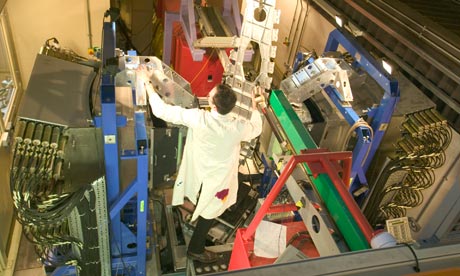
This scenario is currently what threatens the ISIS Facility (Science and Technology Facilities Council, UK) in Oxfordshire. ISIS is the UK's neutron facility. It is a flagship of UK scientific research and it is widely regarded by the international community as one of the best neutron facilities in the world. As the name suggests, ISIS produces neutrons (it isn't a nuclear reactor) and muons for scientific research.
Neutron and muon experiments are used for all sorts of things. Neutrons are used to test stress and strain in airplane wings. Neutrons are used to understand materials that make iPhones work. Neutrons are used to understand biological molecules and drugs. Neutrons are used to understand new battery materials, which makes your smartphone last longer. Neutrons are used to determine the authenticity of ancient relics. The list goes on and on.
ISIS is currently under threat of having to slash its operational days by two thirds for a savings of a few million pounds. ISIS is already running under full capacity, doing its part for austerity, but to cut more days would cut enormous hunks out of important research. Running at full capacity, ISIS can run the equivalent of 1,000+ experiments in a year – supporting 2,000-3,000 scientists – 40% of whom are students. Cutting these days by two-thirds means a mere 300 or so experiments per year under the best-case scenario and in reality probably even less than this. It is a bit like pruning a rose bush; you can only cut it back so far before you kill it. Scientists funded by industry, by UK research councils and a whole host of foreign scientists use ISIS. If you cut their time, you kill their science. In many cases there is nowhere else to go.
If fewer days just meant everyone had to cut experiments short by a day, it might actually be reasonable, but this isn't really how science works. Experiments are babies, not loaves of bread; cutting experiments in half is fatal for huge swathes of essential, good science.
Importantly, this could have even more enormous impact on early career researchers and students and industry. If you are on a three-year studentship where running experiments at ISIS is fundamental to the success of your project, and then there is no time to do experiments because the government has cut your funding, where do you go from there?
Our government wants to encourage industrial links with scientific research. How is it going to look when researchers have to tell BIG-INDUSTRY-LOOKING-TO-INVEST-BILLIONS-IN-THE UK, "Sorry, we can't do the experiments because the government won't pay enough to keep the facility running; you'll have to take your money somewhere else."
It is a small price to pay to fund ISIS to full capacity; a mere £3m a year. A few more pounds for substantially more research. ISIS is important to so many disciplines – and to industry – so rather than cutting its allocated time being some kind of great saving, it is really smarter to keep it running at close to full capacity. It is, in fact, a cost-effective way for a government who wants to "do more with less".
Sylvia McLain runs a biophysics research group at Oxford. You can follow her on Twitter @girlinterruptin