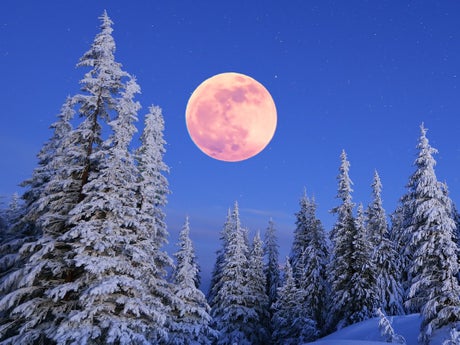
The second full moon of 2021 rose over clear UK skies on Friday, offering a great opportunity for sky-gazers to witness the final full moon of the winter.
February’s full moon is traditionally known as the Snow Moon in the northern hemisphere and typically symbolises the beginning of spring.
The moon will reach its peak at 8.17am GMT on Saturday but will appear full in the sky on both Friday and Saturday night.
Clear skies over the UK on Friday will provide ideal conditions for viewing the celestial spectacle, though areas of Scotland and Northern Ireland will turn cloudy going into Saturday morning.
The Met Office’s forecast for Saturday is slightly less favourable but will still offer a great opportunity for people in southerly areas to see the full moon.
The Saturday forecast states: “Band of cloud and odd spot of rain sinking into parts of northern England. Southern areas, along with eastern Scotland seeing decent amounts of [clear skies].”
Viewing tips to see the night’s sky at its best include steering clear of areas with light pollution and spending at least 45 minutes away from artificial light sources to allow eyes to adjust to the darkness.
The full moon also appears larger when it is close to the horizon due to a mysterious optical effect known as the moon illusion.
Nasa explained this phenomenon in a recent blog post, stating: “In general, the proposed explanations have to do with a couple of key elements of how we visually perceive the world: how our brains perceive the size of objects that are nearer or farther away, and how far away we expect objects to be when they’re close to the horizon.
“There’s also some thinking that objects in the foreground of your lunar view play a role. But this isn’t a perfect explanation, either. Nasa astronauts in orbit also see the moon illusion, and they have no foreground objects to act as distance clues. So, there’s likely more going on.”
Several apps are available that allow users to track the position of the moon, as well as star constellations.