FUKUSHIMA -- The agricultural club of the J.League third-division team Fukushima United FC has seen its efforts, in which players grow fruits and vegetables to sell, bearing fruit.
Last year, the agricultural club saw its farm produce sales reach about 7 million yen, which accounts for more than 50% of its ticket revenue. The third division of J.League, Japan's top soccer league, opened the season on Saturday, but the games will be held without spectators for a while amid the novel coronavirus outbreak. However, hopes are high for the agricultural club to support the team as revenue from ticket sales is expected to fall.
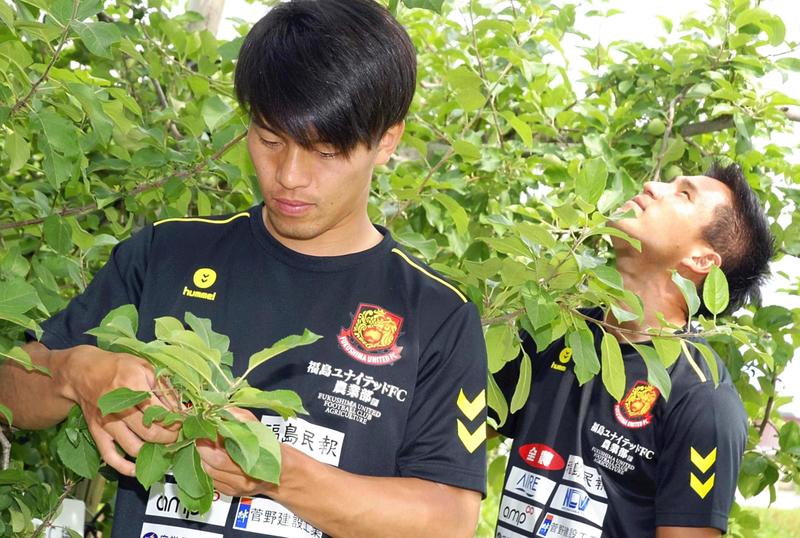
Four players wearing jerseys bearing the name "Agricultural Club," were working to pick green apples at an orchard in Ishikawa, Fukushima Prefecture, on June 18.
"I wonder which one will be bigger?" one player asked, while another said, "It seems like a waste that we have to drop some [apples to allow the others to grow]."
Hiroki Higuchi, a 28-year-old forward in his fifth year with the team, serves as the head of the agricultural club and closely supervises the other club members. Similar to when they are playing soccer, they are not allowed to cut corners when farming.
The team joined the J.League third division in 2014. Compared to teams in large cities, Fukushima United had a disadvantage when it came to attracting spectators and securing sponsors. It was urgent that the team find other sources of income. At that time, food products from Fukushima Prefecture were also plagued by harmful rumors even three years after the accident at Tokyo Electric Power Company Holdings, Inc.'s Fukushima No. 1 nuclear power plant.
What is something that can be done consistently? The team came up with the idea of doing some "serious farming." The team's General Manager Kai Takehana, 43, said he thought such an initiative could help dispel the harmful rumors. About 50 people, including the team's players and staff, joined the agricultural club. The team purchased a portion of some orchards and rice paddies from local farmers and learned from them about various farming operations, from harvesting to shipping.
The club started out by planting two apple trees, but now grow six types of plants, including rice, grapes and asparagus. Some members even know how to operate rice planters. Players will train in the morning and go to the farms in the afternoon. They spend their days juggling games, working out and farming.
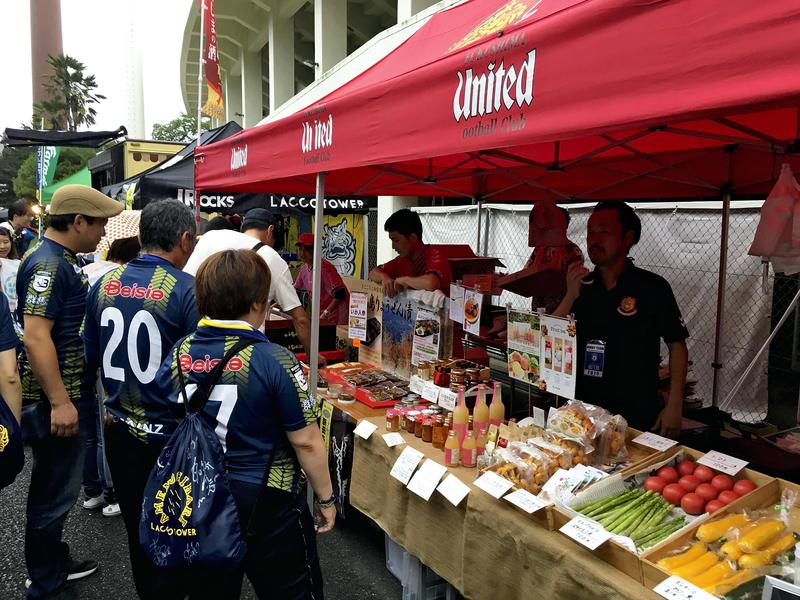
During their away games, the rice and fruits that the team harvests are sold at the opposing teams' venues along with vegetables and other goods grown by farmers in Fukushima Prefecture. The team has also begun selling their products at the venues during the J.League first and second division games to have more people taste the food from the prefecture. Sales from the farm products only make up a small percentage of the team's revenue as a whole, including sponsorships, but the agricultural club saw its annual sales, which were initially only a few hundred thousand yen, top 7 million yen last year. The figure was higher than the team's fan club business, which earned 6 million yen.
This month, the team set up the agricultural club's online store, which has already sold about 1 million yen worth of goods.
"Since fans of other teams are also buying the products, we gain revenue [for the team] but also support the farming industry of Fukushima Prefecture at the same time," Takehana said. "The coronavirus has severely impacted [the team], but we want to overcome it by further expanding the agricultural club."
Read more from The Japan News at https://japannews.yomiuri.co.jp/