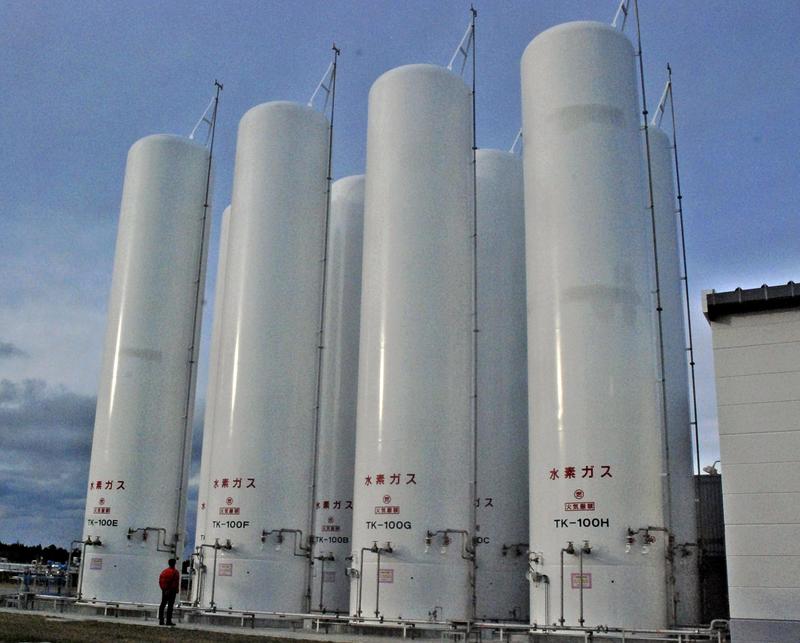
NAMIE, Fukushima -- Aiming to reach effectively zero CO2 emissions by 2050, the town of Namie in Fukushima Prefecture is putting its efforts into using hydrogen.
In this town that was once completely evacuated due to the nuclear accident at Tokyo Electric Power Co.'s Fukushima No. 1 nuclear plant, a hydrogen production facility called Fukushima Hydrogen Energy Research Field started operating in March. To supply hydrogen for power generation to the whole town in the future, a new pipeline began to be trialed in September. The trial will continue until February next year to verify efficiency and safety.
According to the New Energy and Industrial Technology Development Organization, which is involved in the construction, the research field in the Tanashio area of the town is one of the world's largest hydrogen production facilities.
The solar panels installed at this facility produce hydrogen by electrolyzing water without emitting CO2.
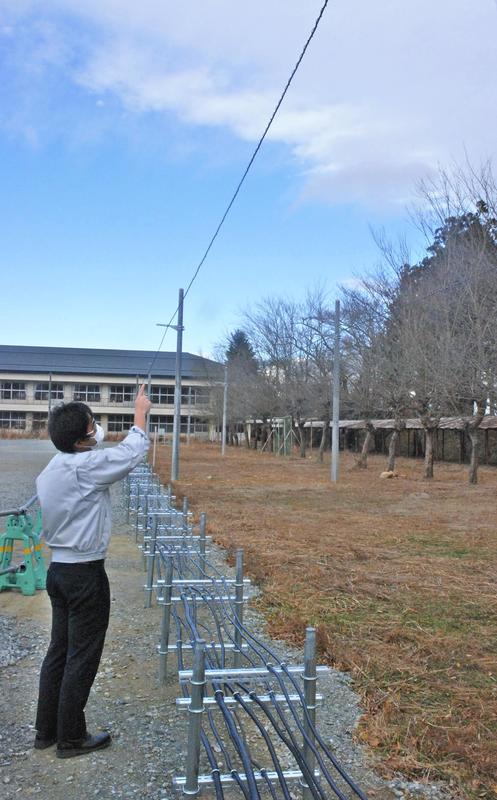
In the playground of Namie junior high school, which is set to close due to the evacuation of residents, a 360-meter-long pipeline supplying hydrogen is seen. The pipe is a stainless steel tube 8 millimeters in diameter and runs between poles 4.7 meters above the ground. The pipeline is being trialed in collaboration with Nagoya-based Brother Industries Ltd., Yokohama National University and others.
One of the problems of promoting hydrogen energy is how to transport it. Gaseous hydrogen at room temperature is generally compressed or liquefied for transportation by tanker truck, but this is costly. Underground pipelines require a lot of work, although in this case the hydrogen does not need to be compressed or liquefied. However, the risk of leakage is understood to be high, and an odor must be added to detect leaks.
On the other hand, by using poles, even if the hydrogen leaks, it diffuses into the air. It is lighter than air and disperses easily, so the negative impact is said to be rather small. The installation cost of transporting hydrogen this way is also one-tenth that of the underground method.
Evacuation orders were lifted in some areas of the town in March 2017. However, the pre-disaster population of about 21,500 has drastically decreased, and only about 1,500 people currently live there. The town hopes to use hydrogen as a catalyst for new and former residents to move back as well as to attract companies. At the Michi-no-Eki Namie roadside station that opened in August, power for air conditioning is supplied by hydrogen from the facility. The town also decided to adopt hydrogen fuel cell vehicles for official use.
"This will serve as a model for technological development in the hydrogen field and contribute to the reconstruction of the town," a town official said.
Hydrogen from Namie is also set to be used as fuel for the torch at next year's Tokyo Olympics and Paralympics.
Read more from The Japan News at https://japannews.yomiuri.co.jp/