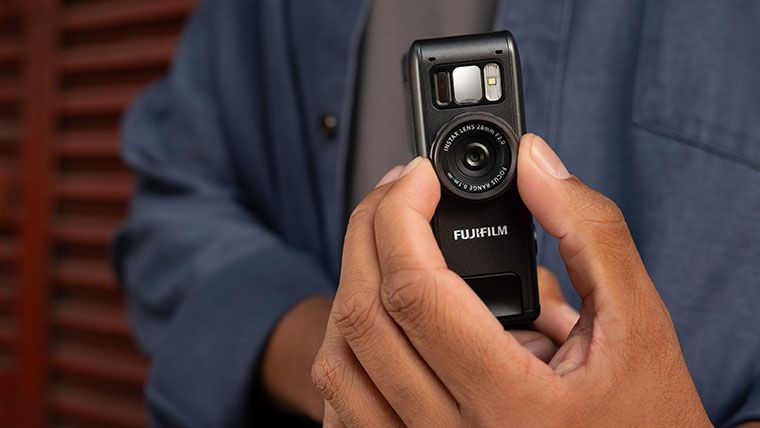
After launching the unusual X Half last year, Fujifilm said it would continue to introduce more “concept cameras.” Not even a full ten days into 2026, and the brand is already making good on that promise with what looks like the strangest Fujifilm camera yet: a digital-instant cinema camera hybrid that “time-travels” with effects modeled after different decades.
The Fujifilm Instax Evo Cinema has, so far, only been launched in Japan, with no word yet on if the first Instax camera with video capabilities will be available in other regions. But while the availability of the Evo Cinema is unknown, its strangeness is not – and Fujifilm Japan recently shared a spec sheet that suggests that, like the original Instax Mini Evo, the new camera isn’t about megapixels.
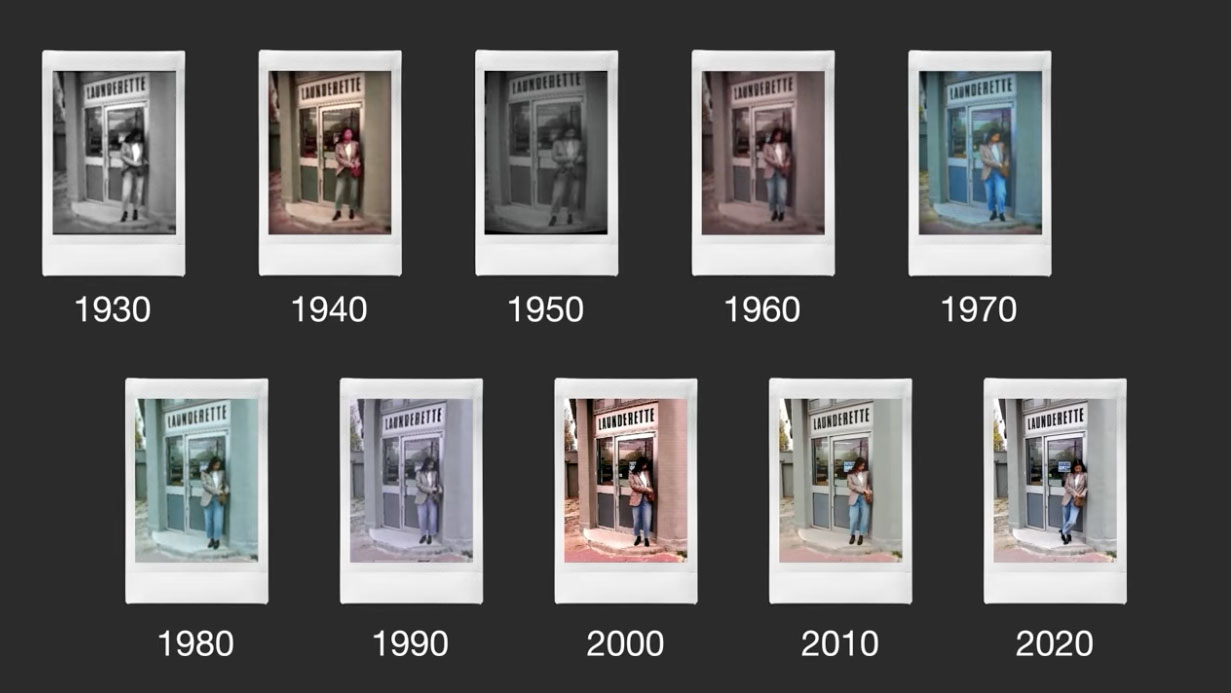
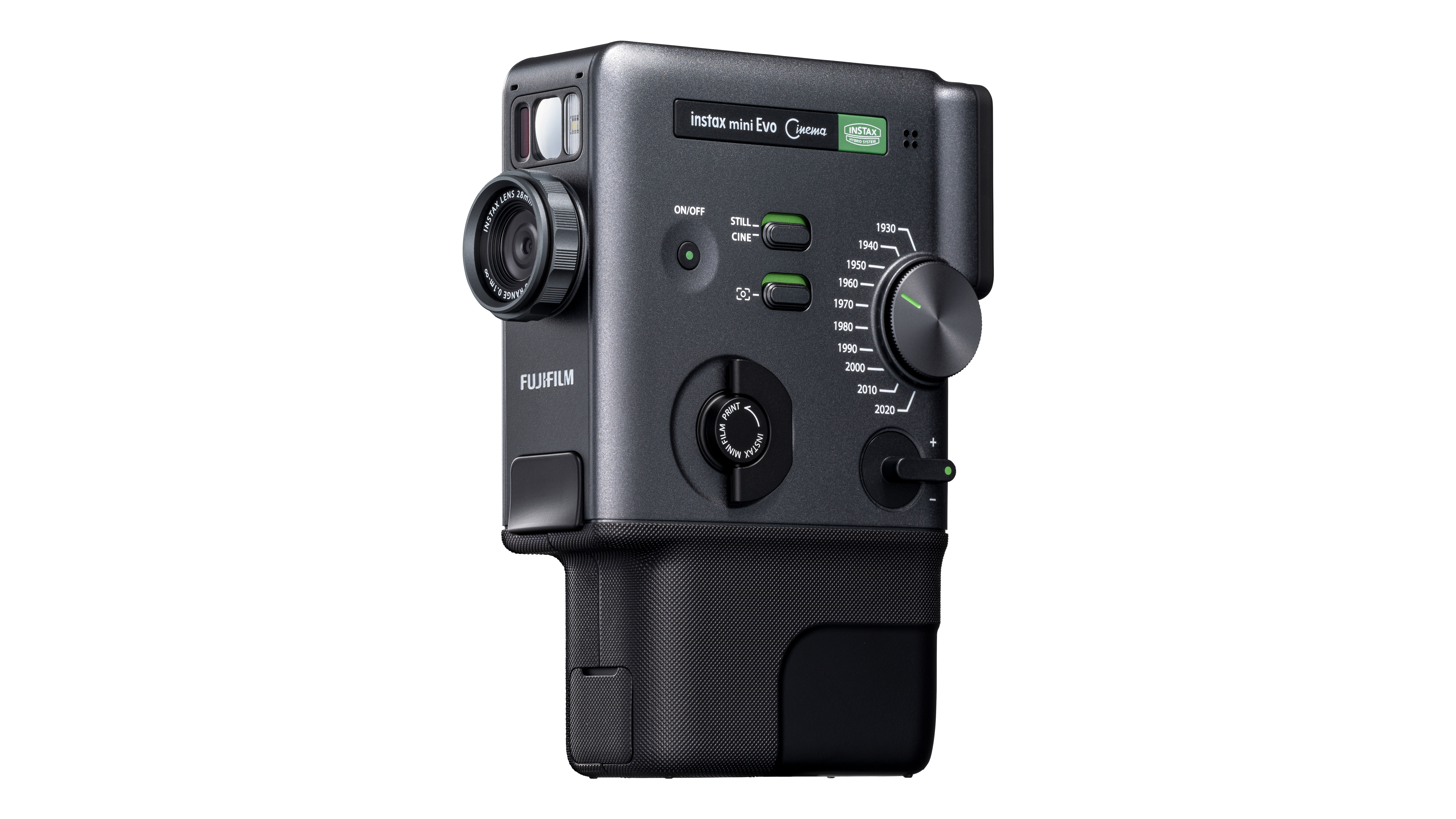
The Instax Mini Evo Cinema’s most unusual feature is a dial at the side that appears to allow creators to choose a different decade, which then applies a look to stills and videos inspired by that decade. Videos shared on Fujifilm Japan’s YouTube offer more insight into what, exactly, those modes look like.
When I saw the Japanese announcement earlier this week, I knew the Evo Cinema was odd – and now that more information is gradually becoming available, we know a bit more about Fujifilm’s latest gamble.
According to specifications translated by Google from Fujifilm Japan, the Evo Cinema uses a 5MP, 1/5-inch sensor. That’s relatively tiny and low tech, but matches what the original Instax Mini Evo offers.
Video is new for Instax’s hybrids, though, and the spec sheet lists a normal mode at 600x800 pixels and a high-quality mode, which is only available with the “time travel” dial set to 2020 at 1080x1440 pixels.
Above: this Fujifilm Japan YouTube video gives an idea of what the Evo Cinema is about
That resolution offers another insight into the Evo Cinema: the images measure the longest on height, suggesting a vertically oriented sensor, like Fujifilm’s other recent concept camera, the X Half.
Megapixels aren’t everything – and that’s especially true when applying a retro filter where image and video quality are supposed to be terrible. Instax Mini cameras print out credit-card-sized instant film, which certainly doesn’t require a high resolution.
I can’t help but look at the Japanese launch of the Evo Cinema and think about the X Half. Fujifilm’s early teasers hinted that specs weren’t everything, and, sure enough, the X Half focuses more on the joy of photography than the technical aspects. The sensor is much larger than the Instax Mini Evo’s at one inch and with a much higher 18MP resolution, but there’s no RAW shooting.
Of course, it’s worth noting that not all of Fujifilm’s “concept cameras” are low tech. Fujifilm also referred to the GFX100RF as a concept camera, which, with a 102MP medium format sensor, is about as opposite from the Instax Mini Evo Cinema as you can get. The experiment with the GFX100RF is the form factor, cramming such high-end tech into a travel-friendly compact camera.
Fujifilm’s concept cameras focus on the experience of shooting more than the technical aspects of image making – the question is, is such a gamble going to pay off? Both retro cameras and compact cameras are trending as younger generations look for ways to snap photos without the distraction of a smartphone. Computational photography and AI is pushing “perfect” photography aside for authentic, emotional images.
Last month, the original Instax Mini Evo was the top-selling compact camera in Japan. That Instax hybrid was launched all the way back in 2021, and the fact that it’s hitting top sales charts again is a good sign that the new Instax Mini Evo Cinema could sell like hot cakes.
The Instax Mini Evo Cinema certainly doesn’t look like something I could add to my pro kit – but honestly, I still want one. The decade dial just looks FUN. I’m just hoping this unusual camera isn’t going to be a Japan-only exclusive.
Above: this Fujifilm Japan YouTube video gives a more detailed view of what the Evo Cine's features
You may also like
Browse the best instant cameras or the best retro cameras.