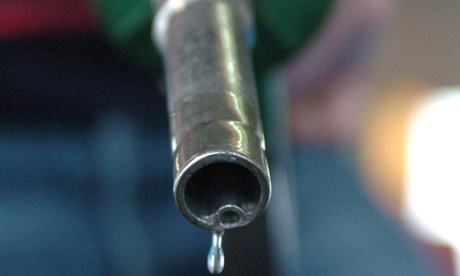
Petrol tax will increase from November after the government bypassed Senate opposition and imposed the excise hike proposed in the budget to raise $2.2bn from motorists over the next four years.
But the crash-through approach sets up a high risk standoff with the Senate, which has to retrospectively approve the six-monthly inflation-linked increases in excise within a year. If it does not, the government must repay the money raised in the first 12 months to the petrol companies.
Announcing the move, the finance minister, Mathias Cormann, said that if Labor and the Greens refused to “validate” the government’s decision, fuel companies would receive a $167.5m “windfall gain” and would have no obligation to pass the money on to the motorists who had ultimately paid the new tax.
Asked whether this was effectively ignoring the will of the voters who had elected the upper house, Cormann said it was simply “using the powers and authorities the government has” and pointed out the former Labor government had used the same powers to impose its so-called “alcopops” tax despite Senate opposition.
The excise increase had been scheduled to take effect from 1 August, and will now occur on 10 November, with further inflation-linked increases on 1 February and 1 August 2015.
Cormann said the government had lost only $35m due to the short delay in implementation and was still budgeting $2.2bn in extra revenue from the move.
The first increase will see the excise increase from 38.143 cents a litre to 38.6 cents a litre, which the government says will cost the average family around 40 cents a week. According to the parliamentary library, indexation would add around one cent a litre to the current rate in the first year.
The government will legislate to make sure those groups it intended to exempt from the excise increases – primarily farmers and miners – would not have to pay the increase.
The Labor leader, Bill Shorten, said the move was an “outrageous” and “sneaky” tax on Australian motorists and directly contradicted the prime minister’s call for a mature and sensible debate on taxation.
He said these were “the petrol taxes Tony Abbott said would never happen under a government he led … he ambushes Australian motorists and the parliament of Australia … and through the backdoor [launches] a sneak attack on the motorists of Australia”.
Andrew McKellar, the chief executive of the Australian Automobile Association, said it was an “ad hoc revenue grab” which would result in “absolute chaos” if the Senate did not approve it after 12 months, because motorists would expect to get a refund from the fuel companies.
“At the last election the Coalition said they would not introduce new taxes … this is a clear broken election commitment. The honest thing to do would be to put this to the Senate … instead they are seeking to bring in a tax hike through the back door.”
He also said the government was vastly understating the cost to motorists as the excise escalated over time. He said by the fourth year the excise increase would add $2 to $3 every time the average motorist filled their car.
The excise increase will be imposed through tariff proposals to be tabled in the House of Representatives this week.
The treasurer, Joe Hockey, was widely condemned for asserting that higher income earners paid more in fuel excise because the poorest people either don’t have cars or actually don’t drive very far in many cases.
The former prime minister John Howard froze regular increases in fuel excise to counter community concern over rising fuel prices around the time he introduced the goods and services tax.
The Greens originally indicated they would support the fuel tax increases, but then decided to oppose it because of the government’s pledge the money raised would only be spent on roads.
“It is a difficult issue for us because we want to see people using less polluting fuels, but if we facilitate this we will see more and more money going into roads with more cars on them,” the Greens leader, Christine Milne, has said.
“Why would we want to put more money into the Abbott government’s pockets to roll out more freeways and tollways that people don’t want.”