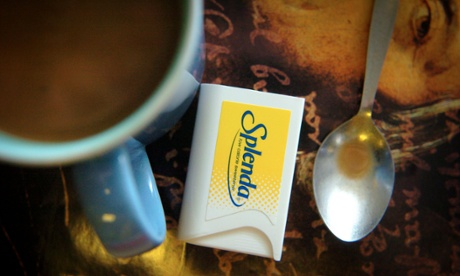
Markets moved higher in the run up to the Easter weekend, with Tate & Lyle rising nearly 3% after it said it would soon reveal its strategy for its struggling Splenda sucralose business.
Intense competion from cheaper Chinese rivals has hit prices of the artificial sweetener, which is sold to food and drink manufacturers. But alongside confirmation that it full year profits would be slightly below the £230m to £245m range it had forecast in February, it said it would decide on Splenda’s future this month. Jefferies analyist Martin Deboo said:
The Sucralose review is reaching a conclusion, with a board review in April. The outcome is expected to be communicated ‘in the next few weeks’. This suggests to us that Tate might be contemplating advising the market ahead of the prelims on 28 May. We have argued, consistently, that Tate’s choices in Sucralose are, pace Jack Welch, to ‘fix’, ‘close’ or ‘sell’ the business.
‘Close’ not attractive? Total closure of both plants would incur one-off costs in excess of £100m (based on what was provided for the closure of McIntosh in 2009). This continues to look unattractive to us, relative to the alternatives.
‘Sell’ a realistic option, even now? We think Tate might find a buyer for the assets, despite eroding profits. We note that Monsanto sold NutraSweet (Aspartame) to private equity in 2000 for $440m, nearly two times sales and eight years after the price collapsed on generic entry. Applying a similar multiple to Sucralose now implies a value of £250m to £300m.
But we think Tate would want to think carefully about the broader consequences of an exit from what remains the world’s top-selling sweetener.
‘Fix’ preferred for us. Even at a price $60-$70 per kilo, we think Sucralose is making a strong factory-level contribution. We think that a more focused approach could put Sucralose back on a path to modest but sustainable profitability and keep Tate in the broader sweeteners game. In this context, we see the recent decision to hike list prices by 20% as a signal that Tate is either trying to restore order on pricing (responding to positive signals from leading Chinese player JK Sucralose) or alternatively is contemplating a lower volume/higher price niche strategy, supported by single plant manufacturing.
Tate ended 18p better at 626p.
Overall the FTSE 100 finished 23.96 points higher at 6833.46, despite a slowdown in UK construction growth and continuing concerns about the financial situation in Greece. In the US there were better than expected weekly jobless claims figures, ahead of Friday’s key non-farm payroll numbers.
Marks & Spencer jumped more than 4% to 554p after it reported better than expected clothing sales, but mining shares came under pressure as iron ore fell below $50 a tonne for the first time in more than a decade.
Miners were weaker as iron ore hit new lows. iron ore prices fell below $50 a tonne for the first time in more than a decade. Analysts at Davy said:
Iron ore benchmark and premium prices are down 60% and 54% year-on-year respectively, with benchmark prices breaching the psychological barrier of $50 per tonne. Despite signs of stabilization emerging from the Chinese property market, overcapacity in the country’s steel industry and the onslaught of global iron ore supply growth are keeping sentiment firmly in bearish territory.
BHP Billiton lost 38.5p to 1431.5p while Rio Tinto dipped 11p to £27.51 ahead of next week’s expiry of the bar on Glencore, down 3.35p at 280.75p, mounting a new takeover offer. Analysts at Investec said:
We remain of the view that Rio shareholders would not support a Glencore bid, although as [Rio chief executive] Sam Walsh points out, it does all come down to value. The Rio price has in recent months been relatively weaker, but it remains amazingly resilient against a collapsing iron ore price. Ironically, the Rio price is probably being supported to some extent by the threat of a Glencore bid.
Oil slid back on signs of a nuclear deal with Iran, which would see crude from the country flood onto an already oversupplied market. Brent fell 2.7% to $55.54 a barrel and Royal Dutch Shell A shares slipped 6.5p to 20.24.5p but BP shrugged off the concerns, up 0.75p at 442.85p.
Finally Aim-listed Koovs, an ecommerce fashion business focused on India, fell 43% to 66.5p despite forecasts of a tripling of full year sales, as it said marketing costs were higher than expected and were likely to continue in that vein.
It also said it would be seeking further funding in due course to “accelerate development.”