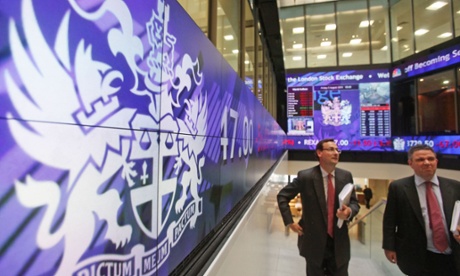
The FTSE 100 index has slipped to its lowest level since January as global investors reacted to concerns that a slowdown in China will undermine demand for oil and industrial metals in the world’s second largest economy.
Weak data from the US helped drive fears that global growth is slowing and commodity prices have much further to fall, hitting mining and oil stocks in London as well as shares across Europe.
The selloff began in China on Wednesday, where an initial slump of 5% in the Shanghai Composite Index was reversed as authorities signalled their continued financial support for higher prices.
However, US figures revealing lower than expected inflation and a glut in oil production then hit stock markets in Europe, as investors expressed concerns that a global slowdown could accelerate.
Mining conglomerate Glencore was the biggest faller as the FTSE 100 sank almost 2% to 6403. The company, which owns a vast array of mines from Chile to Norway, lost almost 10% of its value, bringing its total loss to more than 40% since May or £18bn.
Rival miners Rio Tinto and Anglo American, which saw share price declines of 3.5% and 4.5% respectively, were also dragged lower in a febrile market that saw billions of pounds lost by several of Britain’s major corporations.
Any euphoria following the Greece deal with Brussels that had sent continental stock markets higher earlier in the week evaporated as fears over China and the direction of global trade took centre stage. The German Dax fell more than 2% to 10682 while the Paris-based CAC was down 1.7% at 4844. The Dow Jones in New York closed almost 1% down.
Laith Khalaf, senior analyst at stockbroker Hargreaves Lansdown, said: “Markets are looking east and don’t like what they are seeing. Slowing economic growth, currency devaluation and stock market mayhem in China have hit commodities and mining stocks, and with them the UK stock market.
“The fact UK stocks fell so steeply despite Germany signing off on the Greek bailout underlines how peripheral this issue has now become, and how quickly the market can switch its focus,” he said.
The FTSE 100 index is heavily skewed to oil and mining companies. Together they make up about of a fifth of the index. The combined loss of value for the mining sector was 4.7%, taking it to its lowest level since 2009.
Oil prices also registered losses after falling about 4%. US crude hit a six and a half year low and threatened to break below $40, after figures showing an unexpectedly large stockpile reinforced concerns about a growing global oil glut.
US crude inventories rose by 2.6m barrels last week to 456.21m, the government’s Energy Information Administration said. The figures stunned energy market analysts on Wall Street, as well as traders and investors who had been expecting a cut in the stockpile.
US over-production stems in part from a new generation of fracking plants, many of them uneconomic at current prices, maintaining operations. The oil-rich middle east countries have kept pumping at levels more aligned with a strongly recovering world economy.
But reductions in global demand for oil, especially in south east Asia, have created a mismatch between supply and demand, forcing a return to rock-bottom prices last seen at the beginning of the year.
The price of Brent, the global benchmark for oil, was down $1.72, or 3.5%, at $47.09 a barrel. Prices traded above $110 before a decline last summer that followed worse than expected manufacturing and industrial production figures from China.
A recovery in the spring pushed oil above $60, but renewed fears of a global slowdown has seen prices fall by a third since June.
The intentions of the US Federal Reserve are also unsettling investors. The US central bank could raise interest rates as soon as next month after a series of speeches by boss Janet Yellen indicated that the Fed was readying itself for a rise. Minutes of its last meeting showed that many of its voting members believe the date of a rate rise is nearing. But several weeks of lacklustre US figures and the worsening situation in China could derail their plans and force a delay until next year.
Robert Parkes, a strategist at HSBC, said he believed the pessimism surrounding China was overdone and the picture would brighten in the coming months. He expects China to react to the deteriorating situation with a cut in interest rates that would stimulate domestic demand and boost growth in the second half of the year.