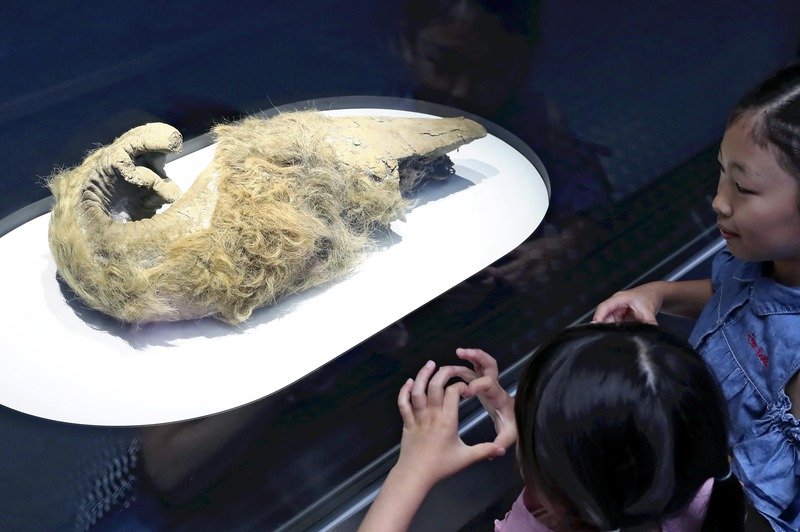
Frozen mammoth specimens excavated from permafrost in Russia's Siberia region, including some world firsts, are on display at an exhibition at the National Museum of Emerging Science and Innovation (Miraikan) in Koto Ward, Tokyo.
Featured at "The Mammoth" exhibition, which kicked off Friday, are about 40 items, including frozen specimens of a horse and other species that lived alongside mammoths, in addition to the bones and hairs of those extinct mammals.
Among highlights, the frozen trunk of a woolly mammoth is being shown for the first time in the world, while the head of a Yukagir mammoth, which was also featured at Expo 2005 Aichi, still has its skin and hair. These exhibits show what those animals looked like in prehistoric times.
"I'm glad that some precious frozen specimens that have been discovered in our country are being shown in Japan," said Semyon Grigoriev, director at the Mammoth Museum in Russia's Sakha Republic and a supervisor for the exhibition, during a preview on Thursday.
Writer Seiko Ito, who also serves as supervisor, said during the preview that global warming and the development of refrigeration technology are the contributing factors for people to be able to view mammoths today, and why an exhibition like this can be organized.
"Whether a mammoth can be revived, which scientists have been researching, is related to the question of how humans will deal with life in the future," Ito said.
The exhibition, for which The Yomiuri Shimbun is among the organizers, is divided into three sections, "Past," "Present" and "Future," to showcase mainly frozen specimens discovered in the Sakha Republic, where the permafrost has thawed due mainly to global warming.
By also showing extinct creatures living in the same era, the exhibition aims to encourage visitors to reflect on that prehistoric time, as well as on today's cutting-edge life science technology.
The woolly mammoth's trunk, discovered in 2013, dates back to about 32,700 years ago. A female, the mammoth is estimated to have been between 65 to 75 years old, and visitors can see the trunk in every detail up to the top end, which was used to eat grass and drink water.
It is rare to find a specimen of a mammoth trunk in good condition because the part can easily get cut off, according to organizers.
Another highlight, the skin from the hind legs to the buttocks of a woolly mammoth measuring 1.8 meters by 1.38 meters. Discovered last year, the skin is believed to have belonged to a male aged 50 to 60 years old that stood 3.5 meters tall. Visitors can see pores on the skin.
The exhibition also has a section that re-creates a laboratory at Kindai University, which aims to revive a mammoth using cells from frozen specimens.
"The Mammoth" opens from 10 a.m. to 5 p.m. through Nov. 4 and is closed on Tuesdays, except for July 23-Aug. 27 and Oct. 22.
Admission is 1,800 yen for those aged 19 or older, 1,400 yen for elementary school students to those aged 18, and 900 yen for preschoolers from age 4.
Read more from The Japan News at https://japannews.yomiuri.co.jp/