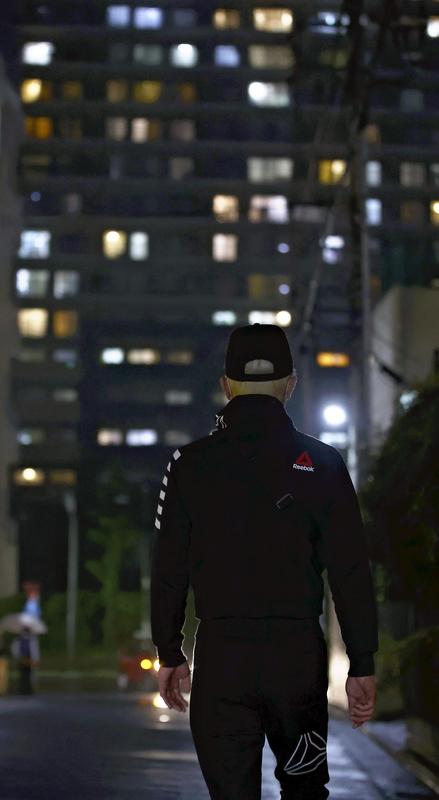
The contract employee in his 30s still cannot conceal the shock he felt at the heartless treatment he received after returning to the manufacturing plant in Kanagawa Prefecture following his recovery from the novel coronavirus.
"The company avoided saying anything specific, but it indirectly pressured me to resign," the man recalled.
He was found to have caught the coronavirus in early April and stayed in hospital for 11 days. A few days after being discharged, the man received a phone call from the personnel management officer. "We disinfected the production line and told your colleagues who had close contact with you to stay home. This cost the company money," the officer reportedly said. "For your own sake, not coming to the factory would be better."
The man still had almost four months left on his contract. At the onset of his illness, he lost his sense of taste and developed a fever. However, he felt absolutely fine when he left hospital. He refused to quit his job and finally returned to the workplace in mid-May after consulting with the company's occupational physician. He is grateful that his colleagues warmly welcomed him back, but a nagging doubt lurks in the back of his mind.
"I don't understand why I received such cruel treatment from my workplace just because I caught the coronavirus," he said.
Cases like this are not uncommon. According to the Health, Labor and Welfare Ministry, about 14,800 people in Japan have recovered from a coronavirus infection and left hospital, or completed their recovery at home or an accommodation facility. Many people who have recovered from the virus are agonizing over what to do when companies make it difficult to slot straight back into their jobs, either because of apprehension that the infection could spread inside the workplace or the lack of clear guidelines for how companies should handle such employees. Cases like the contract worker's raise questions about how society should deal with these infections, about which little is known, and prevent these patients from suffering prejudice at the hands of others.
A company manager in his 40s living in Saitama Prefecture also received frosty treatment following his bout of coronavirus. After being discharged from hospital in mid-April, he went to meet a client. The manager wore a mask and told the client, "Actually, I had the coronavirus." The client reportedly looked stunned, and then stood up and walked away without saying a word.
The client later called to apologize for "becoming flustered" at the meeting. Despite this, the manager was stung by the episode. "I painfully felt how previously infected people are confronted by the strict judgment of society," he said.
Since then, the manager has continued working without divulging that he once had coronavirus.
-- Risk low after 7-10 days
Medical experts around the world are building up their knowledge about the coronavirus as more time passes since the outbreak started. However, failure to share accurate information with the public could create fertile ground for prejudice against people infected with the disease.
The health ministry's current benchmark for allowing people who were hospitalized with coronavirus to return to work is basically the passage of 14 days since symptoms appeared, and then 72 hours after their condition has improved. For instance, a patient whose condition has improved by day 12 after the onset of the illness could leave hospital three days after that and then return to work.
However, many patients feel better just a few days after they developed symptoms. In these cases, people who stayed in hospital but are feeling better within 10 days can be discharged if two consecutive PCR tests come back negative for the coronavirus.
People recovering at home or accommodation facilities cannot return to work for 14 days, even if their condition has improved within a few days. They also must wait an additional three days from when they are healthy. This means that if a person's condition has improved sufficiently on day 14, they are permitted to return to work after three more days have passed.
Research conducted in Japan and overseas has revealed that the possibility of a person spreading the virus to others is low from seven to 10 days after they started displaying symptoms. "If a patient meets the conditions set out by the health ministry, at that stage the risk of them spreading the virus is quite low and returning to work is no problem," an official of the ministry's tuberculosis and infectious diseases control division said.
However, swiftly returning to work is, realistically, difficult for many people who have recovered from the coronavirus. The Justice Ministry said it received about 1,000 consultations about discrimination or prejudice due to the virus between early February and May 15. Among these inquiries was a person seeking after advice after they had returned to work but were troubled by colleagues making comments such as "Don't come close to me" or "You'll spread the virus."
--Companies also in a bind
Companies also are struggling to decide when their employees should be allowed to return. Occupational Health Support Company for SMEs, a Yokohama-based industrial health support service provider for small and midsize companies, has received a flurry of calls from company personnel managers. At one company, the planned return of a recovered coronavirus patient sparked a protest from the employee who sat at the next desk, who allegedly said, "I might catch the virus, so I don't want you to let that employee return to the office." Eventually, the employee had no choice but to self-isolate at home for a while.
"If a company's response is to prevent infected workers from returning to their jobs for a protracted period, an employee who develops a fever will become reluctant to tell their company," said the head of OH Support. "Each company should clarify their own rules for employees returning to work, based on government-set standards, to prevent infections from spreading."
Read more from The Japan News at https://japannews.yomiuri.co.jp/