Why do some British citizens leave the safety of home to fight a foreign war? If Frontline Fighting: The Brits Battling Isis (Channel 4) is supposed to answer the question, we aren’t offered straightforward answers.
While on-the-ground battle footage has undeniable impact, so much of this story is missing in favour of all-action reportage, sometimes from body-mounted cameras, giving the viewer an almost computer-game like, first-person perspective.
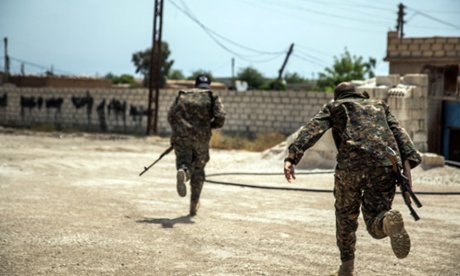
We arrive in the middle of a gunfight, the pop and crunch of bullets echoing across the dust bowl of north-eastern Syria. Joining the Kurdish YPG freedom fighters in repelling the extremists are Brits Harry (28), Jac (22) and Jim (40). Although they do speak about their noble, selfless reasons for becoming volunteer warriors, that’s pretty well all we hear. Information on family, and their circumstances before leaving for Syria, is scant. Harry does admit he is starting to enjoy fighting, but that means firing round after round at indistinguishable shapes on the horizon, running across perilously open ground and finally radioing US special forces for airborne backup. It arrives in the form of a rumble on the soundtrack and leaves a cloud of dust where the enemy used to be.
Back with the ruggedly named Lions of Rojava, preparations are under way for a dangerous mission to clear the remaining villages between them and Isis HQ in the mountains. Although not quite the orange-and-teal palette of Hollywood, the well-edited pale blueand-beige footage sticks to the action, or what we can see of it. The enemy is always just beyond the reach of the lens, a moving shape, always faceless.
Perhaps because film-makers Mauricio Gris and George Tyldesley are themselves former soldiers, they can’t offer an outsider’s perspective and never really explore beneath the noble utterings and proud displays of bullet wounds in young skin.
Harry has left his city trading job after applying to join the YPG on Facebook. Jim from Stoke-on-Trent describes a rootless existence, a brief military career, but mentions no family. He says he was driven to join up after seeing an image of a jihadi brandishing the severed head of a woman, also on Facebook. A shrugged description of a tearful girlfriend, a foreign teaching post or a mundane job in IT suggest that none of them was particularly stimulated by civilian life. But they all admit that they didn’t discuss their decision with family, preferring to avoid the emotional pleas and explanations. I wanted more here, but they are too busy cleaning rifles, packing ammo and matter-of-factly preparing to kill.
“It’s not because I’m bloodthirsty,” says Harry levelly. “But I need to actually start killing people for my beliefs.” He couldn’t sound more like a fundamentalist, but his brash talk is always at odds with his mannerly exterior.
In one truly disturbing scene, they hold captive a blindfolded man who swears he is not a member of Isis and begs them to let him go back to his children. They taunt him and tell him they will slit his throat before putting him through a mock execution. Jac explains that Isis would do worse to one of them, but it’s still repulsive. Possibly more so than their stop-off on the way home to take cameraphone pictures of the charred remains of their enemy, strewn by the roadside after a US air strike.
The epilogue features a tearful Jac listing the names of the men and women from his unit who have died in action since appearing in this film. After a brief return home, we are told, he has gone back for more. What was home like? Couldn’t he stand the humdrum of the morning commute after the adrenalin and camaraderie of conflict? Too many questions are left unanswered.
Talking of men running away from the nine to five, former Top Gear host Richard Hammond declares it his life’s ambition to be a wildlife photographer in Richard Hammond’s Jungle Quest (Sky1), before heading off to the Amazon with too many lenses and his usual enthusiasm. “I want to take beautiful shots of animals doing stuff,” he says insightfully from the deck of his luxury river cruiser. Eduardo Gomes is the expert tracker and regular saint who patiently points the animals out to him, while Hammond shouts: “Where?”
These shows now require strap-on jeopardy to penetrate our care centres, and the producers here have gone for: “Will he come back with nice holiday photos?” It’s not even close to mild peril. They shouldn’t have bothered. It’s all very well, Hammond dishing up his “Ooh Betty” brand of self-deprecation, but it’s getting old and a new background changes nothing.