Frontiers: The Rosetta Mission (Radio 4) | iPlayer
A History of Ideas (Radio 4) | iPlayer
Wednesday was one of those days, a day so busy with ordinary life that Big News just passes you by. So it wasn’t until the early evening that I clocked anything about Comet 67P and the Rosetta mission. As I hadn’t even registered that the Rosetta space craft had been in outer space since August, busily orbiting around the 67P, a rubber-duck-shaped comet one-tenth the size of LA, I definitely had some catching up to do. Social media wasn’t much help, merely offering illustrations of what would happen if the rubber duck landed on LA, so thank goodness for Radio 4’s Frontiers, which opened its new series with a special on the Rosetta mission.
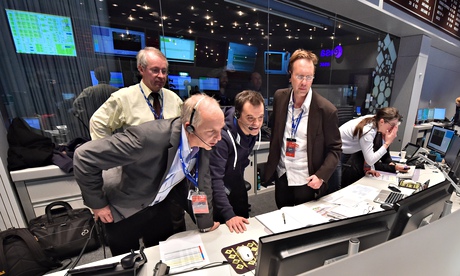
Science correspondent Jonathan Amos hosted an enthusiastic yet admirably brisk companion. He topped and tailed his report with pieces from the European Space Operations Centre in Germany, recorded on the day of broadcast, but the main body of the programme was packed with well-researched, easy-to-understand information as to why this scientific effort is so important. (Just a note: doesn’t the Rosetta mission sound religious? Perhaps it’s to inspire the correct amount of awe and wonder.)
We heard from scientists (one of whom was named Jessica Sunshine) who explained, well, all sorts of stuff. I know now that comets are subject to lots of little forces, as opposed to the great big yank of gravity, so they are less “solid” than Earth; more bumpy, but less dense. We learned, too, that the difference between asteroids and comets is the amount of ice within comets (they originate further away from the sun, so they’re colder). I also know that one of the reasons we’re interested in what comets are made of is that if, as some scientists believe, life on Earth came about because comets crashed into our planet, then “if you’re drinking a glass of water, you might be drinking a glass of comet water,” as one expert said.
I know that manoeuvring the robotic probe Philae from Rosetta to 67P was incredibly difficult, with scientists having to use these small forces around the comet to sail Philae in, like a little boat with a great big sail. I know that Philae looks like “a fridge with legs”...

Honestly, even while dealing with a family phone call and a toddler who was reluctant to stay in bed, I learned all I needed to know about the Rosetta mission. Amos even managed to squeeze in the fact that Philae bounced as it landed on the comet, a fact that only emerged right at the end of the day. A perfect primer.
A perfect primer was, I suppose, what I wanted from Radio 4’s new series A History of Ideas. I’m not sure that I got it. The opening programme, presented by Melvyn Bragg, was, essentially, a 15-minute version of In Our Time, with Bragg chatting to four experts. Their topic was freedom, and quite why we needed this opening segment, I’m not sure. It was like a dinner party, with a theologian, a criminal barrister, a neuropsychologist and a philosopher all putting forward what they wanted to talk about. Why didn’t they just get on and talk about it?
Once they did, each hosting their own 15-minute programme on freedom, I enjoyed things much more. Giles Fraser, the theologian, was particularly interesting. But there are flaws in this show that undermine its seriousness. Perhaps the dinner party opener was excusable, but the terrible choice of music was not. The hey-kids-this-is-fun! jazz theme is awful, plus the heavy-handed use of the ‘freedom’ section of Aretha’s Think was embarrassing. Poor Fraser had to deal with the Soup Dragons’ cover of I’m Free! Also, the much-heralded animations that accompany the series are old-fashioned and patronising.
If you want to present a history of ideas, surely you need to ensure that all the ideas around it are as excellent as the ideas within.