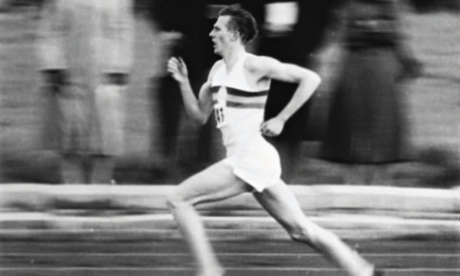
“I didn’t know it was so difficult.” This remark of Roger Bannister’s after his fantastic run last Thursday was not made lightly. It reflected neither modesty nor pride. It was the comment of an engineer who had solved a problem of human engineering.
At the moment of his success, Bannister found himself in a state of utter physical exhaustion. He was suffering from a condition of acute anoxia, or a semi-blackout caused by lack of oxygen in the system; his heart was beating 155 times a minute.
Bannister’s heart is like a Rolls-Royce engine. Were it not so, he could not have broken the mile record. A normal person’s heart must beat about 72 times a minute to drive the blood round the body, but Bannister’s heart, in ordinary circumstances, needs to beat only 40 times a minute to do the job. In other words, a normal person lives like an eight horse-power car at 45mph, whereas Bannister can produce the same speed on about half the effort. The size and big muscles of Bannister’s heart are the result of years of training.
Bannister dislikes competing and competitions. He has raced comparatively little and has never won a county or a district title. Since he first realised his possibilities as a world-beater in Massachusetts in June 1949, he has been under constant strain, as others battered themselves against the four-minute mark. He made his decision: he would try on 6 May. He told his two training companions, Chris Brasher and Chris Chataway, and Franz Stampfl, the Austrian coach to the Amateur Athletic Association.
Twelve days later, Bannister and Chataway ran a three-lap time trial in three minutes flat. Four days after that, Bannister went to the athletics ground near Paddington station. He had been visiting between lectures or operations at St Mary’s Hospital nearby. On 28 April he ran the final test, without a pacemaker, in a tenth under three minutes. Three people saw what was perhaps the most prodigious piece of solo running ever performed. One more two-lap trial followed on 30 April – then six days of complete rest.
Bannister travelled to Oxford with Stampfl. They talked of the wind. The decision to carry on was taken just five minutes before the one-mile event – Bannister all the time wishing to postpone. The wind dropped. The attempt was on. If the planning was sound, the execution was brilliant.
Over this weekend Bannister has gone into hiding, away from publishers and newspapers offering high prices to write articles. He may find himself able to ignore these offers: he qualifies as a doctor shortly, and presumably will have little difficulty in establishing a practice.
One of his immediate obligations is to send a signed photograph of himself to a Lancashire bootmaker who wrote to Bannister and said he would like to make him a free pair of running shoes. Bannister sent him his specifications, and it was with these shoes that he broke the record.
This is an edited extract