
“Hey, F1. Don’t let the door hit you on the way out.” The headline in The Indianapolis Star on Monday 20 June 2005 summed up the post-race feeling after Formula 1 had trashed a marketplace it desperately wished to cultivate. That irony had seemed lost on those in power, specifically FIA president Max Mosley, as a pig-headed political conflict reduced round nine of the FIA Formula 1 World Championship to a farce.
The arrogant insult heaped upon 150,000 spectators was summed up by two photographs running side-by-side beneath the newspaper’s scornful headline. One image showed 20 F1 cars leaving the grid to begin the parade lap. The other picture, taken a few minutes later from exactly the same angle, laid bare the sham of just six cars taking the start from a desolate grid.
The fact that the so-called race had actually got under way in this manner simply beggared belief. The race fans were stunned. So, too, were many within F1 itself. No one had truly imagined that the impasse gathering momentum over the previous 48 hours would come to this. But it did.
Six cars started the US Grand Prix and, 90 minutes later, the same six cars shuffled across the finishing line. The result was of no consequence to anyone bar the three teams scooping the easiest championship points they would ever earn – if that’s the right word. Discussion about the actual race was enveloped in an acrimonious miasma of blame culture and bitterness over events leading to this shocking debacle.
A fermenting sense of unease had become public at around 3.50pm on the first day of practice. Tackling Turn 13 (a long right-hander that was, in effect, Turn 1 on the Indianapolis Motor Speedway in reverse), a failure of his left-rear Michelin had sent Ralf Schumacher into the wall. The SAFER foam-filled barrier may helped save the car – not to mention the driver – from more serious damage, but the spectacular incident ripped open Michelin’s reputation as surely as the tyre’s sidewall had succumbed to the high lateral and vertical loading.
Tyres had been a talking point in 2005 thanks to a new rule requiring each driver to use the same set of rubber for qualifying and the race (ostensibly to cut costs). The challenge was heightened (in every sense) at the IMS because of having to deal with the 9.2-degree banking as cars accelerated hard towards a terminal speed of 200mph on the main straight. Not only had there been no testing beforehand but the teams were surprised to find the track surface more abrasive than expected thanks to a resurfacing process involving diamond grinding. This was more of a potential problem for Michelin than for its rival, Bridgestone.

During the previous eight races, Michelin had been more daring when pushing the use of soft compounds and methods of construction. A comparatively conservative choice by Bridgestone had affected its leading runner, as proved by Ferrari labouring in fifth place on the constructors’ table. At Indianapolis, however, Ferrari – along with fellow Bridgestone runners, Jordan and Minardi – had fewer concerns about tyre behaviour under such extreme duress.
Michelin, meanwhile, were under the cosh as technical directors from Renault, McLaren and Toyota led the mounting ‘inquiétude’ among the French firm’s clients. The rules stipulated that a tyre manufacturer should provide a ‘safe’ alternative at times like this. That was not an option for Michelin since its tyres of a more durable compound came with the same method of construction. Put bluntly, Michelin could no longer guarantee the safety of the left-rear, no matter which tyre it chose.
The teams held a meeting and all bar Ferrari agreed to the proposed installation of a chicane, just before Turn 13. It was also suggested that the Michelin teams would not race for championship points.
The spectators, many having travelled thousands of miles to part with hard-earned cash in return for a worthless procession, were in no doubt that F1 as a whole had disappeared up its corporate exhaust pipe and flicked a metaphorical finger at the public enclosures
The FIA would have none of it. Speaking from his office in Monaco (via Charlie Whiting, the race director), Mosley said the fault lay with Michelin. It would be unfair, he said, to penalise Bridgestone and its contracted teams because of Michelin’s basic failure to provide a suitable tyre. The FIA suggested that the Michelin runners could take Turn 13 more slowly – an unbelievable proposition from an organisation that professed to be safety-driven. Meanwhile, spectators, enjoying a race day lunch in the warm midday sun, knew nothing of this.
All seemed to be in order as the entire field formed on the grid in the usual manner. But 14 cars heading for their garages at the end of the parade lap made a sorry sight. The race began – and so did the recriminations.
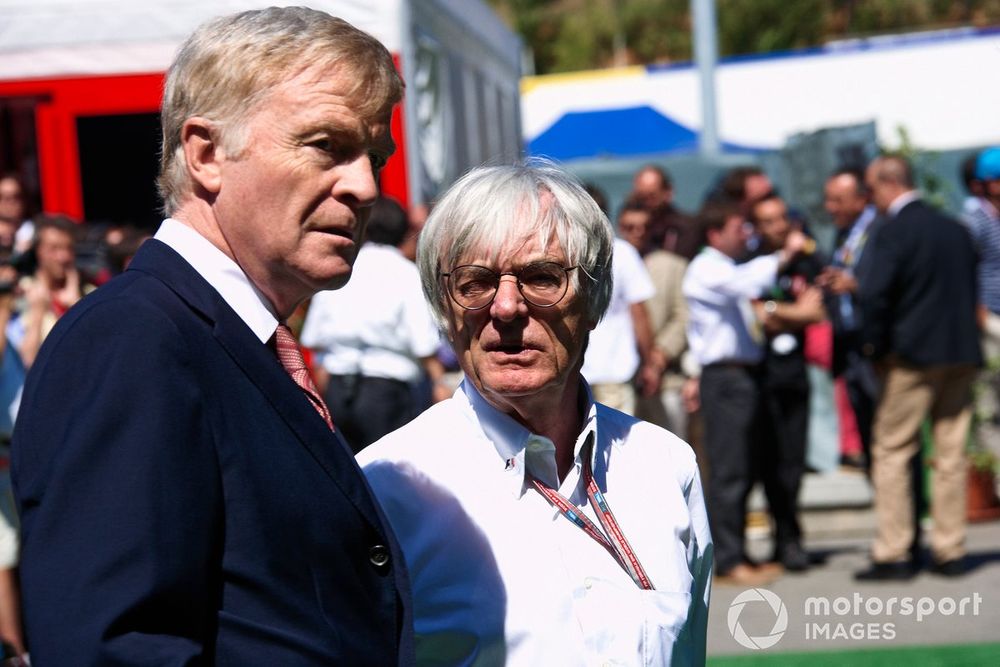
If the teams, led by Bernie Ecclestone, thought the FIA would back down rather than put on a third-rate race, they did not bargain for Mosley, a former barrister, adhering to the Rule of Law – even if the consequences were as dire as this.
Both sides were in a delicate position. The FIA could not agree to a chicane without first testing its safety and practicality, as laid down by its own regulations. The Michelin teams, having been advised that the tyres were not safe, could not risk an accident of any kind, particularly in a country noted for its enthusiasm for litigation. Nonetheless, the complete absence of a reasonable compromise on the part of the FIA had generated less support than a reluctant sympathy for the plight of the teams.
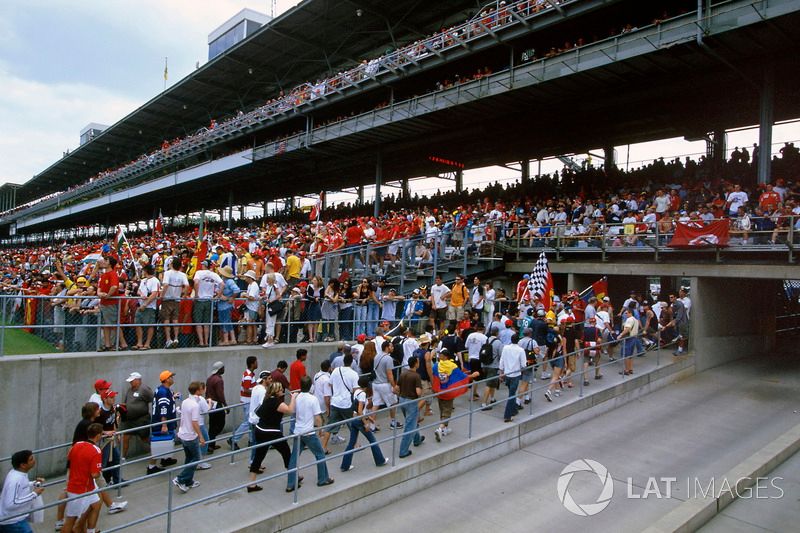
The spectators, many having travelled thousands of miles to part with hard-earned cash in return for a worthless procession, were in no doubt that F1 as a whole had disappeared up its corporate exhaust pipe and flicked a metaphorical finger at the public enclosures. The outrage was evidenced at various stages by booing and a stream of plastic bottles and beer cans landing on the track. The towering grandstand opposite the pits simmered with visceral anger.
A few days later, the ‘miscreant’ seven teams were called before the World Motor Sport Council to answer a number of charges. They were found guilty of a failure to ensure the supply of suitable tyres and refusing to start the race. Since these errors were considered to have been made “under extenuating circumstances”, sentencing was postponed.
The ensuing lull did nothing for the reputation of either side. While Mosley was increasingly seen as the Bad Guy, the Michelin runners did themselves no favours. During a shambolic press conference at the next race in France, the seven teams claimed the media “didn’t understand” anything; an assertion that was not only insulting but also completely unnecessary. F1 had screwed up massively at Indianapolis and this was no way to make amends.
After further private discussion between Mosley and team representatives Ron Dennis (McLaren) and Christian Horner (Red Bull), it was agreed that the FIA World Council should remove the guilty verdict through a fax vote.
Significantly, Michelin’s drastic failure was never in doubt and added weight to Mosley’s belief that F1 did not benefit from a tyre war. A single supplier would be, in Mosely’s words, “safer and simpler”. Two years later, Bridgestone won an exclusive F1 contract.
Meanwhile, Michelin had offered to reimburse all ticket holders at Indianapolis and proposed to buy 20,000 tickets for the 2006 event, an exercise that would cost around $15million.
Time can be a great healer. An admission-free first day in 2006 and an organised autograph session (both a novelty in F1) helped smooth previously troubled waters. The Michelin runners, meanwhile, went into the weekend to find a serious lack of grip from tyres that were – no surprise -ultra-conservative. But at least they provided a motor race.