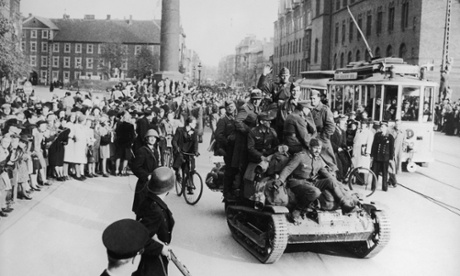
Copenhagen, May 7.
Germany’s last two seaworthy big warships, the cruisers the Prinz Eugen and the Nuremberg, are lying in the north port here with their German crews aboard, having apparently made no attempt to flee when Denmark was liberated.
With them are various anti-submarine craft and 54 German merchant ships aggregating some 150,000 tons.
The entrance to the docks where the ships lie is still guarded by German soldiers armed with tommy guns and rifles, and in streets around the dock area German soldiers come and go pretty much as they please, brushing shoulders with British paratroops; the Germans ostentatiously ignore their ex-enemy’s presence, but the British and Danes are in a position to find the whole situation ridiculous.
Meanwhile discipline in some of the German warships has suffered in a fashion reminiscent in a small way of what happened in October, 1918. On the deck of a minesweeper I saw a crowd of German sailors gathered drinking, singing, and playing an accordion.
When they caught sight of me they started cheering and yelling “Hullo, Tommy,” “Good old Tommy, come and have a drink.” I walked over to their ship and started to talk to them from the quayside when a petty officer appeared on deck with a tommy-gun in his hand which he pointed at me whilst ordering the men below.
A small, pale, harassed-looking German naval commander had driven up to the Hotel Angleterre in a Volkswagen and announced to the hall porter and to me that he had come to discuss the surrender of the German warships with the competent British officer.
NO INTEREST IN SHIP
This officer was not in the hotel at the time, so that for a while there was to be observed the ridiculous spectacle of a German officer roaming through the corridors of the hotel from room to room trying to find someone competent to receive him.
For five years the British Navy and the R.A.F. had been hunting the Prinz Eugen, and under and above the seas hundreds of lives had been lost. Now suddenly there was just no interest in the ship at all.
All this business of the German crews remaining in the ships and the German troops in Denmark retaining their arms is part of a very complicated situation rising out of the fact that there are 300,000 German troops in the country and very few British to whom they can surrender.
Considerations of prestige, they say, forbid them to surrender to the Danes though when they leave the country they have agreed to leave behind their heavy weapons. Neither the Danes nor the British are much interested in German ideas of prestige and have only one concern – to get the Germans put out of the country as quickly as possible.
If this can be done by allowing the Germans to march out armed until they reach the British lines where the weapons can be collected they are willing to agree.
This is an edited extract, read more of the Manchester Guardian’s VE Day coverage