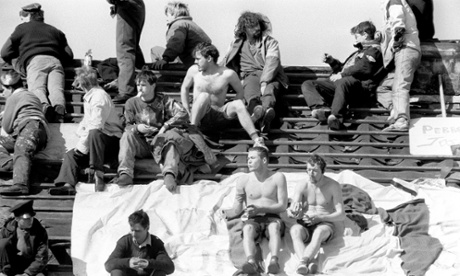
Police yesterday played loud pop music from an Irish radio station in an attempt to force protesters at Strangeways prison in Manchester to end their six-day occupation of parts of the jail.
When negotiations had reached deadlock and up to 20 inmates took to the roof in the sunshine, officials decided they would adopt the tactic used by the US to drive General Noriega of Panama from his sanctuary at the Vatican embassy.
Loud music from Radio Atlantic including songs by Rod Stewart and Julio Iglesias was blared from speakers in the prison compound. But the only response from inmates was dancing and chanting as they waved defiantly.
It had been thought that the prisoners had run out of food, but they were seen eating biscuits and crisps on the roof.
For the first time since the disturbance began, none of the protesters surrendered after negotiations and it is believed that the hard core has decided to hold out as long as possible.
Barry Cuttle, a Manchester solicitor who is acting as an independent observer, said he was convinced ‘most of those left want to give up, but are being prevented by one or two who want to stay . . . it’s a case of the minority ruling the majority’.
Earlier, Ivor Serle, of the Prison Officers’ Association, said at least one of the prisoners was thought to be injured.
He said morale among the men was extremely low. He confirmed that 21 had been identified on the roof, with only seven now unaccounted for.
Mr Serle said it was still possible that inmates had been killed during the rioting, despite no bodies having been found in the wrecked jail.
The authorities are unable to identify at least 50 prisoners who have been transferred from Strangeways to other jails, according to the National Association of Probation Officers.
‘Some have changed their names, hoping to capitalise on the fact that their files are missing,’ said Harry Fletcher, the assistant general secretary. ‘Others are refusing to give any information at all about themselves. It has become extremely difficult to know how to deal with prisoners who have been dispatched on buses from Strangeways without the normal paperwork.
‘Often there is no information at all about the inmate’s criminal background. There is a safety problem because the authorities do not know whether they are dealing with violent offenders or people who have stolen milk bottles.’
The authorities lost records when the prisoners took control of the jail on Sunday.
The mother of Paul Taylor, who claims to have started last Sunday’s uprising, arrived at the jail soon after her son issued a warning that he would rather die than surrender. Mr Taylor, who also took part in last year’s disturbance at Risley, continued to accuse prison officers of brutality. Lilian Taylor spoke to the chaplain, but was refused permission to try to talk her son into surrendering. A prison spokesman said her presence had been considered ‘not appropriate at this stage’.
Later, as Ian Lockwood, a governor on secondment to Strangeways, attempted to hold a press conference outside the jail, one former inmate accused the authorities of trying to cover up the abuses which led to rioting.
Bill Gould, aged 32, said he had been in and out of nearly every jail in the country, but Strangeways was one of the worst. ‘The prison should have been burned down years ago. It is a barbaric regime ruled by brutality and drug abuse.’ He shouted at the protesters to hold out. ‘You’ll be battered and then banged for a long time when you come down. They did it to me when I was involved in a riot situation.’
He said he had been inside the Manchester jail five times and was not condemning all prison staff, only those who used drugs as a ‘liquid cosh because it was the only way for them to keep control.’
David Waddington, the Home Secretary, has agreed to meet leaders of the Prison Officers’ Association on Wednesday to hear their complaints about understaffing. The Home Office maintains it has honoured the Fresh Start agreement by recruiting 3,350 extra officers, but the association says there are still acute shortages.