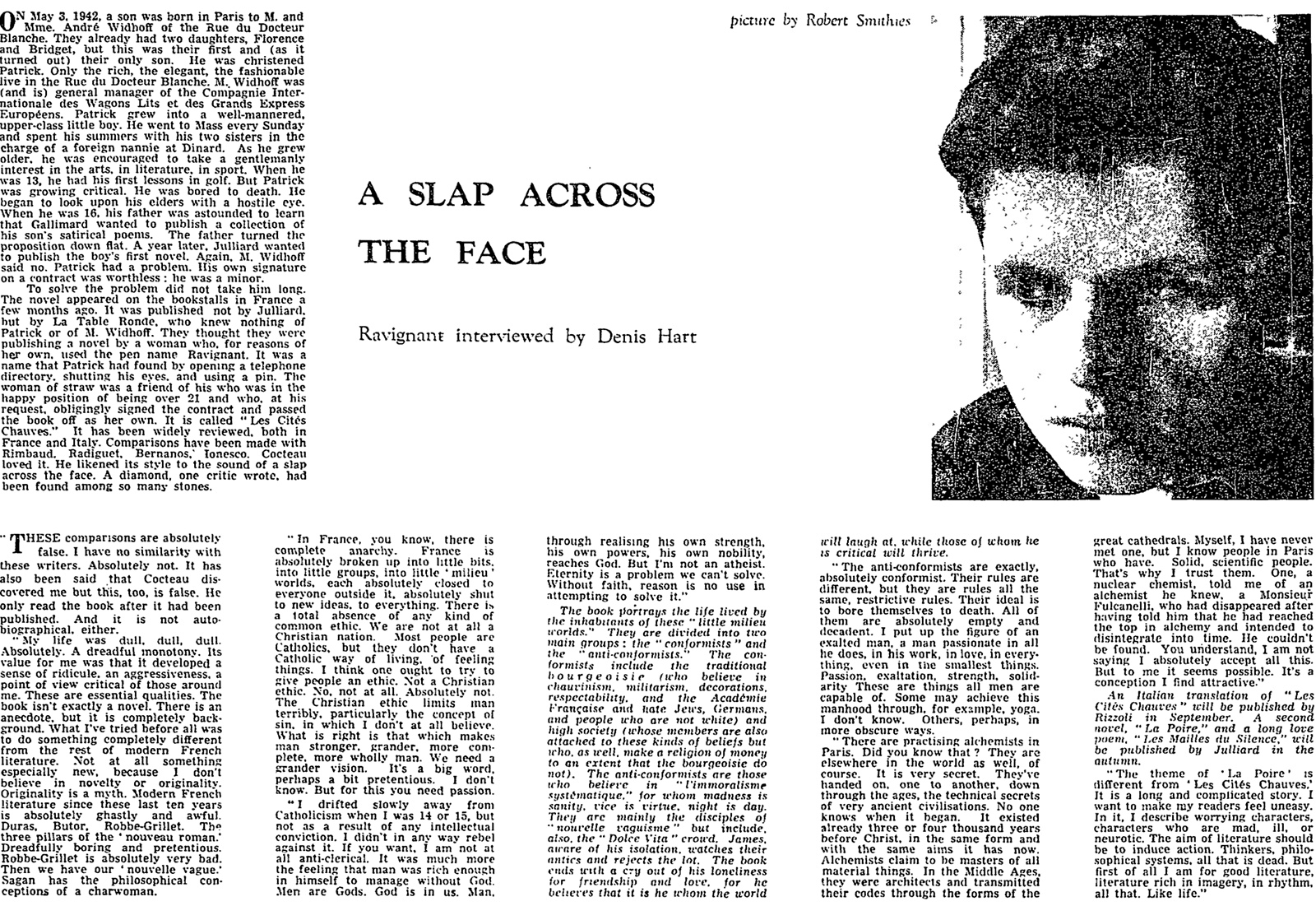
On May 3, 1942, a son was born in Paris to M. and Mme. André Widhoff of the Rue du Docteur Blanche. They already had two daughters, Florence and Bridget, but this was their first and (as it turned out) their only son. He was christened Patrick. Only the rich, the elegant, the fashionable live in the Rue du Docteur Blanche. Patrick grew into a well-mannered, upper-class little boy. He went to Mass every Sunday and spent his summers with his two sisters in the charge of a foreign nanny at Dinard. As he grew older, he was encouraged to take a gentlemanly interest in the arts, in literature, in sport. When he was 13, he had his first lessons in golf. But Patrick began to look upon his elders with a hostile eye. When he was 16, his father was astounded to learn that Gallimard wanted to publish a collection of his son’s satirical poems. The father turned the proposition down flat. A year later, Julliard wanted to publish the boy’s first novel. Again, M. Widhoff said no. Patrick had a problem. His own signature on a contract was worthless: he was a minor.
To solve the problem did not take him long. The novel appeared on the bookstalls in France a few months ago. It was published not by Julliard, but by La Table Ronde, who knew nothing of Patrick or of M. Widhoff. They thought they were publishing a novel by a woman who, for reasons of her own, used the pen name Ravignant. It was a name that Patrick had found by opening a telephone directory, shutting his eyes, and using a pin. The woman of straw was a friend of his who was in the happy position of being over 21 and who, at his request, obligingly signed the contract and passed the book off as her own. It is called “Les Cités Chauves.” It has been widely reviewed, both in France and Italy. Comparisons have been made with Rimbaud, Radiguet, Bernanos, Ionesco. Cocteau loved it. He likened its style to the sound of a slap across the face. A diamond, one critic wrote, had been found among so many stones.
“These comparisons are absolutely false. I have no similarity with these writers. Absolutely not. It has also been said that Cocteau discovered me but this, too, is false. He only read the book after it had been published. And it is not autobiographical, either.
“My life was dull, dull, dull. Absolutely. A dreadful monotony. Its value for me was that it developed a sense of ridicule, an aggressiveness, a point of view critical of those around me. These are essential qualities. The book isn’t exactly a novel. There is an anecdote, but it is completely background. What I’ve tried before all was to do something completely different from the rest of modern French literature. Not at all something especially new, because I don’t believe in novelty or originality. Originality is a myth. Modern French literature since these last ten years is absolutely ghastly and awful. Duras, Butor, Robbe-Grillet. The three pillars of the ‘nouveau roman.’ Dreadfully boring and pretentious. Robbe-Grillet is absolutely very bad. Then we have our ‘nouvelle vague.’ Sagan has the philosophical conceptions of a charwoman.
“In France, you know, there is complete anarchy. France is absolutely broken up into little bits, into little groups, into little ‘milieu’ worlds, each absolutely closed to everyone outside it, absolutely shut to new ideas, to everything. There is a total absence of any kind of common ethic. We are not at all a Christian nation. Most people are Catholics, but they don’t have a Catholic way of living, of feeling things. I think one ought to try to give people an ethic. Not a Christian ethic. No, not at all. Absolutely not. The Christian ethic limits man terribly, particularly the concept of sin, in which I don’t at all believe. What is right is that which makes man stronger, grander, more complete, more wholly man. We need a grander vision. It’s a big word, perhaps a bit pretentious. I don’t know. But for this you need passion.
“I drifted slowly away from Catholicism when I was 14 or 15, but not as a result of any intellectual conviction. I didn’t in any way rebel against it. If you want, I am not at all anti-clerical. It was much more the feeling that man was rich enough in himself to manage without God. Men are Gods. God is in us. Man, through realising his own strength, his own powers, his own nobility, reaches God. But I’m not an atheist. Eternity is a problem we can’t solve. Without faith, reason is no use in attempting to solve it.”
This is an edited extract, click to read on