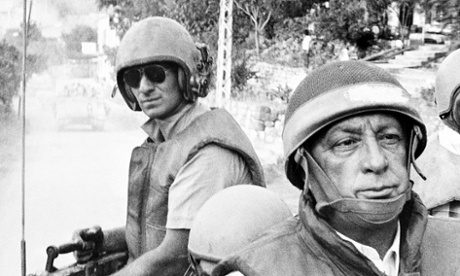
Sweating beneath their flak jackets, but bareheaded under the burning sun, two young Israeli soldiers peered occasionally down the road to West Beirut. What lay beyond their sandbagged check point? “Terrorists.”
It is a word repeated endlessly in a day’s journey north from the Israeli border, through Phalangist-held hills and Druze and Shi’ite villages to the point where, at Bahamdoun on the Beirut-Damascus road, Israeli troops hold the Syrian army at bay.
But Palestinians, who lie at the root of this 3-week undeclared war in Lebanon, are hard to find. Before it began, there were perhaps 150,000 of them outside Beirut, living, working - and occasionally fighting.
There are still refugee camps, Palestinian civilians, teachers, doctors, workers, housewives, and shopkeepers. But Israelis know only of “terrorist strongholds,” “terrorist nests,” and “mopping-up operations” in areas “crawling with terrorists.”
In besieged West Beirut, Israel seeks the removal of the 15 “terrorist organisations” that belong to the PLO, and in Nabatiyeh in the South, there are the “RPG kids” - 13-year-old children trained to fire rocket-propelled grenades at the enemy. But the Palestinians are a foe with neither face nor identity.
In Sidon, on the coastal road between Beirut and Israel, plastic sheets shield an Israeli “screening centre” from the public. Inside the compound, haggard and frightened men are questioned about their links with the PLO while women wait in anxious clusters outside the gate.
Of the 15,000 PLO men in the area before the fighting began on June 6, the Israelis have captured 5,000 and killed another 1,000. Anyone found without a Lebanese identity card is suspect and the captives are sent for internment in South Lebanon.
The abuse of language is a familiar component of any war; the “Aargies” produced by the Falklands conflict is a case in point. But, in this showdown between Israel and the Palestinians, words have lost their meaning.
A headline in one Israeli newspaper earlier this week said: “Scores of terrorists disguised as refugees captured by the army and Haddad’s militias.”
Meanwhile, in their mountain strongholds to the south and east of Beirut, the Phalangists are at ease, confident that their hour has come. In Maronite Beiteddin, an Israeli assault on the capital is awaited impatiently.
In the hills around Damour, Christian villagers watch passively, but with evident satisfaction, as Israeli tanks and ammunition lorries grind through the dust towards Beirut.
- The version of this story published in 1982 incorrectly placed Metullah in Lebanon in the byline