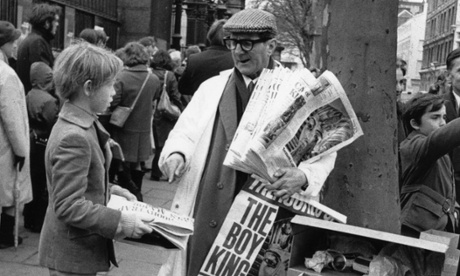
Contrary to the popular belief of the public who read them, the publishers who print them, and the pundits who write for them, newspapers have lost little of their influence since the introduction of television to Britain.
Marshall McLuhan has got it all wrong, according to James Curran, a graduate student at Trinity College, Cambridge, in a new book on the communications media, published today. Far from being dead, the printed word has never been more alive.
Since the introduction of television, gross newspaper consumption has risen substantially; the public is buying more pages of newsprint per head of population than ever before; public spending on national newspapers has increased significantly as a percentage of total consumer expenditure; and the amount read in national newspapers has continued to increase.
McLuhan, writes Curran, “claims only to be reading - or shall we say, feeling - the writing on the wall.” But he, like many other prophets of newspaper doom, has looked too closely at the numbers of newspapers. This, says Curran, is like determining the demand for chocolates by counting the sales of boxes of chocolates sold while neglecting an increase in the size of the boxes.
When more meaningful indicators than the number of newspapers or the combined circulation of all newspapers are taken into account - Curran suggests the number of pages of newspapers read per head - the picture is no longer one of newspaper decline.
Pessimists misled
What has misled the pessimists has been the decline in net sales of newspapers since the Second World War; but what they had failed to take into account was the increase in editorial content. The average national daily and Sunday newspaper in 1968 was more than three times the size of the average daily of 1945.
One of the reasons for higher newspaper sales in the late 1940s was the restriction of newsprint. Once the restrictions were lifted, newspapers were able to expand and reduce the need for a second paper.
In 1968 - 22 years after the first post-war television broadcast from Alexandra Palace - the press still appealed to a much larger audience than television. To be precise, 81 per cent of the population read a national newspaper on an average day while only 69 per cent watched television.
Between 1963-8, some 92 per cent of the population read a national Sunday newspaper and 97 per cent either a national daily or Sunday newspaper.
Curran concludes: “What is clear, however, is that television has not displaced the press. Every meaningful index of demand for national newspapers registers the success of the press in retaining the interest and loyalty of the public during the age of television.
“There is nothing to justify the pessimism among journalists induced by the economic insecurity of the press industry and steadily falling newspaper sales. Nor is there a shred of evidence to support Professor McLuhan’s sweeping assertion that television viewing, by changing our sensory equipment, has eroded the need for the printed word.”