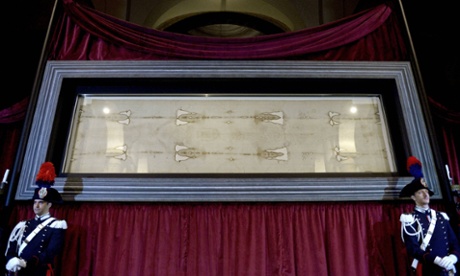
Representatives of the Archbishop of Turin condemned Oxford University last night for allowing news to leak out that the Turin Shroud - revered by Roman Catholics as a bloodstained relic of the crucified Christ - is a medieval forgery. They announced that the university could not possibly know.
The furore began after Dr Richard Luckett, a fellow of Magdalene College, Cambridge, wrote in the Evening Standard yesterday that a date of 1350 “looks likely” for the 14ft piece of linen, which bears the imprint of the face, the thorns, and wounds of Jesus’s body.
He referred to laboratories as “leaky institutions”. A fragment of the shroud is being radiocarbon-dated at the Research Laboratory for Archaeology and the History of Art at Oxford. At Magdalene the message was that Dr Luckett was away for the weekend.
Last night the laboratory was saying nothing. Nor was Dr Michael Tite, keeper of the research laboratories at the British Museum, who is coordinating and supervising the tests at three laboratories, the others being in Arizona and Zurich. Professor Paul Damone of Tucson would only say that all reports were “cock-and-bull. We each signed a pledge that we would say nothing”.
Professor Luigi Gonella, chief scientific adviser to the Archbishop of Turin, said: “Frankly, we in Italy feel we have been taken for a ride. I am amazed that there should be indiscretions of this sort from a university like Oxford.” Another spokesman said: “It is a blind test, and no one in Britain has the key to identify the samples.”
Stamp-sized samples of the shroud have been sent to the laboratories, along with wrapping from an Egyptian mummy from the time of Christ, wrapping from a Christian burial in Nubia of around the 11th century, and threads of a cope from France dated to 1300.
The samples were simply numbered when they were delivered to the three laboratories. Unfortunately, however, the shroud has a very distinctive weave. An expert would know which sample he was handling.
Scientists and the church still disagree about the authenticity of the shroud.