Tracey Thorn is about to become a blue-stocking pop star. In stark contrast to the bimbo sorority currently cluttering the pop charts, pubescent sexual modoms with names like Tiffany, Debbie Gibson, Mandy Smith and Kylie Minogue, Tracey is both pop vocalist and graduate from Hull University, shortly to apply her mind to a part-time MA course in Modern Literature.
Pursuit of both the academic and pop spheres gives Tracey most satisfaction. Although high in the charts with I Don’t Want to Talk About It, a weepingly acoustic Danny Whitten ballad which she sings with Britain’s premier ‘intelligent pop’ band, Everything But The Girl, her voracious desire for reading and analysis still needs fulfilment. ‘I’m happiest when I can switch between the two worlds,’ she says. ‘I’m suspicious of people who’re completely satisfied by books and there’s also a frivolous side to me that likes being on television with Mandy Smith.’
Tracey is a young woman of strong principles. Until last year she refused to appear on Top of the Pops because ‘they used to have women dancing in cages and the camera going up their skirts’. Now, with the more straightforward television format of four groups on stage, a couple of videos and the charts, ‘it’s not a particularly sexist show any more’.
Tracey came up through punk subculture, when, early in 1980, she embraced the alternative DIY pop ethic and formed an all-girl band, the Marine Girls, that was an anti-professionalism, anti-mainstream success. Mere schoolgirls, they were picked up on by the music press as a charming novelty act and, ‘under the pressure of having to become a proper group,’ they eventually split up. This was not before recording two Marine Girls LPs on the small Cherry Red label and her own solo LP, A Distant Shore.
Tracey’s career as a serious vocalist took off while she was studying English at Hull, where she met up with another act on Cherry Red, Mr Ben Watt, now her long-term boyfriend and co-star in Everything But The Girl. ‘His first record hadn’t made a great impression on me, so when I first encountered him I didn’t think: “Oh, here’s my soul mate”,’ Tracey recalls.
‘We had a laugh when we first met. We were both bored. I was in the union bar with my room mate, Tina from Bolton, who played trombone in a brass band. We were obviously put in a room together because I wrote on my UCCA form that I liked music. It was assumed we’d get on like a house on fire. She unpacked her personal lady things, put them on her shelf, and then nailed a curtain over it to cover her deodorant. After three hours I was ready to strangle her!’
Tracey has never been a ‘girly’ girl. Much of her adolescence was spent feeling painfully out of kilter; unsure of the right make-up, the right hairstyle, or the right boyfriends. She expresses much of her personalised independent view in her songs - some prosaic diary style, others full of general yearning and desire. It’s a perspective fostered by the small-town girl image.
Born 25 years ago in Brookman’s Park, a town at the end of a Hertfordshire commuter line, with her mother a housewife and secretary, her father an accountant, Tracey had a stable, well-organised childhood. This has evidently shaped her non-hysterical attitude - one that admires, rather than is seduced by, pop success. And the punk ethic is still with her.
‘I won’t ever shake it off completely. Anyone who lived through that has a natural distrust of the music business. Punk wasn’t just a brief flashpoint; it affected our way of thinking so strongly.’
Punk was an attempt to subvert the pop mainstream, to operate locally and independently of centralised major record companies, to create a TV show that wasn’t Top Of The Pops. Since the early 1980s, many former punk outfits have toned down and joined the limelight, though several, like The Style Council, the Blow Monkeys and Everything But The Girl, have retained a political edge.
Tracey and Ben recently played a benefit concert for the Beirut hostage and former Hull student, the journalist, John McCarthy. ‘He was before my time at Hull ... but every time something like the Iranian Airbus thing happens, he immediately comes to mind. He’s desperately in need of being brought to people’s awareness.’
Tracey is well acquainted with the pop benefit circuit, the competing claims for attention and commitment. ‘You don’t always know which one to go for,’ she says. ‘Recently we had to ask: “Is Nelson Mandela more important than Aids?” How d’you make those kinds of decisions?’
She resents the way that pop has become a kind of service industry for charity: ‘It’s anti-socialist, those doing quite-nicely-thank-you taking on the role of benevolent patrons for the less well off, or places like Great Ormond Street Hospital.’ At the same time, Everything But The Girl has played an active part in Red Wedge, the youth coalition campaigning for the return of a Labour government. Already she’s anticipating tabloid gossip along the lines of: ‘Tracey and Ben are lefties because they bought a new pair of shoes.’
With four musically diverse and acclaimed albums behind them and the current LP, Idlewild, selling well, Tracey is confident enough to cope with attempts to trivialise them and her particularly, as a female performer. ‘Pop is such a superficial industry that the stereotypes you get in the world at large are amplified. Of course women are judged by their looks. It’s easier for men to dismiss those judgments, to be taken seriously or listened to.’
This is summed up in Ugly Little Dreams, one of her strongest songs (on the LP, Love Not Money), dedicated to the ill-fated rebellious Hollywood actress, Frances Farmer: ‘What chance for such girls/How can we compete/In a world that likes its women/Stupid and sweet?’
Determined to be heard, Tracey spent the early years of her career ‘being so aggressive that I frightened people into submission. Now I think they’re relieved I’m a little placatory’. She feels the respect she gets, though, is a little back-handed. ‘The dowdy, intelligent Tracey Thorn, one of a couple. I don’t even enter into the bidding because I’m not “available”!’
To be taken seriously as a female performer she has several failsafe tactics, many at the level of image. ‘Some women can get up on stage in a rubber mini skirt,’ she says, ‘and look incredibly powerful and self determined. But I immediately feel vulnerable. I’m most comfortable on stage dressed in trousers and jackets ... what some would call a masculine style. Being skinny and slight, I feel I have to give myself more weight. Clothes give you confidence in confronting an audience.’
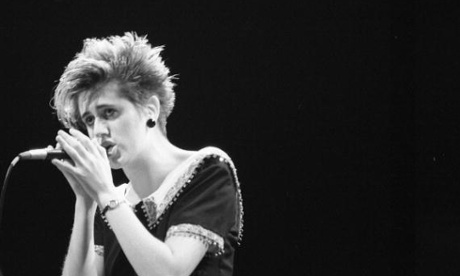
On stage, Tracey exudes composure and awareness, her husky tones striking a rare note of emotional equilibrium. One matured, no doubt, by her studies. ‘When I’m 40 I’ll probably be a horribly overqualified pop star,’ she laughs. ‘Dr Thorn. Still. Nina Simone has a doctorate. I’m following in a great tradition.’