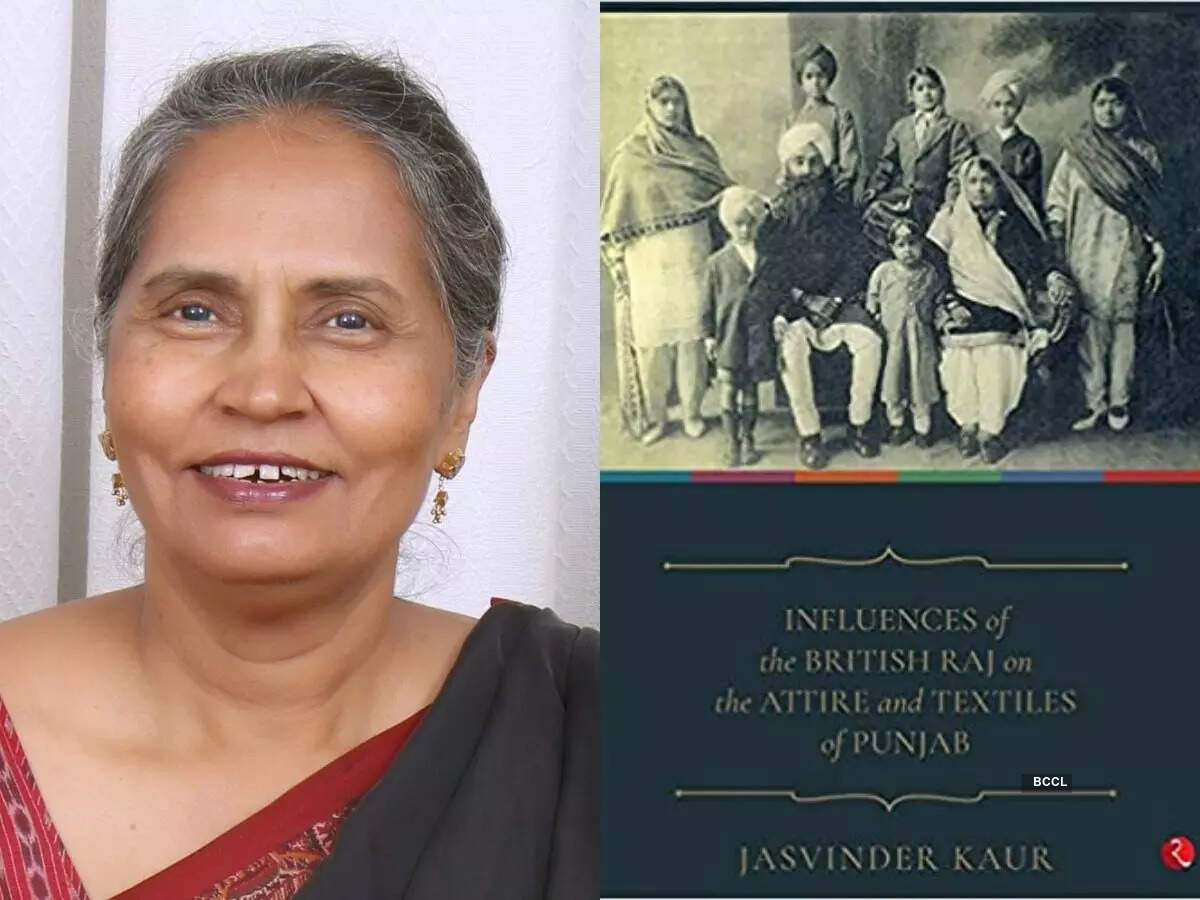
Did you know that the way a saree is worn today is inspired by the English dressing style? Or that buttons were introduced in India by the Britishers? Or knitting, which is a favourite past-time for many women in North India, actually originated in Scotland in the 16th century and was later introduced in India by Britishers during the Raj? Shedding light on some such interesting facts from the past, professor-author Jasvinder Kaur has written an intriguing new book titled 'Influences of the British Raj on the Attire and Textiles of Punjab' which was published by Rupa Publications this year. In a candid interview, Kaur tells us the inspiration behind writing the book, the influence of India's colonial past on Indian attire and culture, and more. Excerpts:
1. What inspired you to write this book?
The hangover of British Raj is everywhere even now in our dressing. Men are wearing western wear these days; women too have started wearing western clothes but at that time they were wearing Western accessories, shoes, socks and purses and broaches. So the book is very relevant even today.
In the 1990s, when I was working at a museum in Geneva, I was writing on the topic 'Indian Influences on Western Textiles'. Indian textiles have been very widely used in Europe in the 17th and 18th century and were also responsible for developing the printing industry of Europe. My colleagues would often ask me that you are writing about Indian influence on the West, but what about Western influence on Indians in terms of clothing and textiles? At that time I didn't have too many answers except for the obvious ones-- like the changes in men's attires-- and that got me thinking. So, writing this book was a long-term goal. And since I am from Punjab and not many books have been written about this topic, I chose to write this book.
2. The theme of the book is very unique and intriguing. Tell us about your research process and how long did it take you to write this book?
I wasn't actively working on this book for many years; it was only after we shifted to Chandigarh over a decade ago that I started working on it. The active research for the book took me roughly five years, and then came the process of writing and putting all of it down together in the form of a book. A majority of my work is from people's homes. As I've mentioned in the acknowledgements of my book, the museum in Chandigarh has focused more on phulkaris and to some extent durris when it comes to Punjab's textiles. But the other garments and European style embroideries were all virgin territories which I had to find by visiting people's homes. People were very generous; they opened their sandooks and allowed me to take their photographs as a part of my research for this book. I focussed on photographs (from the past) because that gave me an idea about transition from Indian attires to Western. What was most interesting was that the process of Westernisation happened with people at different stages. Like initially, they would be seen wearing a coat over an Indian dress, and then they'll be wearing a full western attire with a tie and a shirt. But I must specify that the entire population of Punjab wasn't Westernised during the British Raj. There were many people who didn't wear Western clothes, but those who wore were a significant amount.
3. While writing this book, did you also come across some interesting facts about the influence of the British Raj on modern Indian dressing which you weren't aware of earlier? Tell us about it.
I was not aware of many things! Like the fact that the Achkan was a fusion garment; I always thought it was an Indian attire. Right from my childhood I saw people wearing Achkans; my father always wore an Achkan and my husband too. But, to my surprise, it was a new garment which was created by the end of the 19th century and popularized in the early 20th century in India. Also the manner of tying a saree which has now become a universal way in India, including Punjab where upper-class women do wear sarees, is inspired by the Britishers. Initially, saree was a single garment which wasn't worn with a petticoat and blouse in India. In fact, the words petticoat and blouse are indicators of its origin, irrespective of its form, which is mentioned by many writers as well. This is also something which I had not realised before writing this book.
The saree has an interesting story: it was popularised by Rabindranath Tagore's sister-in-law Jnanadanandini Devi. Tagore's brother Satyendranath Tagore was the first Indian to join the Indian Civil Service. This led to his interactions with foreigners. At that time (the third quarter of the 19th century), saree was a single garment which women wore without a petticoat and a blouse and so it wasn't easy for women to go out of the house and interact socially. It is widely believed that it was Satyendranath Tagore's wife Jnanadanandini Devi, who popularised the new form of wearing sarees which we see today. Rabindranath Tagore mentioned this in the journal Visva Bharati too. Another story attached to it is that once Jnanadanandini's husband, Satyendranath, was sick and she had to go to a Viceroy's reception in Kolkata in 1967 or 68. Though her dress is not mentioned, it would be safe to conclude that she went wearing a new form of tying a saree.
4. While being a British colony for decades was a set-back for India, in retrospect it also brought some positive changes in our country. For instance, the Britisher introduced the railways, tea and Cricket in India... What are your thoughts about it?
As I have mentioned in the book, when Britain and Spain started ruling India they realised they couldn't communicate with the masses. So Lord Macaulay, former Secretary at War of Great Britain, wrote to the minister of education and argued that he was in favour of English education so that they can act as a bridge between the Indian masses and the British rulers. They opened schools and colleges in India, and it also brought a change in our lifestyle. Once kids started wearing European garments as uniforms in schools, as that generation grew-up they were comfortable wearing Western clothes as adults too. Other people also started wearing Western clothes looking at them and that's how the British Raj subtly brought a change in Indian attires. Over a period of time, this led to the rise of fusion clothes where people wore Western garments over Indian-wear. There are lots of pictures of men wearing kurta-pajamas and a coat, which is still followed.
Another big change was the furniture. Back then, in most Indian homes people would sit on the floor. But with the influx of Western-style furniture in Indian homes, came total Westernisation. For instance: men started wearing trousers vis a vis they started bringing Western furniture at home. And with that came in the use of household linen. In the context of Punjab, women started embroidering Western-style motifs, white-on-white patterns, etc on household linen.
And most importantly, the Britishers brought in knitting and socks in India! The use of umbrellas, watches, handkerchiefs, shoes, purses, bras for women, European-style dress supporters, buttons also came only in the 20th century in India. There was a time when people were not wearing socks or even shoes in India! In an 1804 book titled 'Costumes of Hindustan', there is an illustration of Indian soldiers and it is written that they can march in the most rugged terrains without shoes. Almost 100 years later, when the then Prince of Wales visited India by the end of the 19th century he was aghast by seeing the troupes greeting him barefooted. It was only after this incident that uniforms were introduced for the army on a regular basis. I have written in my book too that the doormen at the Gymkhana clubs would always wear a white dress with a kamar-band, which is clearly inspired by the British Raj in India. In the case of Punjab, it was during Maharaja Ranjit Singh's time when uniforms were introduced for the army.
5. You write about how the British Raj influenced the attire and textiles of Punjab in your book. Was it true the other way around too?
Not necessarily Punjab, but India did influence the textile industry in Europe. In the 17th and 18th century, Europe didn't know the true art of dyeing. Silk and wool was used majorly while cotton was used only for making undergarments. There was a French sailor who took swatches of different forms of dyeing from India and it is still preserved in France... That's when people started experimenting with dyeing and printing. Later with industrialization they developed quicker ways of printing, etc.
Also shawls! It was in the 19th century when shawls were exported to Europe from India, where they were popularised by Napoleon Bonaparte's wife who wore them. It is noted that during Maharaja Ranjit Singh's period, Kani shawls were sent from India to France by the French general. When these shawls reached Europe, people there started copying it. People in the Scottish town of Paisley copied the style and designs and hence the name Paisley was given to the hugely popular motif which we call ambi or buta or mango here in India. That's how the French overtook making of the shawls and in later years it was Indian designers influencing others across the world.
6. Your book is written in such a simple yet interesting manner. It's often said that writing simply is the toughest...
Absolutely! There's a story behind it: in the 1980s we were posted in San Francisco. I wasn't interested in museums back then and my husband forced me to accompany him on a museum tour. It was an exhibition on Indian art and the guide there was rattling names like the Gupta period, etc which I wasn't much aware of. And at that time I really felt small because this is my culture and I didn't know much about it. That's when I started taking out books from the library (about Indian history and culture) and I started reading them. I came across a book for children on Mauryan art and I realised that most of the writers which I read had written books in a very complicated manner. Since then I had this in my mind that whatever I write should be easy to read and understand, even for children. And that's what I have tried in my new book 'Influences of the British Raj on the Attire and Textiles of Punjab' too.
READ MORE: 8 deserving authors who never got the Nobel