Scientists are predicting the strongest El Niño weather pattern ever, with human-caused climate change worsening its effects.
“I think we’re going to see weather events that we’ve never seen in modern history before,” WFLA-TV Chief Meteorologist and Climate Specialist Jeff Berardelli, in Tampa, Florida, warns.
An El Niño event is expected to develop from the middle of this year, impacting global temperature and rainfall patterns, according to the World Meteorological Organization. While the models indicate that this may be a strong event, the WMO cautioned that the models also have a harder time making accurate forecasts in the spring.
What is El Niño?
El Niño (Spanish for 'the boy') is a natural climate phenomenon in which sea surface temperatures in the equatorial Pacific are warmer than average. This then alters the world’s weather patterns.
Its counterpart, La Niña, is marked by waters that are cooler than average.
Berardelli says that an El Niño event essentially redistributes heat on Earth. Currently, the subsurface heat in the Pacific is moving east across the ocean and ascending to the surface from the deep waters, the initial stages of El Niño.
The WMO’s Global Seasonal Climate Update shows that sea-surface temperatures are rising rapidly. There is high confidence in the onset of El Niño, followed by further intensification in the months to follow, according to Wilfran Moufouma Okia, chief of climate prediction at WMO.
El Niño typically occurs every two to seven years and lasts around nine to 12 months, according to the WMO.
Why are scientists worried about this year's El Niño predictions?
It looks like the predictive models are onto something, says California Institute for Water Resources climate scientist Daniel Swain. That is because the volume and the intensity of the subsurface warm water anomalies – or pulses of unusually warm water that are a key part of El Niño physics – are about as large as we’ve seen in the historical record, he added.
The very strongest events are commonly referred to as “super El Ninos.” However, this term isn't used by the US National Oceanic and Atmospheric Administration (NOAA).
Zero Carbon Analytics put the likelihood of El Niño emerging between May and July 2026 at 61 per cent, saying "some models are forecasting the possibility of a very strong El Niño." Adding that, "The occurrence of extreme El Niño and La Niña events has increased since the 1950s. Some projections suggest a doubling of extreme El Niño events as global temperatures continue to rise."
If the Pacific releases a lot of heat, it supercharges the climate system and wreaks havoc weather-wise, Berardelli explains. With more heat, there will be stronger heat waves, worsening drought in some areas, but also more moisture in the air that leads to more intense floods.
El Niño also subdues the hurricane season in the Atlantic because there is so much heat in the Pacific that outcompetes the Atlantic, Berardelli adds. Places like the Caribbean will be extra dry this summer and likely have fewer tropical systems, he warns.
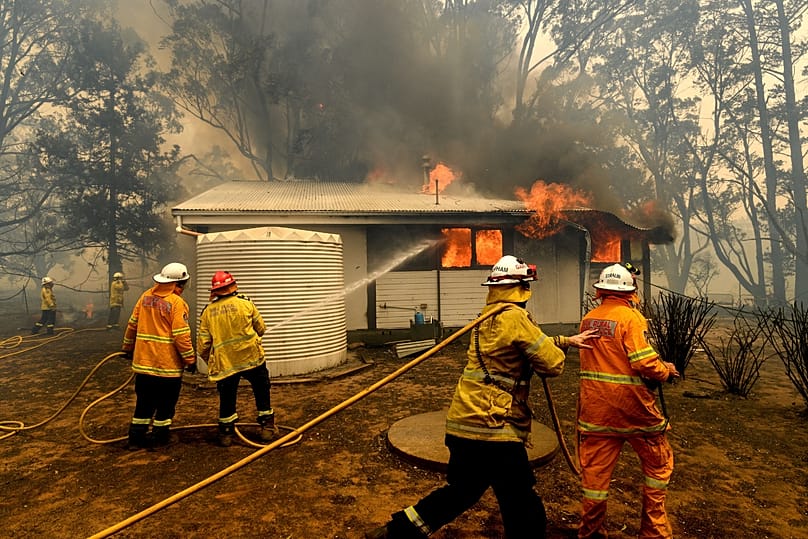
El Niño increases the risk of deadly wildfires
2026 is already an extraordinary year for climate change-fuelled extreme weather, with the WMO warning that the planet is “more out of balance than at any time in observed history.”
Since the start of this year, wildfires have burned more than 150 million hectares globally - double what burned in the same period in 2024.
A strong El Niño "can have a major effect on wildfire risk later in the year", says Dr Theodore Keeping of Imperial College London. "Whilst in many parts of the world the global fire season is yet to heat up, this rapid start in combination with the forecast El Niño means that we could be looking at a particularly severe fire year."
Wildfires don't just kill people in the moment, they impact air quality for hundreds of kilometres around leading to many different health problems. For example, the Australian wildfires in 2019, killed 33 people, but its smoke caused 417 excess deaths and thousands of hospitalisations for six months afterwards.
About 12 per cent of global human mortality from fire fine particulate matter in the 2010s were attributed to climate change.
Years of extreme regional fires across global forests are now more likely compared to a pre-industrial climate. Annual potential burning hours were estimated to increase by 36 per cent between 1975 and 2024, while extreme days with more than 12 potential burning hours rose 81 to 233 per cent in fire-prone biomes.
What are the impacts of a super El Niño?
El Niño has global impacts. Across the United States, it looks like this summer will be hotter than normal, with significant heatwaves. While the specifics are hard to pinpoint this far out, Berardelli is also expecting to see more frequent daily thunderstorms in the Southwest US.
Forest degradation, driven by wildfires, logging and drought, affects about 40 per cent of the Amazon. This could be exacerbated in 2026 with a strong El Niño.
The excess heat brought to the surface by El Niño, combined with the planet’s warming due to climate change, will lead to record-breaking global warmth, Swain says. He expects to see record global warm temperatures later this year, next year or both.
Michael Mann, a University of Pennsylvania climate scientist, says that while El Niño boosts global temperatures a bit for a year or two, it’s basically a “zero-sum game.”
It typically oscillates back toward La Nina, which in turn lowers global temperatures for a year or two, he adds. The thing to worry about is the longer-term, steady warming trend that will continue as long as people continue to burn fossil fuels, Mann said last week.
Why El Niño is "not the reason to freak out"
World-renowned climate scientists say that while El Niño attracts a lot of attention and could lead to very extreme conditions later this year, "it's not the reason to freak out."
Dr Friederike Otto, Professor in Climate Science at Imperial College London and co-founder of the World Weather Attribution, explains:
"El Niño is a natural phenomenon. It comes and goes. Climate change on the contrary gets worse as long as we do not stop burning fossil fuels. So climate change is the reason to freak out."
While we can not control natural phenomena, "we have the knowledge and technology to go very, very far away from using fossil fuels", Dr Otto explains.
Countless scientific papers show that global leaders are not doing enough to tackle climate change by transitioning away from burning fossil fuels.
“Over the past couple of years we have watched governments quietly step back from their climate commitments. The language has softened, the ambition has retreated, and some have behaved as though the climate crisis was a chapter," says Dr. Jemilah Mahmood, Executive Director, Sunway Centre for Planetary Health.
The first ever high-level conference to discuss concrete ways to transition away from fossil fuels was held in Colombia in April. Donald Trump was purposefully left off the invite list as it was a gathering of leaders who are committed to the climate. Some progress was made, with the COP31 climate talks in November planned as the next meeting of international leaders.