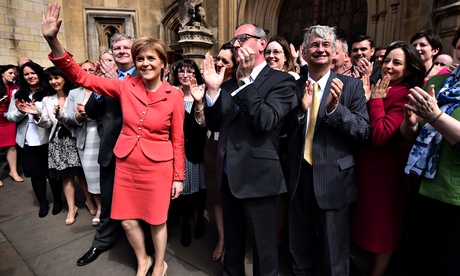
They have had their amazing night of electoral triumph. They have had their photocalls with Nicola Sturgeon by the Forth bridge and outside the House of Commons. Inside the Commons they have taken their dispatch box selfies, have made their prickly point by affirming rather than taking the oath, and have played silly buggers with Dennis Skinner over who sits where.
These are heady days for the Scottish National party. They are loving the limelight. You would have to be churlish and tribal – which many of the SNP’s opponents undoubtedly are – to want to deny them the pleasure of their achievements. On 7 May the SNP changed the Commons, winning 56 seats out of 59 in Scotland. To make a meaningful nationalist comparison in British politics you have to go all the way back to 1918, when Sinn Féin obliterated the Home Rulers across Ireland at the end of the first world war.
That particular comparison ends there. For the Sinners, then as now, never took their seats. The SNP, in contrast, have eagerly seized theirs and are bursting to make use of them. So this week, as parliament begins to settle in for the longer haul, the SNP must start to look forwards too. What now for “the 56”?
This is a question to which the SNP will have characteristically given much thought. That’s why the first thing that needs to be understood about the SNP is that they have a plan, and the 56 will work as one to carry it out. The extent of their parliamentary engagement at Westminster may surprise a lot of people, including parts of the Scottish electorate. But it has a purpose, which is to feed the narrative of the SNP as Scotland’s only true champions.
For the SNP, this is pressing electoral business. The Holyrood elections beckon in 11 months. With Labour and the Liberal Democrats still burying their general election dead, the SNP’s short-term goal is to use the Westminster stage to maximum advantage to give Sturgeon an even firmer grip on devolved Scottish politics than she already enjoys.
Since the SNP won an overall majority at Holyrood in 2011 with 45% of the constituency vote and the SNP took 50% this month, her chances of doing that are high. The crucial decision in that process is whether and how to pledge a further independence referendum after 2016. This poses a delicate problem. Some nationalists will want to go for broke on independence. Others will worry that a second no vote would be worse than not having a second vote at all.
Having 56 MPs gives the SNP lots of new clout at Westminster, which they fully intend to use. Chief among these changes is the SNP’s decision to vote on practically all Commons matters, irrespective of whether they are devolved to Holyrood. This has been done on the basis that most votes on English matters can be argued to have implications for Scotland, a significant blurring of nationalist orthodoxy. The real reason is to make the SNP a power player at every opportunity.
The right to be treated as the third party in the Commons also means the SNP’s Westminster leader Angus Robertson can ask two questions every Wednesday at prime minister’s questions – an unprecedented UK-wide pulpit. The SNP will have a major role in Westminster committees, chairing the Scottish and the climate-change select committees and being entitled to membership of every other select committee and standing committee on bills too. This will include select committees such as health and education, which are fully devolved subjects in Scotland.
The decision to sit on these committees is designed to provoke the English, and it will certainly do so. The SNP thrives on provocation. If you are in England, you may have missed the story last week that the Tories are spitting tacks about the SNP gaining a seat on the committee which oversees the work of the intelligence and security services. But you would not have missed it in Scotland, where it was on the front pages.
Some opponents hope that the SNP will overreach. The antics and flouting of convention, like the clapping that the nationalists have brought to Westminster from Holyrood, may soon pall. The SNP won’t mind the Spectator magazine’s jibe that they are behaving like children. But they may struggle with Speaker John Bercow’s reasoned approach, promising respect for SNP rights while asking for SNP respect towards Commons traditions.
It remains to be seen whether the SNP have tougher tactics in their locker or the will to deploy them. Alex Salmond, an admirer of Ireland’s Charles Stewart Parnell, may fancy using Parnellite tactics like filibustering (harder now than in the 1880s), divisions on minor points of order and deliberate courting of suspension from the Commons. Robertson may feel he needs to secure his leadership by allowing his 56 their chance to use disruptive tactics. But ploys that made sense in the Victorian Commons may not cut it in the digital era.
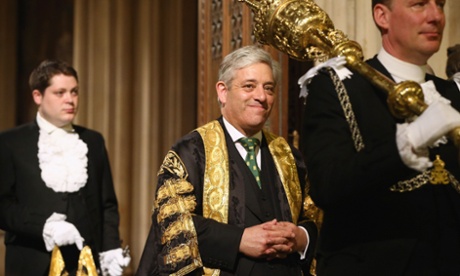
It is possible that the SNP will in time become fonder of the Commons, and its ways than they now believe or admit. This certainly happened to some Home Rulers, and Salmond enjoys being a Commons man, as do Robertson and some of the more experienced nationalist MPs. Bercow’s emollient approach this week may be very smart. The SNP thrives on insult, but softly softly reasonableness would be a disconcerting experience for them.
Until now, the SNP’s Westminster operation has been a distant add-on to the party’s Holyrood focus and itswholly Scottish orientation. How they handle their new importance in London is harder to predict. Since 7 May, the centre of gravity in nationalist politics has begun to shift gradually but inexorably away from Edinburgh, the Scottish media and the familiar political furniture of Holyrood towards London, the UK media and Westminster ways. If nothing else it is a challenge to Sturgeon, who has her plate full in Scotland and won’t now enjoy the UK-wide publicity she got during the general election.
The SNP can’t do much to stop this. The experience of being a medium-size political fish in a very large UK pond rather than the all-conquering big fish in Holyrood’s smaller pond is new. In a subtle way, not to be exaggerated but significant nevertheless, it confronts the nationalists with some of the realities of union which, safe in Scotland, they could caricature or even ignore. For one thing, the 56 will rarely have encountered so many smart (as well as some stupid) Tory politicians as they have seen across the Commons chamber this week. This may have subtle but unforeseen consequences. The 56 will change Westminster. But Westminster will change the 56 too.