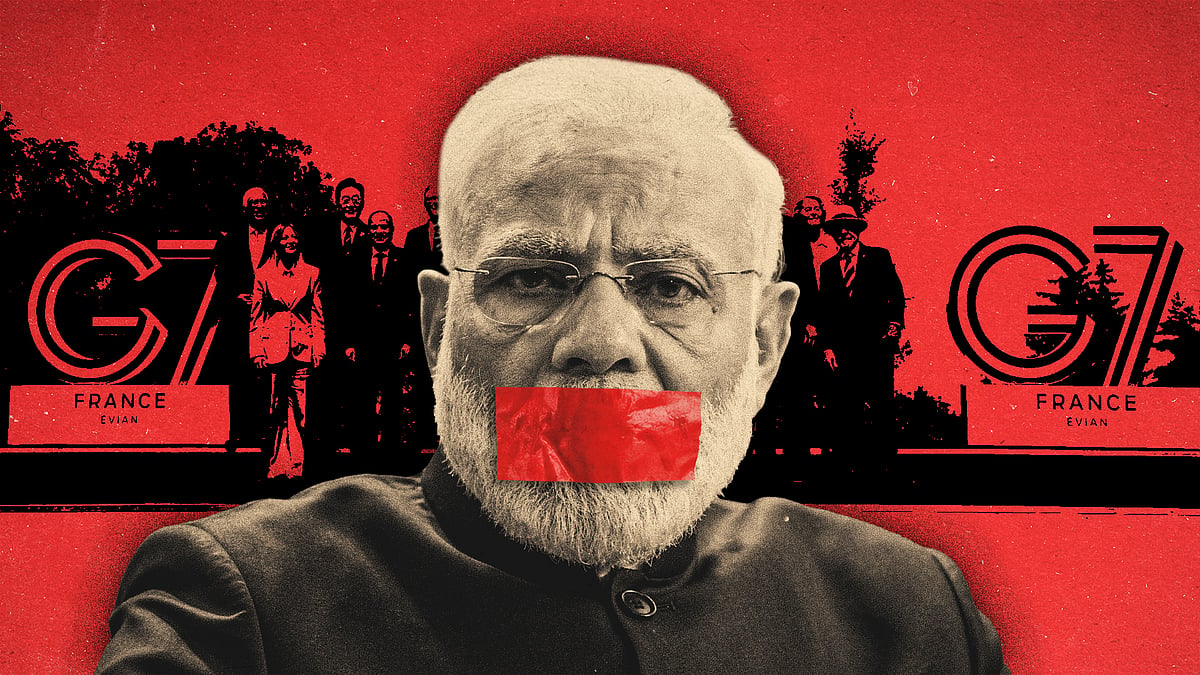
In 2012, when he was still the Chief Minister of Gujarat, Narendra Modi mocked the then Prime Minister Manmohan Singh as “Maunmohan” Singh, accusing him of being silent on the issues of the day, including the serious corruption charges against the UPA government.
What would the Modi of 2012 say about himself now?
For a politician who is never lost for words while launching scathing attacks on opposition leaders or belittling opponents at election rallies, Prime Minister Modi has shown himself to be tongue-tied on every pressing national issue that is going badly for him, as if remaining silent would make it disappear or at least distance him from it.
Just in the last year, his silence on the repeated humiliation of India by the US president, his “friend” Donald Trump, and the unravelling of a celebrated partnership between two great democracies must be distressing for those who believed the PM was a bold and courageous world statesman who could look any world power in the eye and would never let Indians down. Some of his cheerleaders call this “strategic silence”.
The latest demonstration of this came at the G7 summit in Evian, France, where he attended the outreach session, to which India has been invited since 2005. It was days after the killing of three Indian seafarers when a US fighter jet bombed their ship, the MT Setebello, with Hellfire missiles in the Gulf of Oman on the intervening night of June 9 and 10. India was waiting to see what he would say to President Trump when he met him there.
The attack on the Setebello came a day after the US hit another ship carrying Indian seafarers, the MT Marivex. A day after the Setebello incident, another ship carrying Indian seafarers, MT Jalveer, was also targeted by the US military. The three victims on the Setebello were first declared missing, and their deaths were confirmed a day later. No casualties occurred aboard the other two ships.
The reluctance to confront the US was apparent from the beginning. After the hit on the Marivex, the Ministry of External Affairs spokesman offered a statement that appeared eager to draw a line under the incident. The ship had been “disabled” off the coast of Oman. By whom was not specified. The statement added that the US military had been in “communication” with the ship before the attack, and that all 24 men were safe and had been evacuated. The Shipping Ministry and the Indian embassy in Oman were coordinating the return of the seafarers. All good, next question.
Would the US CENTCOM forces have been less trigger-happy with the Setebello had there been a stronger reaction from Delhi on the Marivex?
In the event, the response to the Setebello attack was another demonstration of India’s weakness before the US. The MEA statement came some 20 hours after the incident. Once again, it failed to name the perpetrator while expressing worry at the “continuing attacks” on ships in the region and called for free and unimpeded navigation through international waterways and a de-escalation of hostilities in the region. The MEA also summoned the US charge d’affaires, Jason Meeks, to register a protest, but hours later, on June 11, the US military struck again, this time at the Jalveer.
By then, public anger was all over social media. The US diplomat was summoned again, and another protest was registered.
Some attempts in the Indian media to blame the ships for being “non-compliant” provoked more anger; the government decided to be seen responding to US belligerence a little more substantively. On June 13, a full five days after the Marivex incident, External Affairs Minister S Jaishankar spoke to US Secretary of State Marco Rubio.
Their respective readouts of the call exposed the humiliating gap between Delhi and Washington – supposed partners in a much-vaunted defence and security relationship both sides had talked up for over two decades.
Jaishankar tweeted that he had “reiterated India’s strong protest at the attacks by the US Navy in the Gulf that killed three Indian mariners”. Rubio’s tone was curt. He demanded compliance with “orders from US forces” and said violations of the US blockade – during its illegal war against Iran – and the “illicit” transport of Iranian oil “will not be tolerated”. He expressed no condolences for the loss of life. This was the first time that Indians anywhere had been deliberately and directly targeted by the US military, and the first time that any Indians had been killed in US military action.
With Modi’s public image back home to protect in France, it was apparent that the mandarins had worked out the safest formulation on the seafarers’ issue. Thus Modi wove his way around the incident, speaking in general terms about the safety of Indian seafarers without once breaking his silence on the killings, either in his speech titled “Forging New Partnerships and Rebuilding International Solidarity” at the G7 Outreach session, or later in his opening and only remarks at a joint media interaction with the US President after their one-on-one meeting. At home, the media spun these motherhood and apple pie remarks as Modi “raises seafarers issue, with Trump in the room”.
The silence followed him to the press conference. After his opening statement, Modi sat in odd silence for the remaining quarter of an hour or so. By then, the Trump administration had removed the word Indo from the US military’s Pacific Command – ending the idea of the Indo-Pacific, first introduced in 2018, as a framework central to US stability, security, and prosperity. Even though the command’s area of operation has remained the same throughout, its renaming that year was a nod to India’s importance to US grand strategy. The revert to the original name, soon after the Trump-Xi Jinping meeting, and another one to come, seemed to confirm what strategic thinkers in both countries have been saying over the last year about India’s diminishing strategic importance for the US.
Modi’s opening remarks painted a parallel reality. He spoke of the new energy in India-US ties, with teams from the two sides racing to meet targets set when he and Trump met in February 2025 in Washington, even though within weeks of that visit, the US slapped 50 percent trade tariffs on India. From then, it has been all downhill for the relationship. He repeatedly praised Trump for “rekindling” hope for peace in West Asia, though it was Trump who, along with Israeli Prime Minister Benjamin Netanyahu, destroyed the region’s fragile peace in the first place. No Helle Lyngs in this crowd, so Modi was asked no questions. It was as if all the journalists knew not to. All the international reporters posed questions to Trump, and all the Indians present asked only questions of Trump.
When an Indian reporter asked Trump whether he would condole the deaths of the seafarers, Trump dismissed it with a “Yeah, I heard about that; it’s a rough profession”. Another Prime Minister might have grabbed the clear opening to talk about his anguish at the killing of Indian seafarers to the international media, express his long overdue condolences to the families of the men, say a few words about their untimely and violent deaths, perhaps even say how friendly nations should not do these things to each other. But he preferred silence. The same reporter, or another Indian reporter, could have asked Modi a follow-up question, but he did not. Modi was also silent about what Trump meant when he said in his opening remarks: “Prime Minister Modi is building a lot in the United States; he is spending a lot of money in the US, so we appreciate that.”
Trump sidestepped a question about his visit to the indefinitely postponed Quad summit, instead launching into his February 2020 visit and the seating and the audience numbers at the Namaste Trump event in the Ahmedabad stadium. Modi beamed approvingly. He added nothing from the Indian side about the Quad. Trump joked that the US would protect India from any attack as long as Modi was the Prime Minister and asked Modi for confirmation if that was a “good statement”. The Indian Prime Minister laughed. He was silent when Trump, in apparent praise of Modi as a tough negotiator, called him a “killer” who “looks like an angel”. With Modi sitting next to him, Trump also spoke about the upcoming “G2”, adding that “you all know who they are”.
It is tempting to think that Manmohan Singh, who famously said at his final press conference that history would remember him more kindly, must have been watching the spectacle of the last few days from somewhere up there, wondering if it was his successor’s turn to be called Maunendra Modi, a man who has perfected the art of taking a shower with a raincoat on. But no, Manmohan Singh was too polite and well-spoken to think in insults.
Newslaundry is a reader-supported, ad-free, independent news outlet based out of New Delhi. Support their journalism, here.