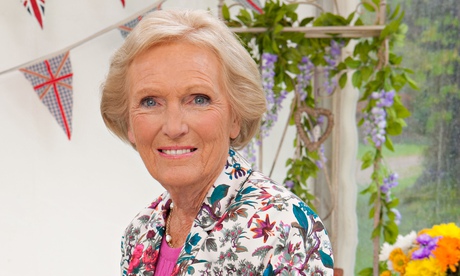
WINNER: Mary Berry, queen of The Great British Bake Off
With 13.5 million viewers for the Great British Bake Off final, Mary Berry is more popular than Sherlock or the World Cup Final. And she’s been on the cover of Radio Times so often, Doctor Who’s getting edgy. With Bake Off’s hugely successful transfer to BBC1 this year, the 79-year-old TV judge became the Cheryl Fernandez-Versini of baking – indeed, quite possibly the new Clare Balding. According to the tabloids, she’ll get her just deserts (desserts?) in 2015, with a 70% pay rise for the next series of Bake Off – to a very tasty £500,000.
LOSER: BBC3
Fans of Don’t Tell the Bride and Snog, Marry, Avoid? will be weeping and wailing in their millions. In March, BBC director general Tony Hall announced plans to close yoof station BBC3 as a linear TV channel, taking it online only and slashing its commissioning budget by £50m. The proceeds will be funnelled into BBC1 drama and the BBC’s iPlayer ambitions, with the much-shrunk BBC3 set to rip up the TV commissioning rule book (or at least turn it into an app). Factual entertainment strands and traditional TV genres will be abandoned, with a new focus on Tumblr-friendly content that “Makes me laugh” or “Makes me think”. Which led Ian Hyland, the Daily Mirror’s waggish TV critic, to tweet: “As in: ‘Makes me laugh that this ever got made, makes me think – Why do I pay my licence fee?’”
WINNER: LBC
Boris Johnson and Nick Clegg don’t usually pull together for a common goal, but both of them – with their regular Call Clegg and Ask Boris Johnson phone-ins – helped to propel LBC radio to new prominence this year. The two programmes won a Radio Academy special award, with LBC’s Tom Swarbrick also claiming a Radio Academy gold as national journalist of the year. Yes, that’s national radio – in February, after years of being London’s Biggest Conversation, the station went UK-wide on DAB under new branding as Leading Britain’s Conversation. At least anecdotally, though, most of the station’s 1,283,000 weekly listeners still seem to be London cab drivers.
LOSER: BBC Radio Norfolk DJ Nick Conrad
His outburst last month provoked comparisons to Alan Partridge – but in truth, Nick Conrad had strayed into very unfunny territory on his real-life, mid-morning BBC Radio Norfolk phone-in show. Discussing the case of former Sheffield United player and convicted rapist Ched Evans, Conrad said: “If [women] don’t wish to give out the wrong signals, it’s best probably to keep your knickers on and not get into bed with [men].” The tirade capped a year in which public misogyny – especially on Twitter – continued to make headlines, with both Fiona Bruce and Kirsty Wark among those speaking out.
WINNER: Mail Online
It’s known for the Sidebar of Shame, but the Daily Mail’s website could also be called the Coffers of Ker-ching: in the year to September 2014, Mail Online revenues rocketed by 40% to £62m. For now, the globally rampant website – with its grubby-but-irresistible diet of Katona, Kardashian and Kendra – continues to offset income falls in parent company DMGT’s newspaper business. Everybody, it seems, is a closet fan of Mail Online. Everybody, that is, apart from George Clooney – who, in July, secured a retraction and an apology over a story about his then-fiancée’s family, which he said was a “lie” and “dangerous”.
LOSER: The spirit of Bill Deedes
Whatever the digital future of the Daily Telegraph, it isn’t currently driven by the old-school journalistic ideals of its legendary Fleet Street editor Bill Deedes. Telegraph journalists now face online-fuelled rotas that start at 6am and end at midnight, with editorial priorities including shareability, interactivity and search engine optimisation. And executives come and go so regularly that the paper’s exhausted hacks wonder who, if anyone, is in charge. Most recently, splashy American hire Jason Seiken was “promoted” after barely a year to make way for new editor-in-chief Chris Evans – who, as an alumnus of the Daily Mail, happily at least has newspapers in his bones.
WINNER: Christmas TV ads
In November 2009, an exasperated Charlie Brooker wrote a piece in the Guardian entitled: “Christmas is the season of awful adverts.” That year, Jamie Oliver handed out vol-au-vents for Sainsbury’s, and Richard Hammond pushed an empty trolley for Morrisons. But in April 2010, John Lewis (and their ad agency, Adam & Eve) redefined British TV advertising with its She’s Always a Woman spot – and that, in turn, has reinvigorated Christmas ads. This year, there’s John Lewis’s own Monty the Penguin and M&S’s magical Christmas fairies. TV channels battle to be the first to show them, and a company’s reputation hinges on the Christmas ad, too: Sainsbury’s first world war commemorative ad has attracted lots of plaudits – but also hundreds of complaints to the Advertising Standards Authority.
LOSER: Maurice Lévy and Publicis Groupe
It was meant to be his legacy, his towering achievement after decades at the top of the advertising industry. But Maurice Lévy’s plan to merge his French marketing monster, Publicis Groupe, with an even bigger American advertising company, Omnicom, not only failed in May – it ended up as what Lévy himself described as a “train wreck”. (Ecoutez et repetez: “une catastrophe ferroviaire.”) Lévy will now never eclipse WPP’s Sir Martin Sorrell as the head of the biggest advertising company in the world, and seems a little bitter about it. “I will not miss him,” said Lévy of Sorrell, when contemplating his own retirement. Soon afterwards, Sorrell retorted – by calling Lévy “the Freddy Krueger of advertising”.
WINNER: BuzzFeed – and other digital Americans in London
It is, apparently, worth $850m. Now BuzzFeed is bringing its newfound muscle to London, and recruiting British journalists away from their creaky old jobs at what we used to call newspapers – recently, the Sun’s Emily Ashton and the Telegraph’s Robert Colvile and Tom Chivers. And BuzzFeed’s aren’t the only tanks on British media’s virtual lawn: Business Insider has also set up a London office, Politico has acquired a Brussels operation and Forbes.com has been recruiting UK bloggers. Cheeky, well-funded and disruptive: the online Americans are definitely coming, and that’s without even mentioning Uber.
WINNER: Serial podcast
Like a downloadable hybrid of The Wire, Broadchurch and Truman Capote’s In Cold Blood, the Serial podcast has become an internet phenomenon in just two months. Its first episode was only released at the beginning of October, and yet Serial has already broken the record for the fastest-ever podcast to reach 5m downloads on iTunes. A spin-off from the US National Public Radio show This American Life, Serial re-investigates the real-life murder of a Baltimore teenager, Hae Min Lee, in 1999. Her ex-boyfriend, Adnan Syed, was convicted of the crime, but did he really do it? You’ll have to download – or listen to Radio 4 Extra’s broadcasts of the show in the UK – to find out.
LOSER: Microsoft’s Xbox Entertainment Studios
Right from the get-go, it seemed weird that Channel 4’s new drama series Humans – a Blade Runner-style remake of a Swedish sci-fi hit – was going to be co-produced by a games brand. And, sure enough, when Microsoft announced a swingeing 18,000 job losses worldwide in July, its Xbox Entertainment Studios were first for the chop – perhaps not surprisingly, given that Xbox consoles already offer much better-established online TV services, such as Netflix and Hulu. Fortunately for Kudos, the UK producers of Humans, a co-production deal with US cable network AMC soon replaced XES. British men who were schoolboys in the 1970s aren’t so lucky – XES’s downfall put paid to a planned remake of classic BBC sci-fi series Blake’s 7.
THE JURY’S OUT …
… on former Daily Telegraph editor Tony Gallagher, sacked by the Telegraph in January, only to resurface as joint deputy editor of his old paper the Daily Mail in April. But he’ll have to really thrive to replace Mail Online’s Martin Clarke and Mail on Sunday editor Geordie Greig as heirs apparent to Paul Dacre … also for Victoria Derbyshire, culled from Radio 5 Live in July as part of incoming controller Jonathan Wall’s new schedule. A new TV show for Derbyshire on the BBC News channel was announced just a week later – but, five months after that, there’s still no sign of Victoria on our screens… and also for ITV, which has managed this year to grow advertising revenues at the same time as its ratings shrank – a trick which even Ant and Dec cannot pull off indefinitely.