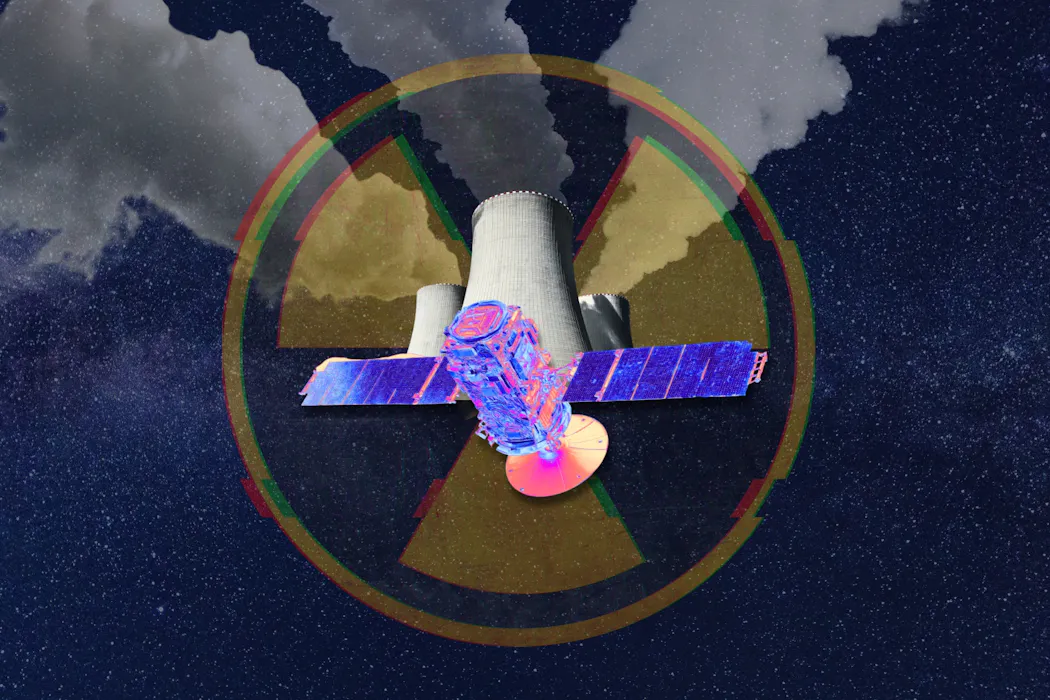
Interplanetary travel to Mars aboard nuclear-powered spaceships may sound like science fiction – yet NASA is planning to make it a reality.
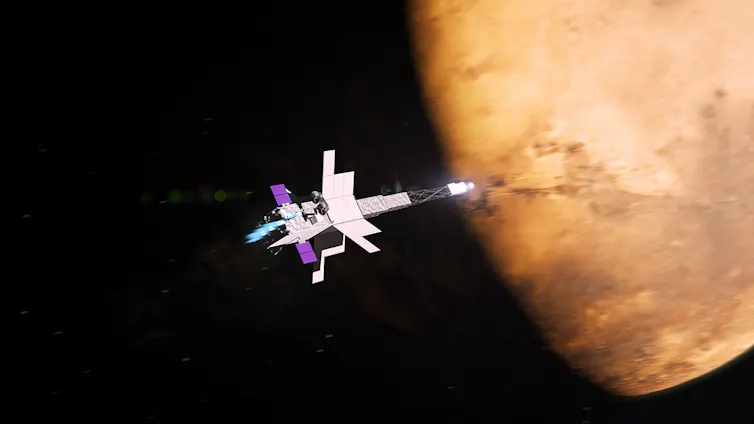
The Space Reactor-1 Freedom mission is scheduled for launch by December 2028 to explore Mars, with NASA heralding it as “the first nuclear-powered interplanetary spacecraft”.
NASA also has plans to deploy a small nuclear reactor on the Moon by 2030 for its Artemis program, though any reactor on the lunar surface would look nothing like the large nuclear power plants found on Earth. And the White House has moved to establish a National Initiative for American Space Nuclear Power.
The US isn’t alone in pursuing nuclear power in space. Interest in nuclear power sources in space now involves a growing list of national and regional space agencies, private actors and research institutions.
Beyond the hype, technical feasibility and timelines are only part of the story. Nuclear power in space also has to be governed responsibly.
The race to the Moon and beyond is accelerating. Some say it’s for the benefit of all humanity. But is it really? In this seven-part series, we explore what our future in space will look like, how we might travel and survive out there, and what’s needed to stop a catastrophe from happening.
Nuclear power in space: why now?
Nuclear power sources in space vary in purpose and design. Some support instruments and communications. Others could power bases on celestial bodies, or propel spacecraft over vast distances.
Radioisotope power systems are one type. They generate electricity from the heat released by the natural decay of a radioactive isotope, plutonium-238.
Meanwhile, fission reactors split atoms to release heat. As in nuclear power plants on Earth, the heat can be converted into electricity. In space, this could power operations and infrastructure on celestial bodies, as well as propulsion systems.
On the Moon, a day-night cycle lasts about 29.5 Earth days, with darkness lasting for about a fortnight. Apollo landings were timed to occur during early lunar daylight. A permanent presence will require reliable power to operate throughout the long lunar night. Solar power alone is unlikely to be enough.
Space Reactor-1 Freedom will also use a fission reactor to support nuclear propulsion, where nuclear-generated electricity powers thrusters. For Mars, this could cut travel times and reduce astronauts’ exposure to cosmic radiation.
While the technological ambitions continue to expand, the idea of using nuclear power beyond Earth is far from new.
A long history
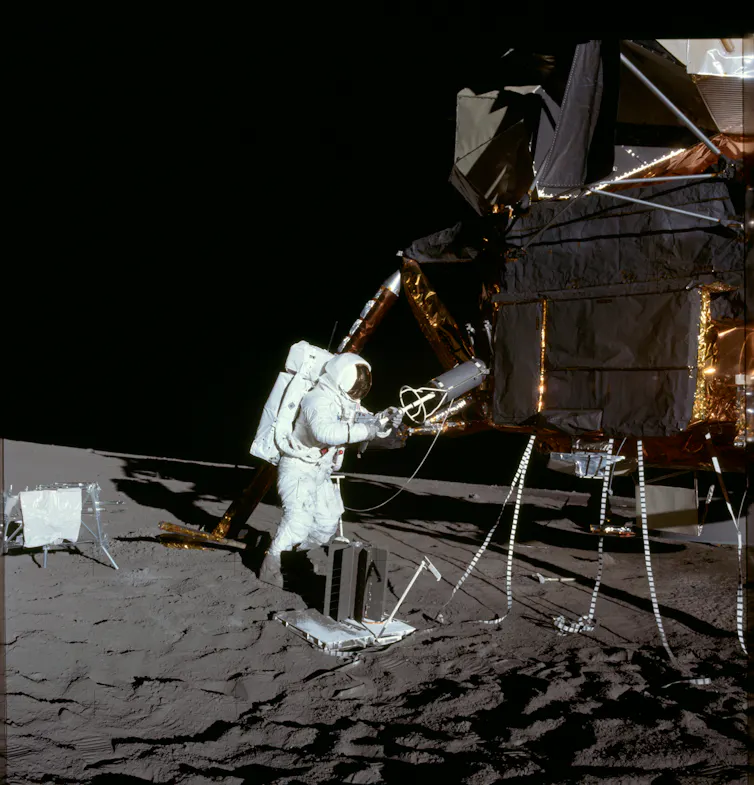
Later Apollo missions used radioisotope thermoelectric generators to power scientific experiments on the Moon.
Similar systems continue to power enduring missions, including the Mars rovers Curiosity and Perseverance, and the twin Voyager spacecraft, which still communicate with us from interstellar space.
Fission reactors have flown in space before.
During the Cold War, the US launched SNAP-10A into orbit. It remains the only US fission reactor successfully launched, though it stopped operating after about six weeks.
The Soviet Union went further, launching nuclear-powered radar ocean reconnaissance satellites (RORSATs) into orbit, to monitor US Navy vessels.
Safety risks and technical challenges
Any talk of nuclear futures in space obliges us to learn from nuclear pasts.
One important precedent is Kosmos 954, a Soviet nuclear-powered RORSAT that made an uncontrolled re-entry in 1978 over Canada’s Northwest Territories.
Kosmos 954 showed how risks in space can quickly become risks on Earth. Radioactive debris was spread across 600 kilometres, reaching the traditional lands of Indigenous peoples, particularly Dene, Inuit and Métis communities. This triggered a major cleanup. No community should bear such risks.
Besides uncontrolled re-entry, another risk is launch failure. Rockets can explode at takeoff. Space nuclear systems are, however, designed to limit the radiological consequences of such accidents.
Fission reactors must withstand extreme temperatures, radiation and vacuum. Researchers from Massachusetts Institute of Technology are studying how materials and reactor designs might perform under harsh conditions.
End-of-life planning matters too, raising questions about decommissioning, disposal and intergenerational responsibility.
These risks have prompted legal and policy responses, though gaps remain.
Rules and guidance
This is not about placing nuclear weapons in orbit or on celestial bodies. The Outer Space Treaty of 1967 prohibits that. International law does not prohibit nuclear power sources in space. But it does seek to ensure they are used safely.
After Kosmos 954, the United Nations adopted the Principles Relevant to the Use of Nuclear Power Sources in Outer Space in 1992, having been developed by the Committee on the Peaceful Uses of Outer Space (COPUOS).
The principles call for safety assessments before launch, notification and international assistance if re-entry risks arise, and recognise state responsibility and the liability of launching states.
They say reactors should not be made “critical” before reaching their operating orbit or interplanetary trajectory, helping to reduce the risk of radiological harm to people and the environment if an accident occurs.
COPUOS and the International Atomic Energy Agency jointly developed a broader safety framework in 2009, providing guidance on launch authorisation, emergency preparedness and response, and operation and end-of-service phases.
Implementation of the safety framework and future work on nuclear power sources in space remain under multilateral discussion.
The UN principles and safety framework are non-binding. Safety assessments and launch authorisations remain largely matters for individual states. That leaves room for a patchwork of domestic regulation and different levels of risk tolerance, even though the consequences of an accident could cross borders.
Governing responsibly
As a growing number of public and private actors seek to develop space nuclear capabilities, states need to consistently implement the UN principles and safety framework, and cooperate multilaterally to update or supplement them where necessary.
International coordination and information-sharing are essential. Responsibilities and risks do not stop at national borders.
Domestic regulators must pursue the highest safety standards, embed accountability, and resist pressures to let compressed timelines, strategic competition or commercial profit set the standard. Space affects us all.
Nuclear power will continue to figure in humanity’s off-Earth ambitions. Wherever it goes, and whoever uses it, safety and accountability must come first.
This article was originally published on The Conversation. Read the original article.