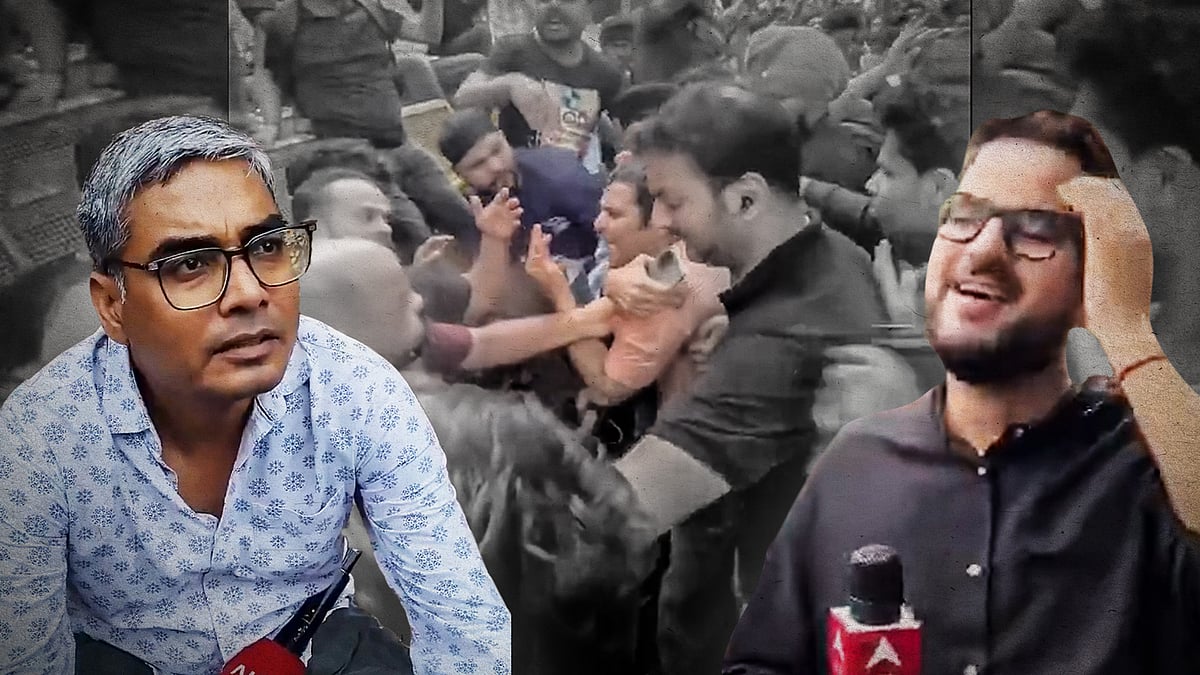
Four days after a young NDTV reporter covered the CJP protest at Jantar Mantar, her mother was surrounded in a neighbourhood park by people demanding to know why her daughter had lied.
They had watched a viral video of the journalist and told the mother: “Why did your daughter lie? She is a liar, Godi media.”
By then, the reporter had already spent days absorbing worse. A group told her at the protest site: “Pimp, pig, you sleep with your father, your mother is …”. Online, she received rape threats and death threats. She has since taken leave from work. According to a source close to her, she now wears a mask when she steps out so that she isn’t recognised.
Within the last four days at Jantar Mantar, reporters from various media channels have been heckled and, in at least two instances, physically targeted by sections of the crowd – one of them chased into a police vehicle that was later pelted with stones. The pattern exposes a problem the television industry has largely refused to confront: public anger at prime-time news, accumulated over years, is being taken out on the people with little say in what goes on air.
‘NDTV ki dalli aurat hai’
The NDTV reporter went to Jantar Mantar on July 18, the day Sonam Wangchuk was taken away by the Delhi Police. She had previously covered the NEET paper leak and questioned the accountability of the National Testing Agency. She was among the few reporters present when Wangchuk was taken away in an ambulance.
Reporting live, she said Wangchuk had been forcibly taken away and that protesters saw the action as an attack on the Constitution. When the anchor asked for the police version, she quoted the DCP’s statement – issued after the detention – that the police had acted peacefully and exercised restraint.
That was when the crowd turned. Some protesters began shouting “NDTV ki dalli aurat hai” (She is a pimp from NDTV). Others joined in. She was called “Dalal media” and “Godi media”, told she had come from Modi’s guest house, and told to leave. Someone recorded her.
The video was posted by a social media account and clocked 60 million views. Links to her personal accounts were circulated; her photographs were posted in the comments.
She received threats but returned to cover the protest the next day anyway. This time she was recognised and surrounded. Protesters made sexually explicit remarks, called her “suwar” and “dalal”, said she slept with her father, and pulled at her shirt. The evening after that, her mother was confronted in the park.
‘They took away my phone’
Two videos of Times Now reporter Dev Kotak circulated on social media, showing an assault by a section of the crowd. In one, two protesters are seen leading him away while he appears to be in shock. “You are safe now,” they tell him. Kotak can be heard asking, “Where is my phone?” His shirt was torn. His phone had been snatched.
Is this a protest or mob violence? A Times Now reporter covering the CJP protest was allegedly chased, assaulted, and hospitalised. His clothes were reportedly torn, his phone and wallet stolen, and his spectacles broken.#Delhi #ViralVideo pic.twitter.com/jKDxShA2Dy
— Smriti Sharmaa (@SmritiSharma_) July 22, 2026
One of the men who pulled him out said: “We put in a lot of effort to save his life. There is a lot of anger against the media among the people, but something like this should not happen at all. Some youngsters did wrong, but we saved him and brought him here.”
Have known Dev since our college days. He is truly a gem of a person- calm, composed, and not easily provoked. While I understand the frustrations with the media house he works for, there is no justification whatsoever for attempting to mob-lynch a journalist. An unruly crowd… https://t.co/Ys9rmGv1IF pic.twitter.com/WRaXC5ILzC
— Piyush Rai (@Benarasiyaa) July 21, 2026
In the second video, Kotak describes what happened: “From six different directions, 100 punches, kicks, slaps, water, and bottles were thrown at me. They took away my spectacles. As my spectacles were not there, I was not able to see clearly. I was telling them that I was not able to see without my spectacles and asking them not to beat me on my face … I was telling them that I had not done anything wrong and that I was just leaving, but they pushed me down and started kicking me. They snatched away my mobile phone, watch, and glasses.”
The same day, ABP News reporter Varun Bhasin was chased by protesters.
इसी माइक से मैंने सवाल पूछे थे।
— Varun Bhasin (@varunbhasinji) July 21, 2026
जब 2024 में नीट रिजल्ट के बाद 67 टॉपर निकले- जब झज्जर सेंटर पर सवाल उठे, जब NTA जवाब देने से बच रही थी - तब मैं पहले दिन से आपके लिए सवाल कर रहा था।
2026 में भी मैने वही किया लेकिन !
आज मेरी रिपोर्ट देखे बिना, मेरा काम जाने बिना, मुझे “गोदी… pic.twitter.com/MEQOC6YSxP
Bhasin was near Parliament when he learnt that protesters had reached Rail Bhawan, and rushed there. “He was simply standing with his microphone and talking to two or three students,” said a source privy to the incident. “Before he could even begin reporting, the protesters noticed his microphone and surrounded him … They said to him, ‘Why do you never show our side of the story? Why have you come now? It is too late.’”
Water and trash were thrown at him. Someone tried to push money into his pocket. Bhasin didn’t respond; he kept smiling and tried to walk away. The crowd followed.
“To save himself, he got into a Delhi Police vehicle,” the source said. “The mob opened the door and tried to pull him out by holding his legs … Somehow, the driver acted quickly and sped the vehicle away. They chased the vehicle, pelting stones on it, damaging the back windshield mirror.”
हमारा युवा साथी रवीश रंजन वही, NDTV का लाल माइक वही, पर मैनेजमेंट बदल गया तो ब्रैंड बदल गया और फिर इसके प्रति लोगों का नज़रिया बदल गया… लेकिन मैं जानता हूँ कि @ravishranjanshu नहीं बदला है। संस्थान के नए माहौल में भी अपनी पत्रकारिता धर्म को निभा रहा है। जंतर मंतर के माहौल को… pic.twitter.com/66QuIyL1PY
— Umashankar Singh उमाशंकर सिंह (@umashankarsingh) July 22, 2026
NDTV journalist Ravish Ranjan Shukla was also heckled and called “Godi media”; a video of the episode was posted online. “In my 22-year career in journalism, I have worked in six cities across four states. Governments have come and gone, yet I never sought even the slightest personal gain from anyone, nor did I ever pander to those in power. That is why the question of bowing down simply does not arise. I am a field reporter; I report exactly what I see, with complete impartiality,” Shukla later tweeted.
I’ve seen Ravish Ranjan at work over the years. He’s a hardworking, honest journalist who believes in reporting from the ground. No journalist deserves to be heckled for doing their job.
— Marya Shakil (@maryashakil) July 22, 2026
Differences of opinion are part of democracy; intimidation is not. https://t.co/WI1t4HUdtX
NDTV’s Anushka Garg, along with Times Now’s Shafali Nigam and Jyoti Mishra, were also among other reporters harassed at the site.
Shafali Nigam told viewers on air, “My cameraman was heckled. He was grabbed by the neck, held by his collar, and thrown backwards. I went up to them and told them that they couldn't do that. That was when someone kicked me on my right leg.”
STATEMENT FROM TIMES NETWORK
— TIMES NOW (@TimesNow) July 22, 2026
.@TimesNetwork strongly condemns the reprehensible attacks on our reporters—Dev Kotak, Shafali Nigam, and Jyoti Mishra—while they were covering protests in New Delhi.
Reporting from the ground is not just the duty of journalists; it is a… pic.twitter.com/PhmaLuDcv8
Times Now said “the manner in which some persons chose to express their disagreement through violence can have a chilling effect on the free movement and functioning of journalists across India, which is not in the interests of democracy. We may differ in views, but we cannot take the law into our own hands.”
Shambhavi Srivastava, a principal correspondent with Republic TV, was hit during the July 20 march. “They hit me on my chest, they hit me on my arm and people deliberately stormed on my feet with their heels and shoes and there was one person who was particularly not happy with the media house that im working with and he had some sort of sharp object a pen or something and he managed to stab me with it,” she said on her channel.
View this post on Instagram
Peek TV co-founder Priyanshi Sharma was heckled for asking questions critical of the CJP leadership on the day of the Parliament march.
The attacks have set off an argument within the profession itself. Some journalists, writing online, have located the cause in the industry rather than the crowd – arguing that years of slanted prime-time coverage built the hostility that field reporters are now walking into. Others have directed their appeals at the protesters, asking that whatever the grievance against a channel, it not be settled on the person holding its microphone.
ये व्यक्ति पत्रकारों के खिलाफ भीड़ को “लिचिंग” के लिये भड़का रहा है.
— Chitra Tripathi (@chitraaum) July 22, 2026
एक पॉलिटिकल पार्टी की राजनीतिक यात्रा में हिस्सा लेकर अपनी पत्रकारिता बेच देने वाला शख़्स पत्रकारिता सिखाने में लगा हुआ है. https://t.co/s1QnOST5HX
चित्रा जी, दौर की बातें आप तो ना करें तो ही ठीक है...क्योंकि दौर-दौर की बात है तो आप किस दौर में क्या कर रही थी इसके रिकॉर्ड सारे मौजूद हैं. वैसे आप खुद को पत्रकार वाली कैटेगरी से हटा ही लीजिए कुछ खास फर्क नहीं पड़ेगा क्योंकि इस पेश के साथ आपसे न्याय नहीं हो पा रहा है. अंतरआत्मा…
— Avdhesh (@Zinda_Avdhesh) July 22, 2026
प्रदर्शनकारियों से अपील है .
— Ajit Anjum (@ajitanjum) July 21, 2026
Pl फील्ड रिपोर्टर्स के साथ ऐसा सलूक न करें . हर चैनल में कुछ अच्छे रिपोर्टर भी हैं . वैसे भी चैनल के कॉन्टेंट से आपको नाराजगी है तो उसकी सजा रिपोर्टर को मत दीजिए . इसी ABP न्यूज में प्रतिमा मिश्रा और संदीप चौधरी जैसे दमदार एंकर भी हैं . https://t.co/ejjwsL1L08
Why should only the journalists be safe - do they have a special license? why shouldn't other citizens be safe? why aren't other citizens safe today? Because journalists didn't do their jobs. Not only they didn't do their jobs, they actively create a situation in the country that… https://t.co/JWD7lc8kPp
— Pratik Sinha (@free_thinker) July 21, 2026
Zee News woke up after about a month to report at the Jantar Mantar Students protest under police protection and ofcourse, Police version. pic.twitter.com/ayq4Pjq1Z4
— Mohammed Zubair (@zoo_bear) July 22, 2026
The anger and its address
Journalists who covered the protest say the hostility is not new, but its intensity is.
“I have covered the farmers’ protest as well, and I was called Godi Media because of the news organisations I worked for, including Zee, Times Now and ABP,” said one. “But this protest felt different. Reporters from television news channels were facing what looked like lynching type attacks, and that is deeply worrying. Reporters are the people on the ground, and in my experience, 90 percent of them report the facts accurately. It is the people sitting in the newsroom, the owners, editors and prime-time anchors, who decide the editorial line and shape the narratives.”
He added: “It is high time to change all this. Otherwise, reporters on the ground will continue to bear the consequences of the agendas set by news channels and the anchors.”
A senior journalist described the heckling as routine. “There are some fringe elements among the protesters who indulge in such behaviour, and this kind of heckling has now become a part of many protests. Because of the way many mainstream television news channels operate, reporters on the ground end up paying the price. Even we do not agree with many of the narratives being pushed by news channels. But reporters do not make editorial decisions … Unfortunately, reporters have been generalised because of the actions of news channels.”
He was careful not to absolve the industry. “It is true that some channels engage in practices that cannot be called journalism, but field reporters are not the ones responsible for those decisions. If there is criticism to be made, it should be directed at those who set the editorial agenda and use television platforms to spread false narratives and support those in power, not at the reporters who are sent to cover events.”
Another journalist at the site said: “The anger many people feel towards sections of the television news industry is real. But that anger is often directed at the wrong people. It is not field reporters who decide editorial lines, shape prime-time debates or push misleading narratives … Targeting reporters on the ground, many of whom are simply doing their jobs, only makes journalism more difficult.”
Several videos in circulation also show protesters intervening to pull reporters out of hostile crowds, and protesters were not the only obstacle journalists faced.
During the July 20 march, several journalists also faced police action. That is a separate story, but it belongs in the frame here for a simple reason: the people covering Jantar Mantar have been squeezed from both directions.
Newslaundry is a reader-supported, ad-free, independent news outlet based out of New Delhi. Support their journalism, here.